Cistercian abbey · Fribourg
Hauterive Abbey
Founded in the 1130s in a loop of the Sarine, it regained a community in 1939 after ninety-one years of silence.
The abbey occupies a terrace at 579 metres, caught in a loop of the Sarine, five and a half kilometres south-west of Fribourg. The river has cut into the molasse and left steep banks, in places a hundred metres high, where sandstone breaks through: it is to that wall that the place owes its Latin name, Altaripa, the high bank. The buildings read from a distance — the long white ranges, the brown roofs, the slender spire above them — against a background of meadow and forest that has never been built over.
Guillaume de Glâne founded the monastery between 1132 and 1137 and endowed it with his lands; the sources do not agree on the exact year, but the church was consecrated on 25 February 1138 in the presence of the bishop of Lausanne, and Pope Innocent II confirmed the foundation in 1142. The monks came from Cherlieu; Hauterive would have only one daughter house, Kappel am Albis, founded in 1185. The church built between 1150 and 1160 applies the Cistercian rule to the letter: no high tower, a flat east end flanked by two chapels on either side of the transept, as Bernard of Clairvaux prescribed. The 13th century gave it an early gothic west front; between 1320 and 1330 abbot Pierre Dives had the choir revaulted with ribs and opened coloured tracery windows in it, while some thirty stonecutters from the works of Fribourg's Saint-Nicolas cathedral rebuilt the cloister.
What followed is a history of blows and returns. The library was plundered by the Bernese in 1387 and devastated by fire in 1578; even so, one of the largest manuscript holdings of any monastery in western Switzerland survives from it, kept today mostly in Fribourg. In 1848, in the aftermath of the Sonderbund war, the radical government closed the abbey: the buildings became an agricultural school, then a teacher-training college, and the last lay brother died in 1893. Monastic life resumed in 1939 with monks from Wettingen-Mehrerau, and the house became an abbey again in 1973. Between 2021 and 2025 a restoration of about 9.6 million francs covered the facade, the frescoes, the stained glass and the stalls; taking the stalls down brought back to light mannerist painted decoration that 19th-century neoclassical altars had concealed. The church reopened on 4 September 2025.
Why this place is remarkable
Few 12th-century Cistercian churches have stayed this legible: the refusal of a tower, the flat east end, the nave under its pointed barrel — everything still states the rule that dictated it. What sets Hauterive apart is that the fabric never became a museum. Closed in 1848, it was returned to its function in 1939 and has served it since; the 2021-2025 restoration was carried out for a community living there, not for visitors.
History and origin
The Sarine here traces a loop deeply incised into the molasse, leaving steep slopes where sandstone breaks through — the alta ripa that gave the monastery its name. The foundation falls between 1132 and 1137, the consecration on 25 February 1138, the papal confirmation in 1142. Under Zähringen protection from 1157, the abbey concluded a citizenship treaty with Fribourg in 1341, suffered a first plundering in 1387, damage from the Savoy war in 1448, then Fribourg sovereignty from 1452; it joined the Upper German Cistercian Congregation in 1618 before its suppression in 1848.
What to do and see
- Look at the 12th-century Cistercian church for its refusal of a tall tower and its flat chevet flanked by two chapels, in keeping with the rule of Bernard of Clairvaux.
- Look for the colourful tracery of the choir, opened between 1320 and 1330 by Abbot Pierre Dives, and the cloister rebuilt by stonemasons from the Saint-Nicolas de Fribourg building site.
- Note, if the stalls are visible, the mannerist painted decorations uncovered when they were removed during the 2021-2025 restoration, previously hidden by neoclassical altars.
- Situate the monastery in the loop of the Sarine, on the terrace of molasse and sandstone that gave it its name, Altaripa, the high bank.
As a couple
- Enjoy the loop of the Sarine and the molasse banks, several dozen metres high, for a quiet walk around the site.
- Contemplate together the recently restored church, reopened on 4 September 2025, with its facade, stained-glass windows and 12th-century flat chevet.
- Pause in front of the long white residential wings and the slender spire standing out against the backdrop of undeveloped meadows and forest.
A Cistercian community has lived in the abbey since 1939: this is a working monastery, not a disused monument.
A Cistercian community has lived on site since 1939: it is a working monastery, not a disused monument, which calls for discretion during the visit.
Location
Loads an interactive Google Maps view on demand, from the place's verified coordinates.
The embedded map will be enabled once an authorized Google Maps key is configured. Use the link above in the meantime.
The map could not load. Check your connection or use the link above to open the place in Google Maps.
Related places
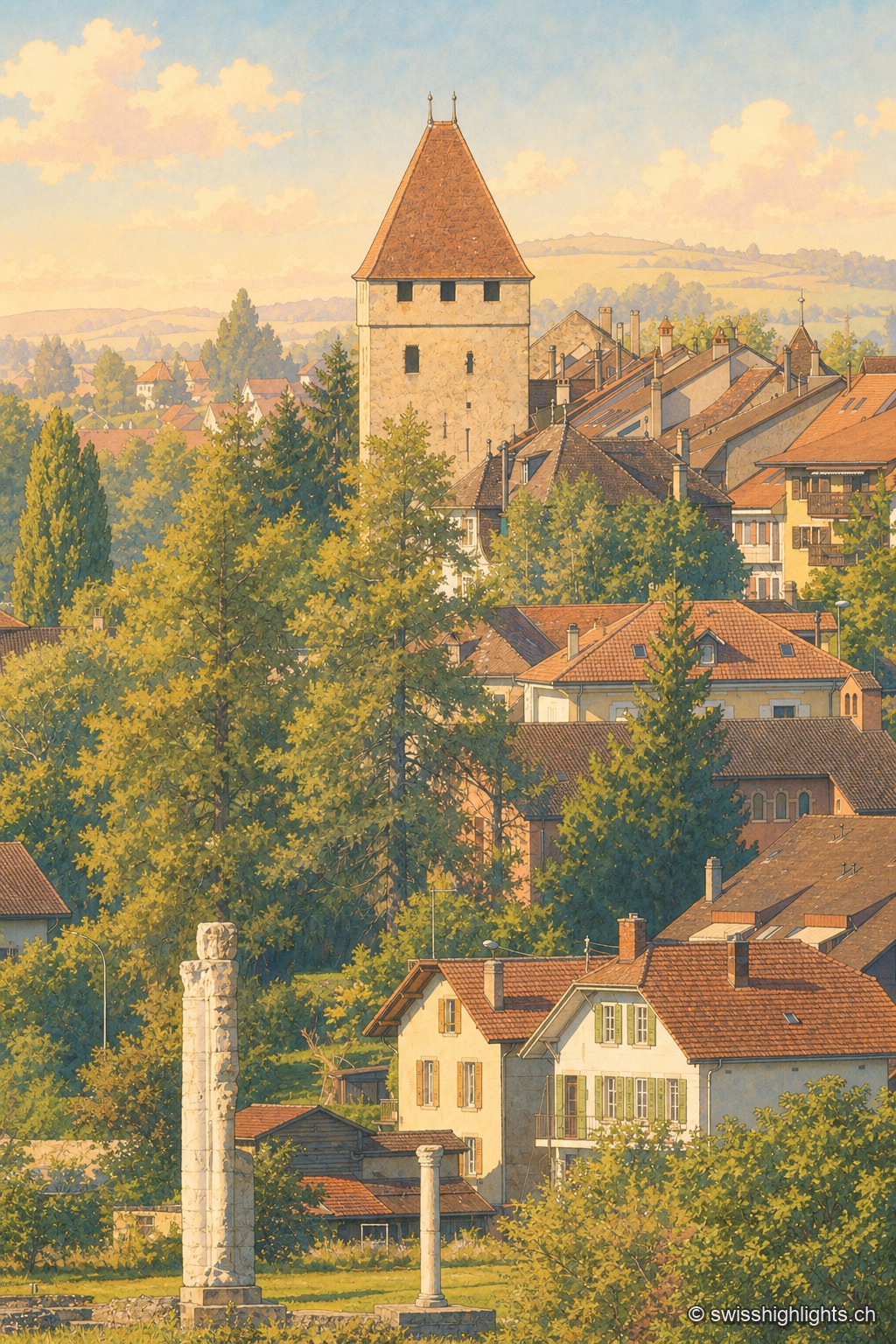
Roman capital · Vaud · 14 km as the crow flies
Avenches
Aventicum had more than 20,000 inhabitants under the High Empire before the Alamanni devastated it in 258. The town hall, rebuilt in 1753, stands over the square; the IENA, opened in 1999, made it Switzerland's horse town.
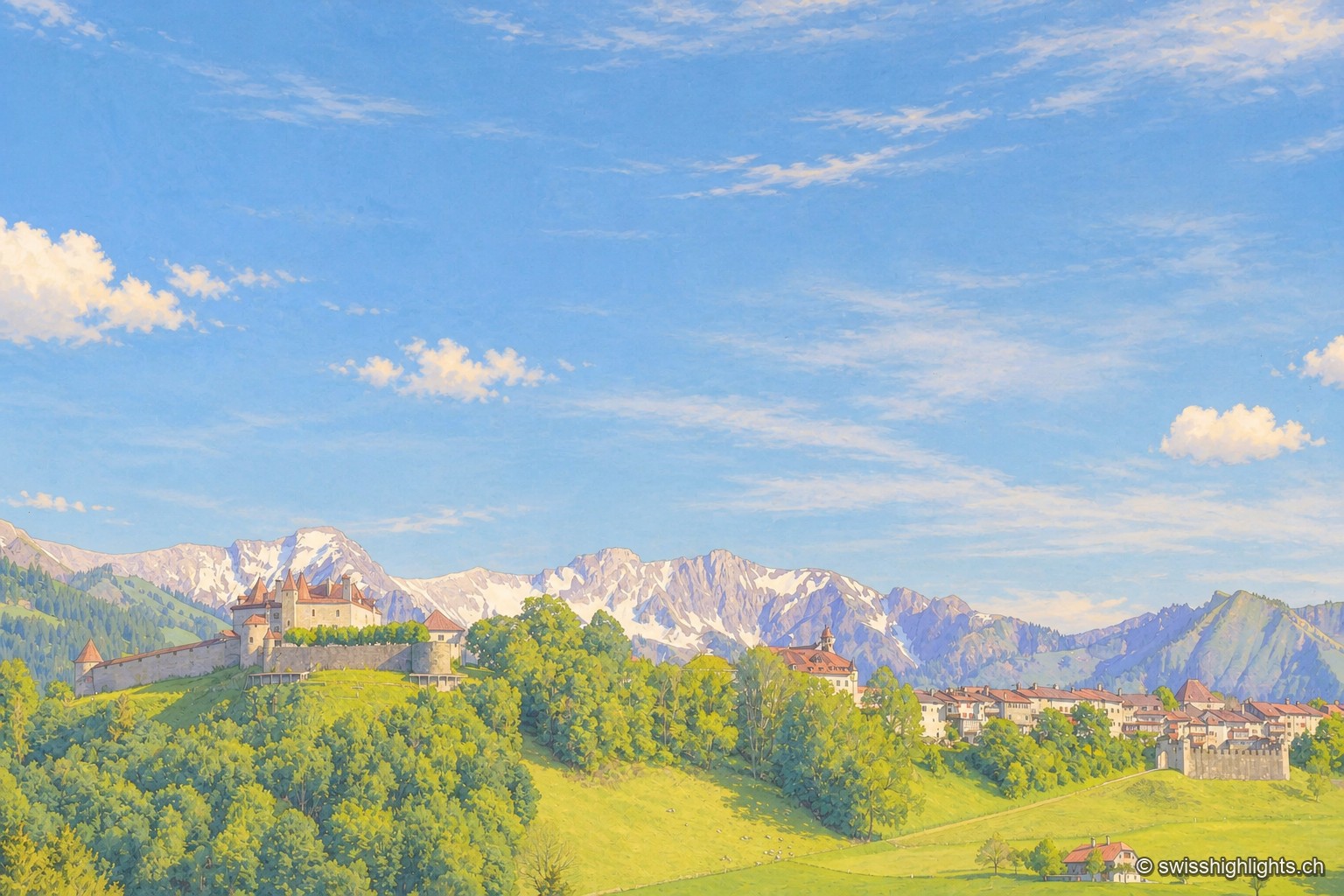
Medieval small town · Fribourg · 20 km as the crow flies
Gruyères
2,339 inhabitants, a castle shaped by eight centuries of building, a museum of Tibetan art and another devoted to H. R. Giger: Gruyères sits on a rocky spur, its territory ranging between 693 and 2,002 metres.
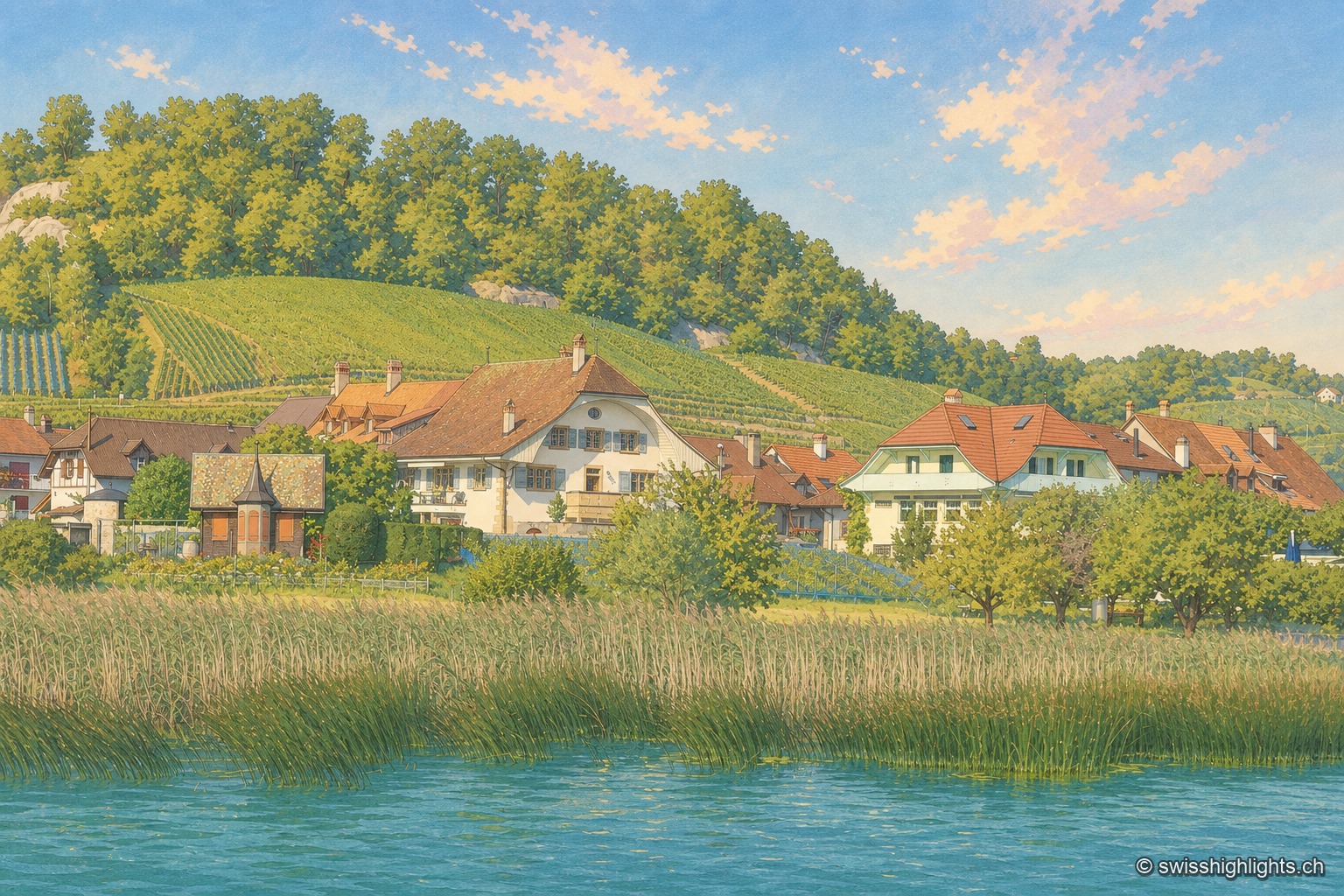
Winegrowing village of the Vully · Fribourg · 21 km as the crow flies
Praz
Praz belonged to the lordship of Morat until 1484. Its patrician winegrowers' houses have earned the site a national heritage listing. Since 1981, the Vully grape harvest festival has been held there every year in late September.