Lakeside town · Ticino
Ascona
A Ticinese town on the north shore of Lake Maggiore, the lowest-lying settlement in Switzerland; above it, Monte Verità keeps the traces of a colony of 1900.
Ascona lies on the north shore of Lake Maggiore, on the Maggia delta, symmetrically placed to Locarno. The core of the town runs down to the water, which makes it the lowest-lying settlement in Switzerland: surveys place it between 193 and 199 metres. The lake front is a row of painted houses opening onto a square planted with pruned trees, dominated by the campanile of Santi Pietro e Paolo. The church is mentioned from 1264 and was rebuilt in the sixteenth century; the vault of the chancel carries frescoes by Pietro Francesco Mola dated 1770, and the high altar a Coronation of the Virgin by Giovanni Serodine, a painter born in 1599 and dead in 1630.
The second building of the town stands back from the shore. Santa Maria della Misericordia, built between 1399 and 1442 and given its bell tower in 1488, holds one of the most extensive Late Gothic fresco cycles in Switzerland. Bartolomeo Papio had the college founded in his name in 1584 built onto it between 1585 and 1620; the same patron had raised in 1564 the house by the water that became the town hall, handed over to the commune in 1580. The Casa Serodine, around 1620, extends this series of commissioned buildings.
Above the roofs, Monte Verità served as a testing ground. At the end of the nineteenth century Henri Oedenkoven, born in 1875 and dead in 1935, and Ida Hofmann, born in 1864 and dead in 1926, bought the hill and settled a vegetarian and naturist community there; they left it in 1920 for Brazil. Three so-called light-and-air buildings, the Casa Selma, the Casa Aida and the Casa dei Russi, date from 1901 and 1902, the Casa Anatta from 1904. The Albergo Monte Verità, raised between 1926 and 1928 by Emil Fahrenkamp for Eduard von der Heydt, followed. Since 1989 a foundation created with the Swiss Federal Institute of Technology in Zurich has run a scientific conference centre there.
Why this place is remarkable
Two unrelated histories are stacked over a few hundred metres of height. Below, a fishing village turned resort, whose church holds frescoes begun in 1399. Above, a hill bought at the end of the nineteenth century by people determined to live differently, whose huts of 1901 and 1902 and hotel of 1926-1928 are still standing. The town is also the lowest-lying settlement in Switzerland, between 193 and 199 metres.
History and origin
The site has been inhabited since prehistory: some twenty graves of a necropolis dating between the Bronze Age and the Iron Age were uncovered in 1950. In the Middle Ages Ascona was a market protected by four castles, now vanished. Around 1250 two Milanese families, the Carcani and the Griglioni, settled here fleeing the troubles of Lombardy; the Confederates controlled the town from 1513. At the end of the 1980s a road tunnel 1.1 kilometres long was driven under Monte Verità, and the old shore road became a pedestrian zone.
What to do and see
- Walk along the lakeside facade of the town, a row of painted houses opening onto a tree-planted square, dominated by the campanile of Santi Pietro e Paolo.
- Look inside the church of Santi Pietro e Paolo for the 1770 frescoes by Pietro Francesco Mola and the Coronation of the Virgin by Giovanni Serodine.
- Climb up to Monte Verità to see the buildings of the 1901-1904 colony — Casa Selma, Casa Aida, Casa dei Russi, Casa Anatta.
- Compare the lakeside town, the lowest settlement in Switzerland at between 193 and 199 metres, with the hill that overlooks it.
Coming with family: what to know
- The Monte Verità hill, with its early 20th-century colony huts, lends itself to an active exploration alongside the walk along the shore.
As a couple
- Walk along the shore at sunset, among the painted houses and the tree-planted square.
- Climb together to Monte Verità to discover the colony huts of 1901-1902 and the hotel of 1926-1928.
- Stop at Santa Maria della Misericordia for its late Gothic frescoes, one of the most extensive ensembles in Switzerland.
Location
Loads an interactive Google Maps view on demand, from the place's verified coordinates.
The embedded map will be enabled once an authorized Google Maps key is configured. Use the link above in the meantime.
The map could not load. Check your connection or use the link above to open the place in Google Maps.
Related places
Botanical islands · Ticino · 3 km as the crow flies
Brissago Islands
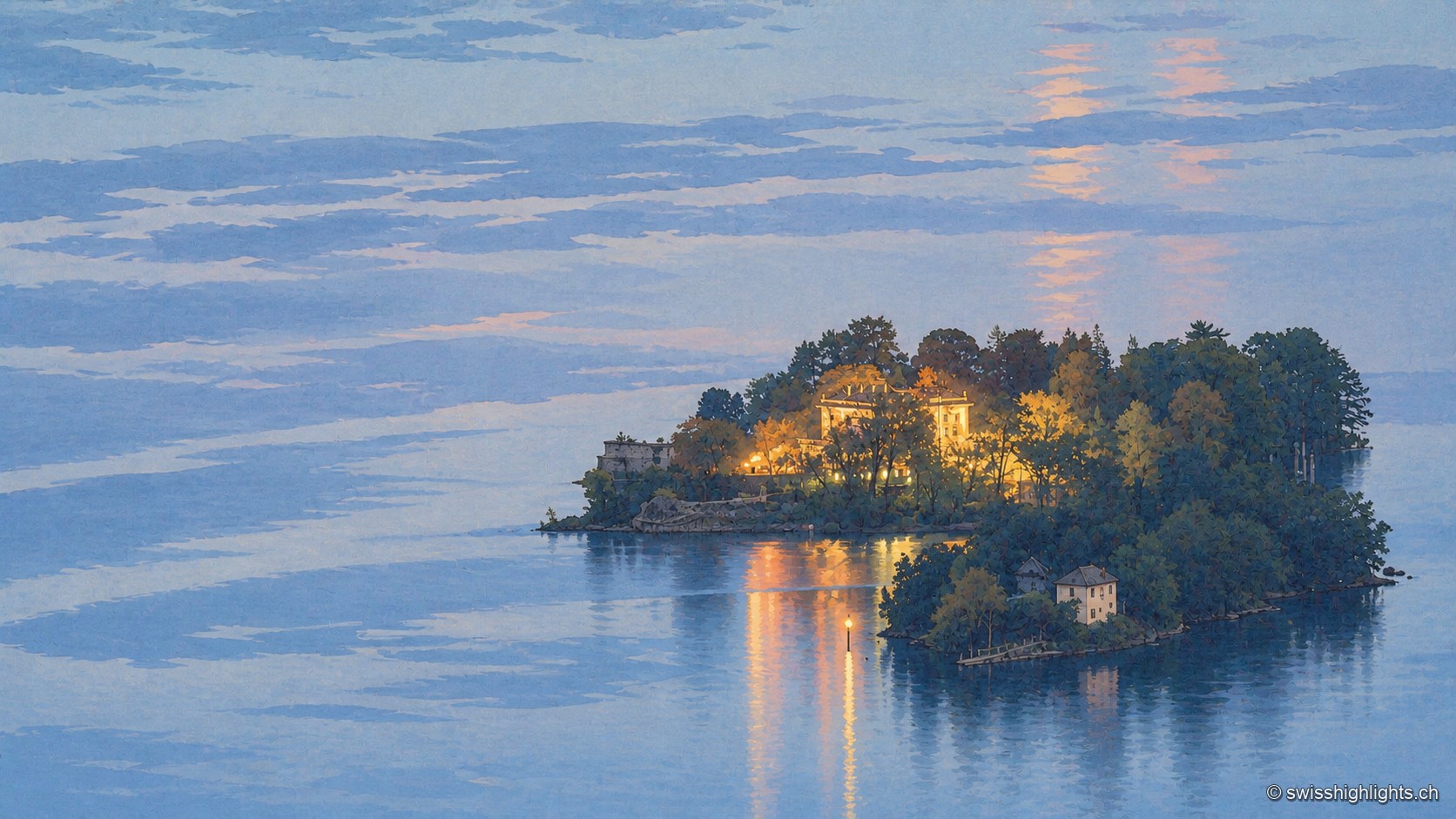
San Pancrazio, the larger, carries a subtropical garden and is reached by boat. Sant'Apollinare, the smaller, stays closed and keeps the ruins of a Romanesque church. The canton of Ticino and five partners bought them in 1949.
Hamlet listed by ISOS · Ticino · 14 km as the crow flies
Osignano
On the old mule track linking Agno to Bellinzona, at the foot of Monte Tamaro, the hamlet lines up two rows of stone or rendered rural houses, the oldest from the 17th-18th centuries, around a chapel dedicated to Saint Roch.
Lakeside city · Ticino · 22 km as the crow flies
Lugano
The country's third financial centre, Lugano hosted the first Eurovision Song Contest in 1956 and has, since the mergers of 2004, 2008 and 2013, an agglomeration of about 150,000 inhabitants on the shore of Lake Lugano.