Cluniac village · Vaud
Romainmôtier
Around the oldest monastery in Switzerland, a Vaud village born of a 5th-century foundation and of a Romanesque church turned Protestant in 1537.
Romainmôtier sits in a fold of the Vaud Jura: a few sloping streets, fountains, stone houses pressed around a single mass, that of the former abbey church of Saint Peter and Saint Paul. The church dominates everything — a bare gable ruled by blind arcading, a Romanesque nave shouldered by a raking buttress, a square tower with paired openings under a spire, a gallery of Gothic arches grafted later onto the flank. The name says where it came from: Romanum monasterium, the monastery of Saint Romanus, of which the village is only the consequence.
The monastery was founded in the middle of the 5th century by the Jura Fathers, Saint Romanus and his brother Saint Lupicinus; it is the oldest in Switzerland. In 753 Pope Stephen II consecrated it and gave it the name of Roman monastery, freeing it from all royal or episcopal power. Around 929 Countess Adelaide handed it to Odo, abbot of Cluny, and the church seen today — among the oldest Romanesque buildings in the country — rose in the first half of the 11th century, under the abbacy of Odilo.
The Reformation changed the use without erasing the stones: the abbey church became a Reformed temple in 1537, and the prior's house, in the same year, a bailiff's seat. It is now called the château de Romainmôtier; its medieval core, reworked in the 16th and 17th centuries, keeps a round-arched portal dated 1605, a Renaissance room with a moulded ceiling and remains of wall paintings from the 13th and 14th centuries. The village is no longer a commune of its own: it merged with Envy in 1970 to form Romainmôtier-Envy, 560 inhabitants at the end of 2024, two thirds of whose territory is forest.
Why this place is remarkable
The interest lies in the continuity of a single site: a monastic foundation of the 5th century — the oldest in Switzerland —, a Romanesque abbey church of the 11th century that ranks among the oldest buildings of that style in the country, a Reformed temple since 1537, and a village that has never been anything other than what was built around it. The abbey church, a Cluniac site, is listed as a Swiss cultural property of national significance.
History and origin
The history of the site reads as a series of changes of tutelage. Foundation by the Jura Fathers in the 5th century; restoration in the 7th century under the influence of the Irish monasticism of Saint Columbanus; papal consecration in 753; transfer to Cluny around 929; building of the Romanesque church in the 11th century; then, at the Reformation, conversion into a temple and a bailiff's seat in 1537. The present commune was born of the merger of Romainmôtier and Envy in 1970; the name Envy is recorded in 1216 as Envi, probably from the Latin in via, “on the road”.
What to do and see
- Observe the abbey church of Saint-Pierre-et-Saint-Paul: a bare gable with blind arcading, a Romanesque nave, a square bell tower with twin openings and a later Gothic arcaded gallery.
- Follow the village's sloping streets and fountains, which draw in close around the church's single mass.
- Visit the Château de Romainmôtier, formerly the prior's house that became a bailiff's seat in 1537, with its portal dated 1605 and its Renaissance hall with a moulded ceiling.
- Look inside the château for the remains of 13th- and 14th-century wall paintings.
Coming with family: what to know
- The village is a walk on sloping, cobbled streets.
As a couple
- Take time in front of the round-arched portal dated 1605 at the château.
- Compare the sobriety of the 11th-century Romanesque abbey church with the later Gothic addition of its arcaded gallery.
- Walk to the wooded edge, since the merged commune of Romainmôtier-Envy is two-thirds forested.
Location
Loads an interactive Google Maps view on demand, from the place's verified coordinates.
The embedded map will be enabled once an authorized Google Maps key is configured. Use the link above in the meantime.
The map could not load. Check your connection or use the link above to open the place in Google Maps.
Related places
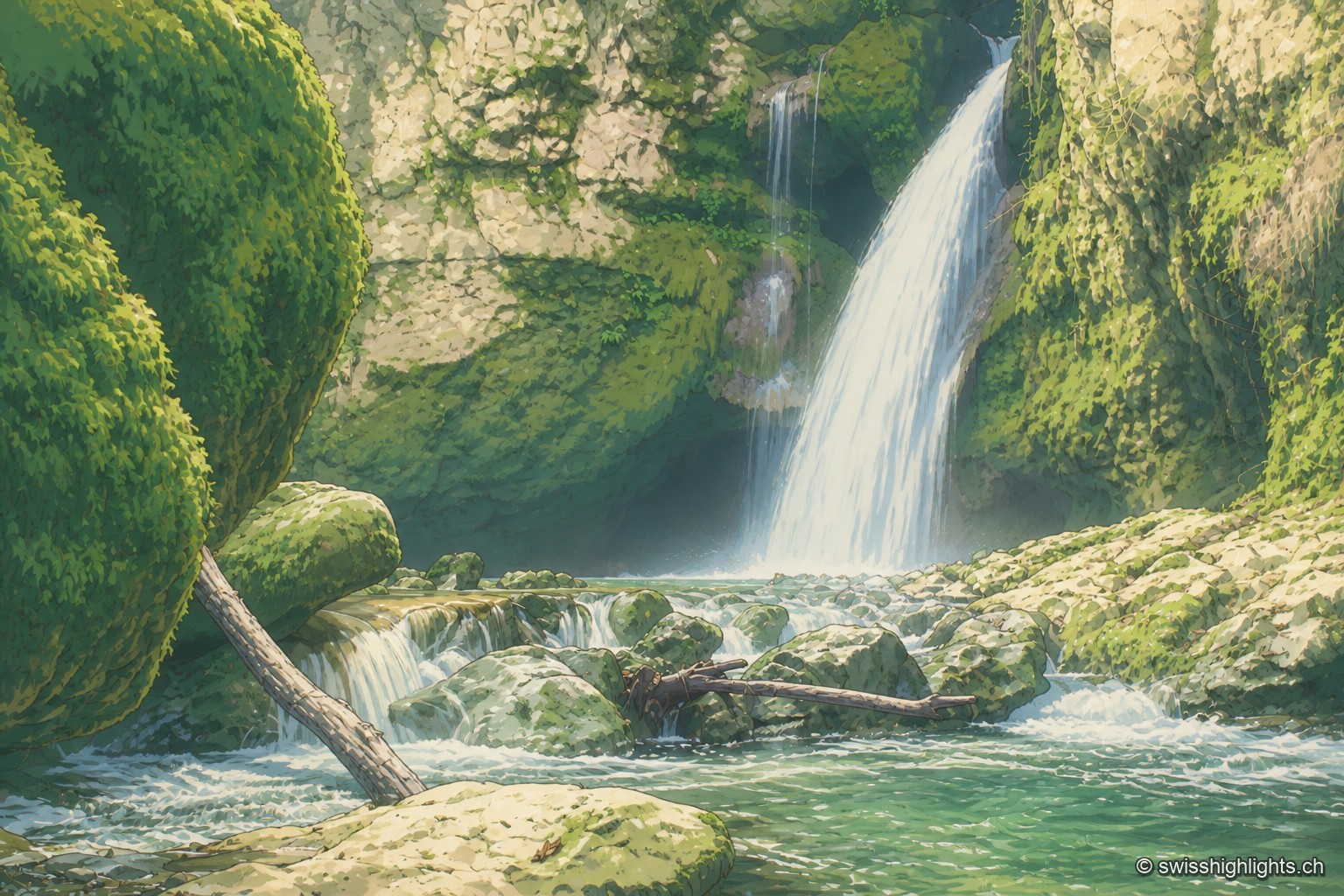
Rock cirque · Vaud Jura · 5 km as the crow flies
Tine de Conflens
Named after a Vaud patois phrase meaning 'confluence falls', the Tine de Conflens brings together two waterfalls: the Veyron's and the Venoge's, which it swells. A steep but maintained path leads to their foot.
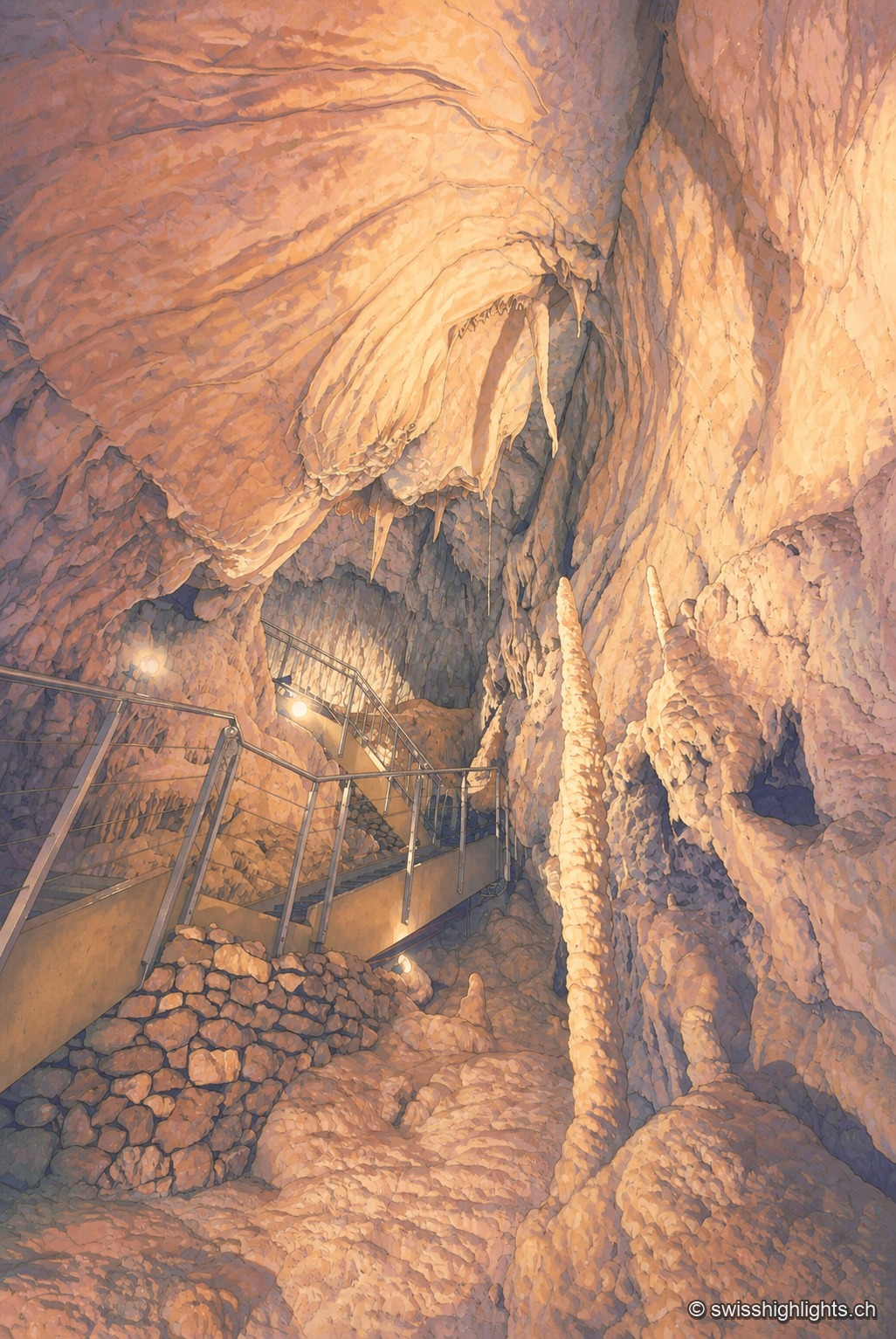
Karst cave · Vaud · 9 km as the crow flies
Grottes de Vallorbe
The Orbe leaves Lake Joux, vanishes into the limestone and comes back out 4.8 kilometres away at Vallorbe. Its underground course runs 2,980 metres with a drop of 228 metres; a third of the known network is walked in an hour.
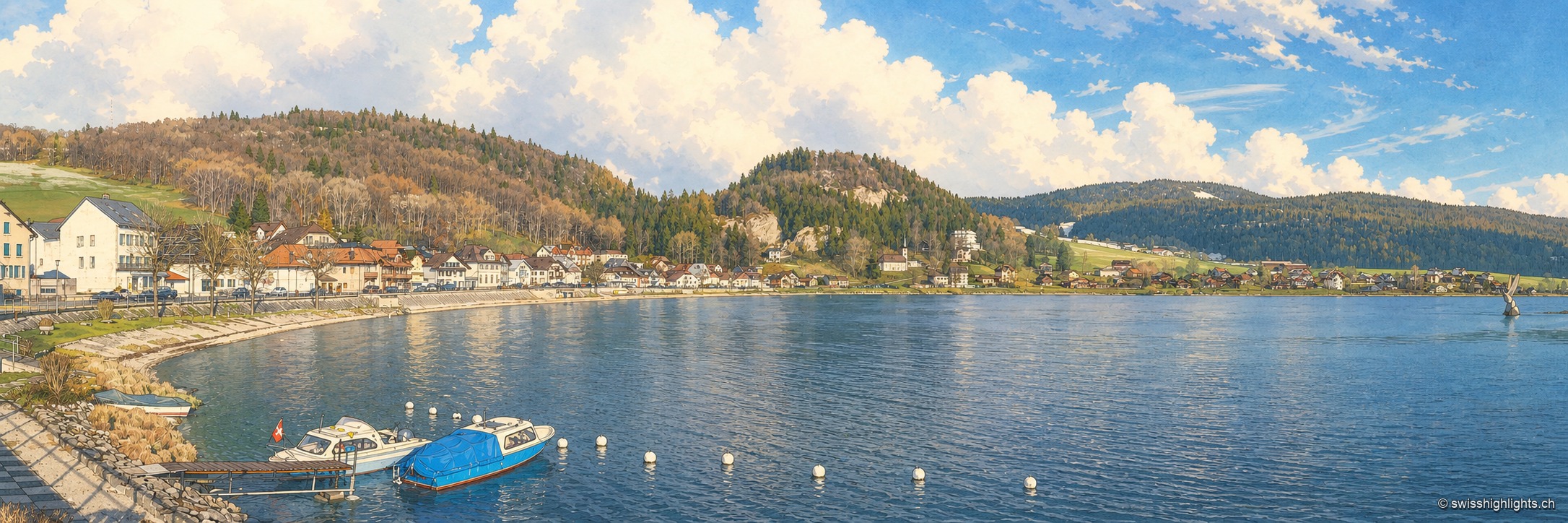
Hamlet on Lac de Joux · Vaud · 11 km as the crow flies
Le Pont
On an estate once named Champ du Port, a bridge built in the 17th century by Le Lieu and Le Chenit gave the hamlet its name. The railway brought French families; the Grand Hôtel rose in 1900-1901.