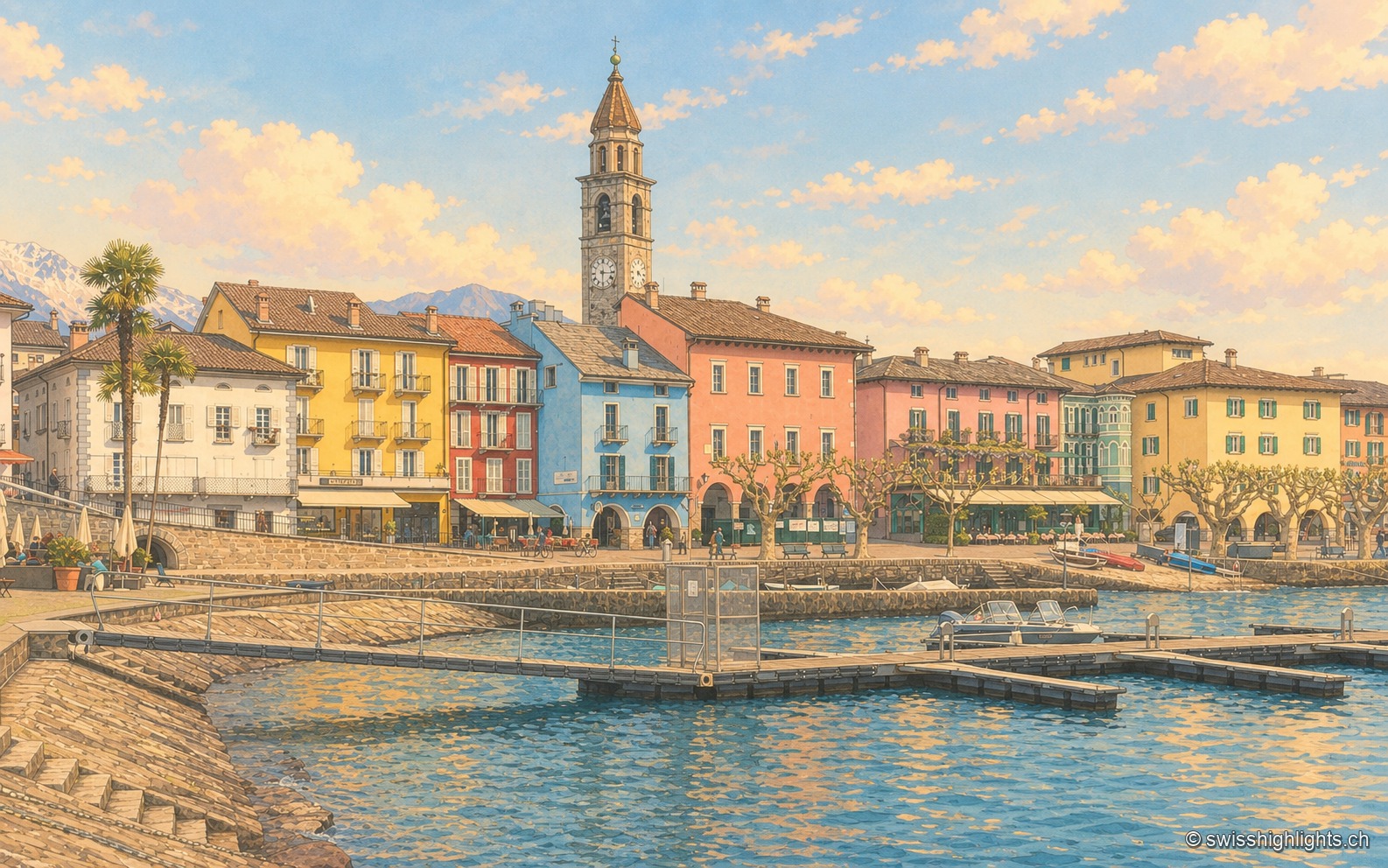
The Ascona lakefront seen from a jetty: a row of yellow, red, blue and pink houses lining the Piazza Motta, the bell tower of the Santi Pietro e Paolo church in the center, a palm tree on the left, and the mountains of Lake Maggiore in the background.

Ticino

Regions

The canton of Ticino brings together 10 places referenced on Swiss Highlights: 2 natural sites, 0 heritage or cultural sites, 7 villages and 1 town.

Not to miss

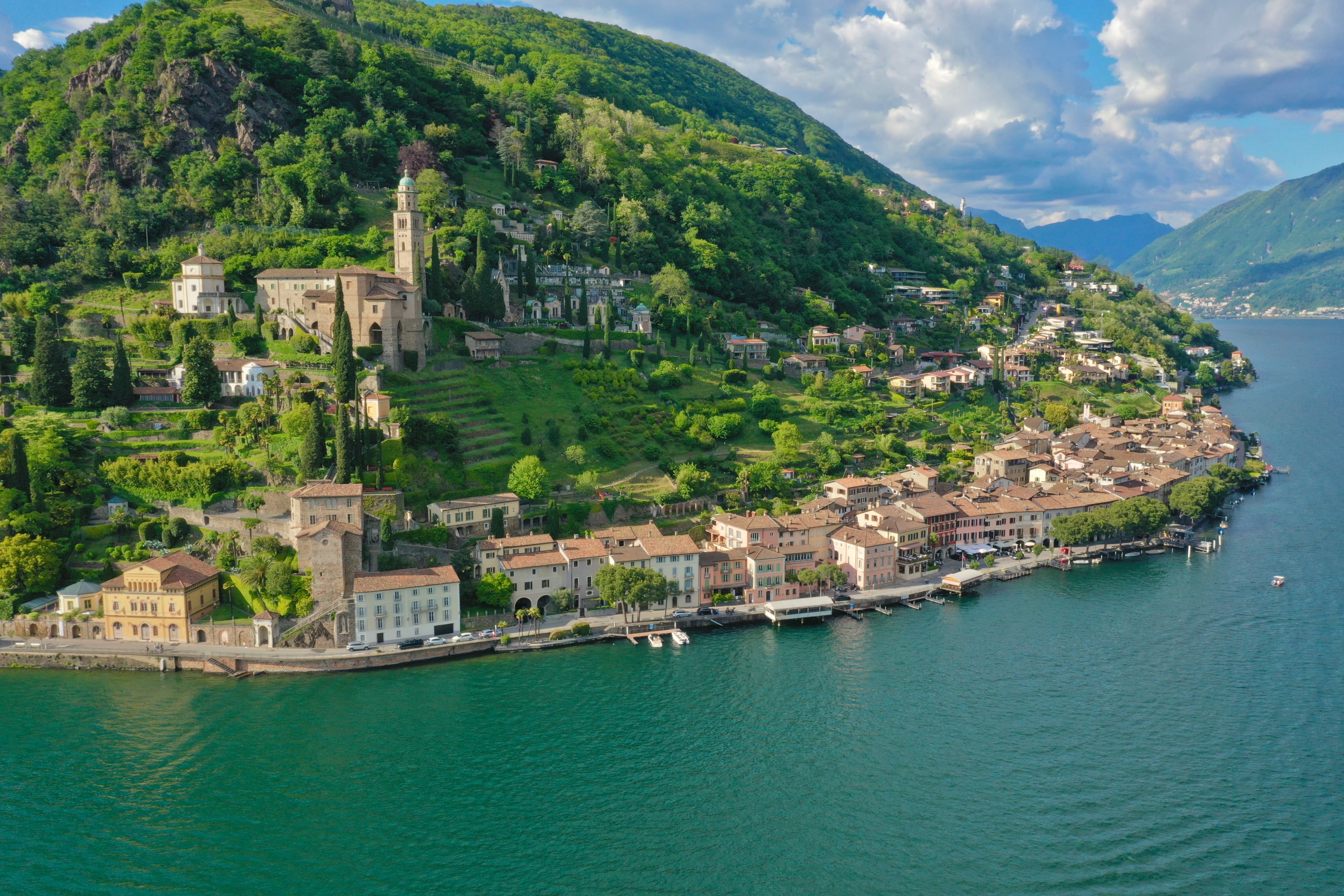
An aerial view of Morcote: the houses lined up along the shore of Lake Lugano, the church of Santa Maria del Sasso and its bell tower on the wooded slope above the village.

Ticino · Lake Lugano

Morcote

Morcote is strung along the shore of Lake Lugano, facing Italy. Above the roofs stands the church of Santa Maria del Sasso; between them, a stairway of 404 steps and a cemetery of 1750.
Family suggestions

Couple suggestions

Related collections

Best Swiss Villages members · “The 50 most beautiful sites” (Switzerland Tourism)

AsconaBosco/GurinGotthard PassGiornicoBrissago IslandsLuganoMerideMorcoteMuggioOsignano
Interactive map — schematic view of Switzerland.
The Ascona lakefront seen from a jetty: a row of yellow, red, blue and pink houses lining the Piazza Motta, the bell tower of the Santi Pietro e Paolo church in the center, a palm tree on the left, and the mountains of Lake Maggiore in the background.

Lakeside town · Ticino

Ascona

A row of painted houses closes the square that opens onto the lake, behind the campanile of Santi Pietro e Paolo. On the hill stand the light-and-air huts of 1901-1902 and the hotel of 1926-1928.
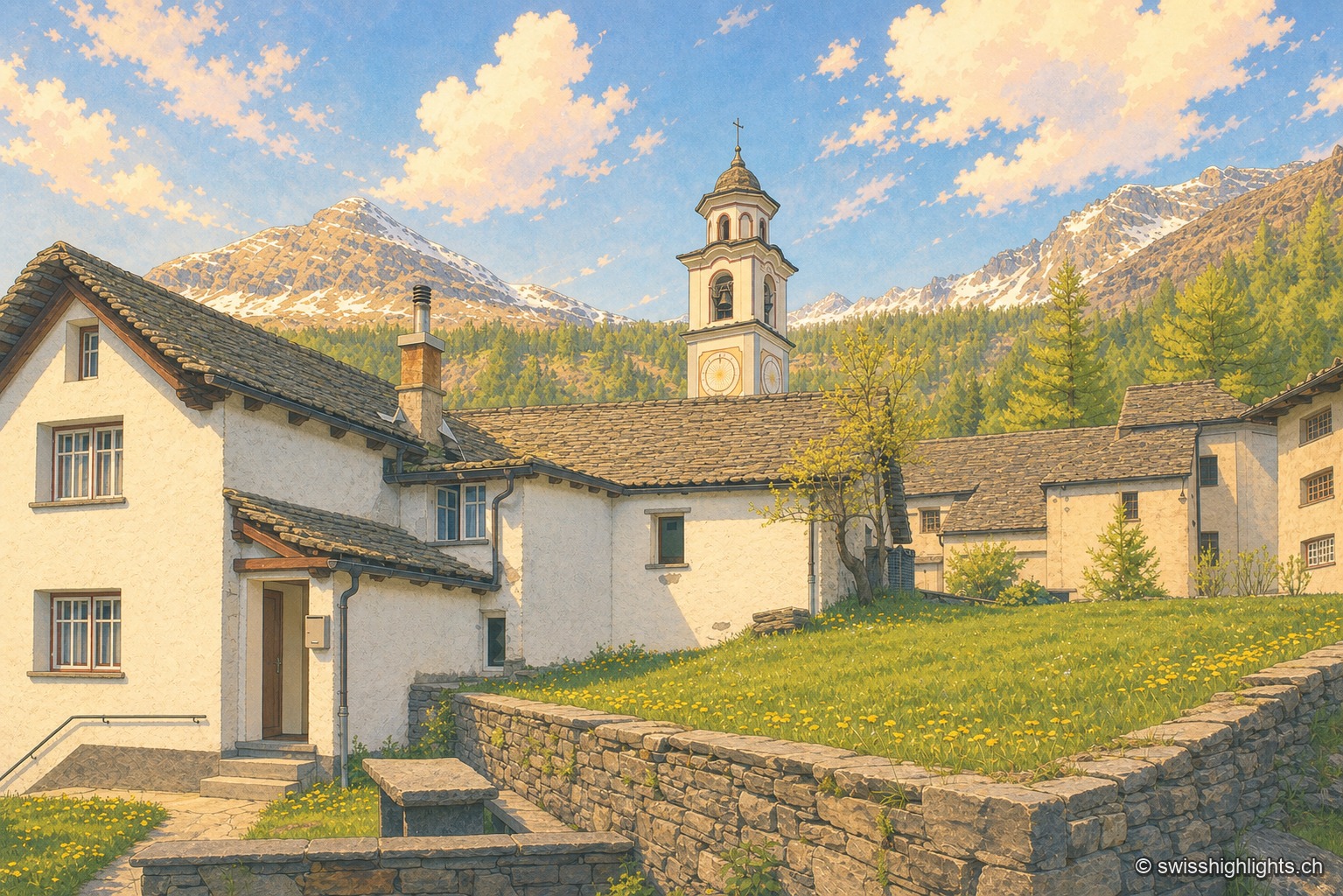
In the foreground, a dry-stone wall and a meadow of blooming dandelions; behind, the houses of Bosco/Gurin, whitewashed and covered with wide stone slabs, line up around the onion-domed church steeple; in the background, light-colored larches and two still snow-covered ridges under a May sky.

Village · Val Rovana, Ticino

Bosco/Gurin

Walser settlers arrived here in the thirteenth century and brought an Alemannic speech that isolation kept archaic. At 1,506 metres, Bosco/Gurin is still the highest village in Ticino — and the only German-speaking one by tradition.
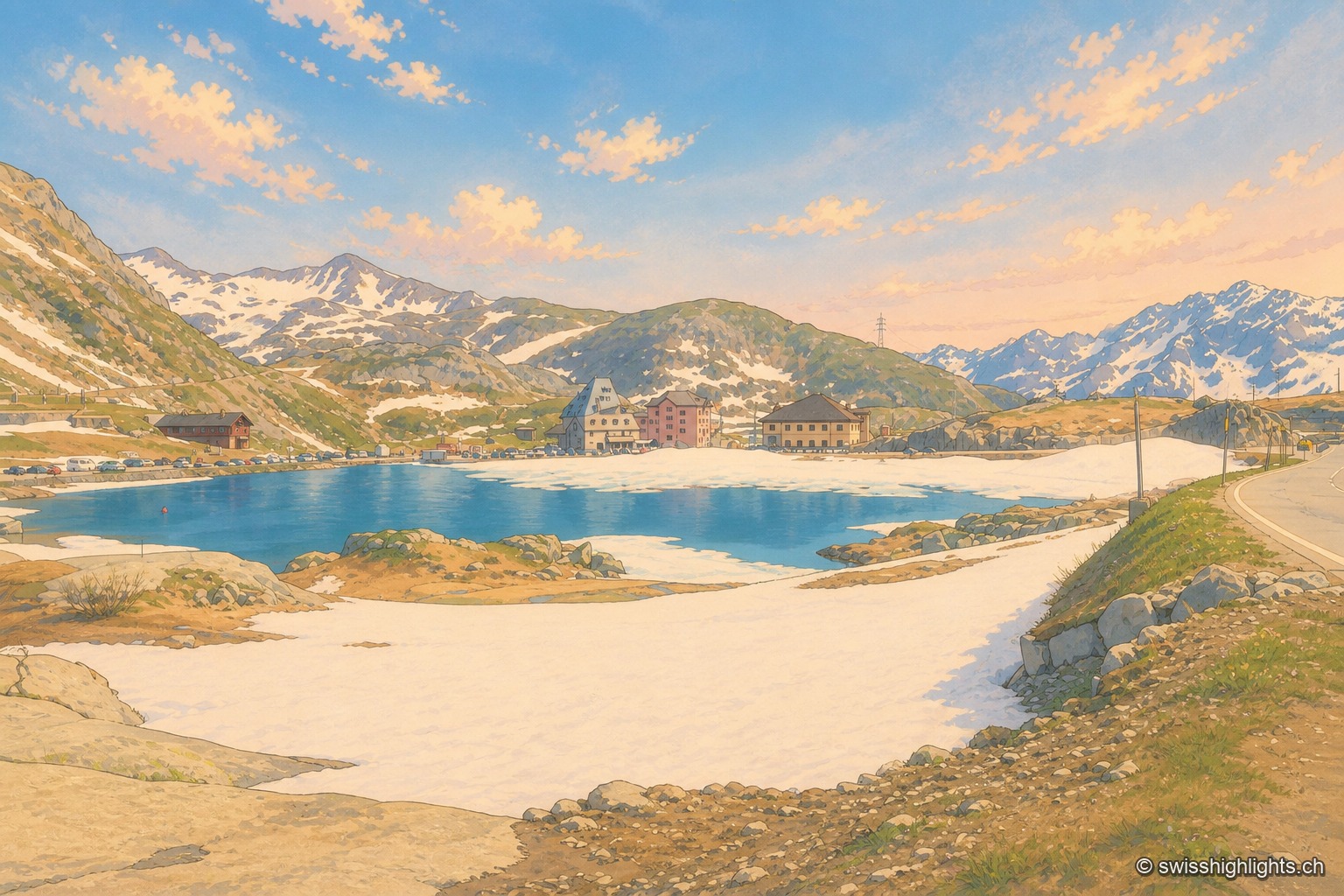
The pass basin during the snowmelt: in the foreground a broad patch of snow and brown granite slabs, in the centre the pass lake still partly covered with ice, on the far shore a cluster of buildings — a dark structure on the left, a long pink building, another yellow one — and, all around, snow-capped ridges under a deep blue sky; on the right, the pass road runs along the embankment.

Alpine pass · Uri – Ticino

Gotthard Pass

Opened around 1220, the crossing linked the Po plain to northern Europe and weighed on the beginnings of the Confederation. A hospice recorded from 1237, the old cobbled Tremola road, the Sasso da Pigna fort turned museum.
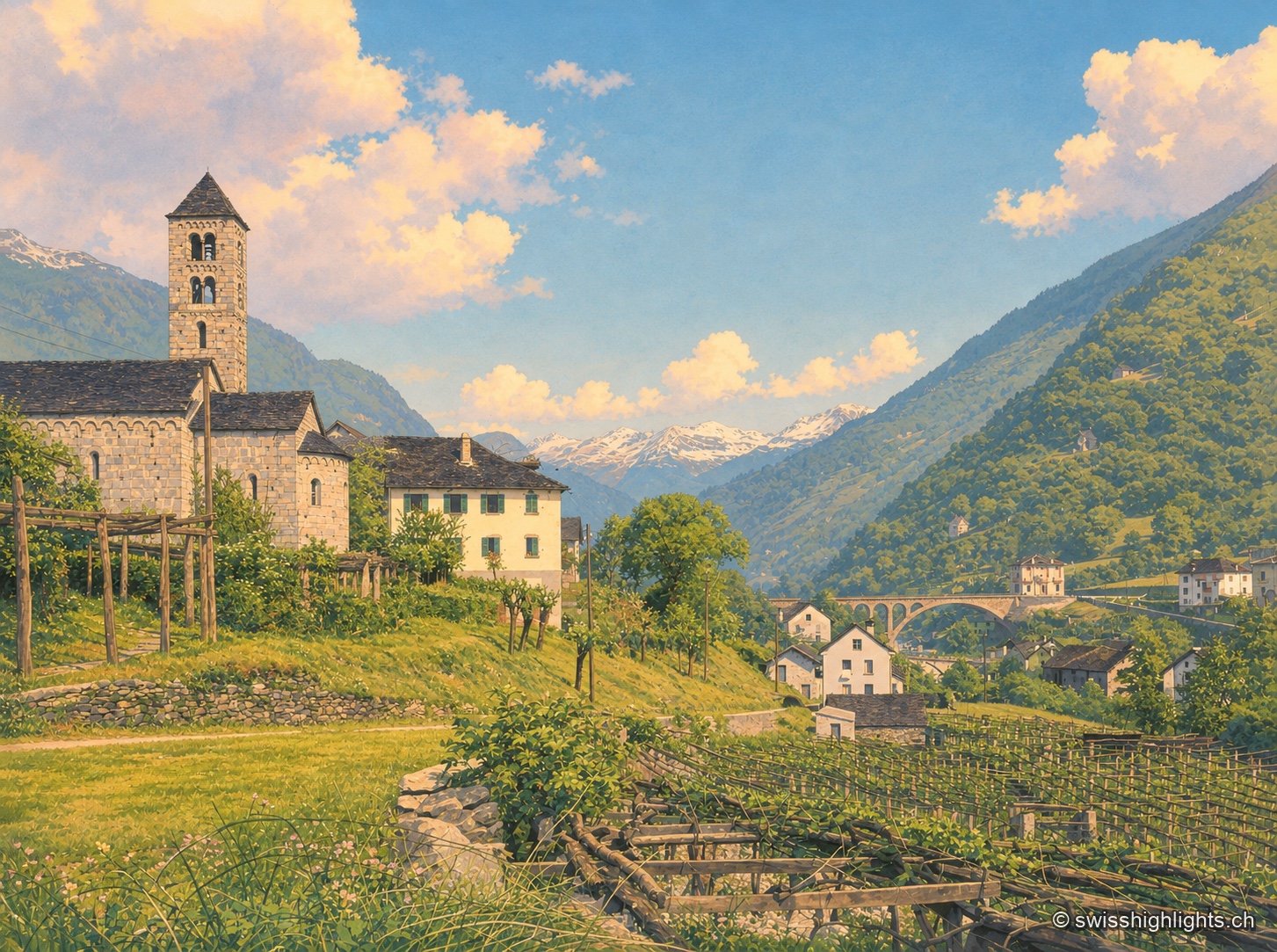
Old black-and-white photograph, taken from a vine-planted slope. On the left, a stone church with a rounded apse and square bell tower, pierced by narrow twin windows, overlooks vine pergolas and a few dark-roofed houses, including a large light-colored building with shutters. At the center, the valley opens toward a snow-capped range, under a sky where large cumulus clouds are building. On the right, a stone bridge with a large arch spans the riverbed in front of a wooded slope and a few houses. In the foreground, low rows of vines and wooden stakes.

Ticino village · Leventina

Giornico

The river holds an island here, reached by two bridges of the Middle Ages. Apart from the village, the La Congiunta museum, built by Peter Märkli, contains nothing but reliefs and sculptures by Hans Josephsohn, made between 1950 and 1991.
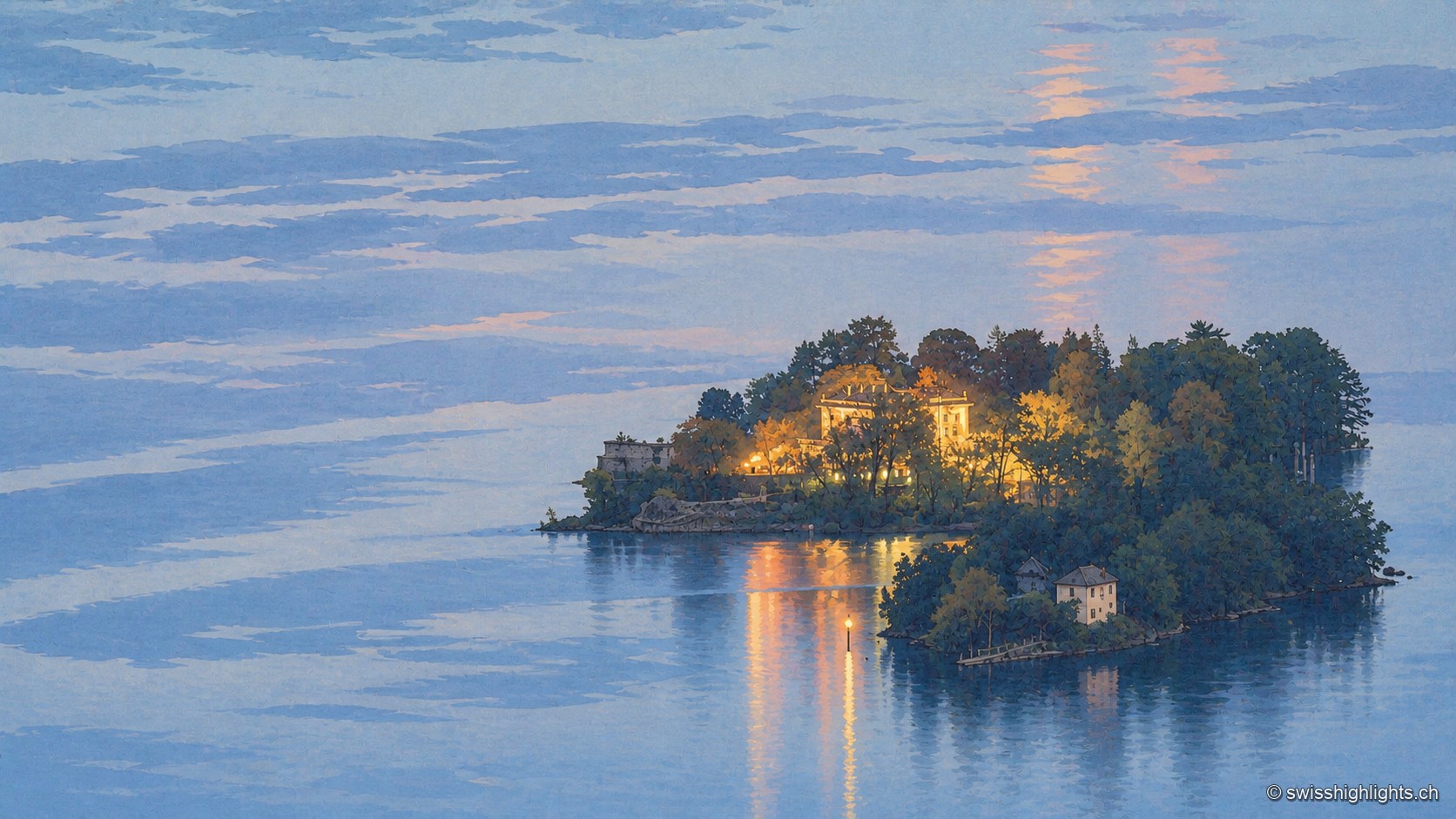
At blue hour, the small wooded island of Brissago stands out against calm Lake Maggiore: the lit windows of a villa pierce through the foliage, their golden reflections stretching across the water under a sky streaked with pink clouds.

Botanical islands · Ticino

Brissago Islands

San Pancrazio, the larger, carries a subtropical garden and is reached by boat. Sant'Apollinare, the smaller, stays closed and keeps the ruins of a Romanesque church. The canton of Ticino and five partners bought them in 1949.
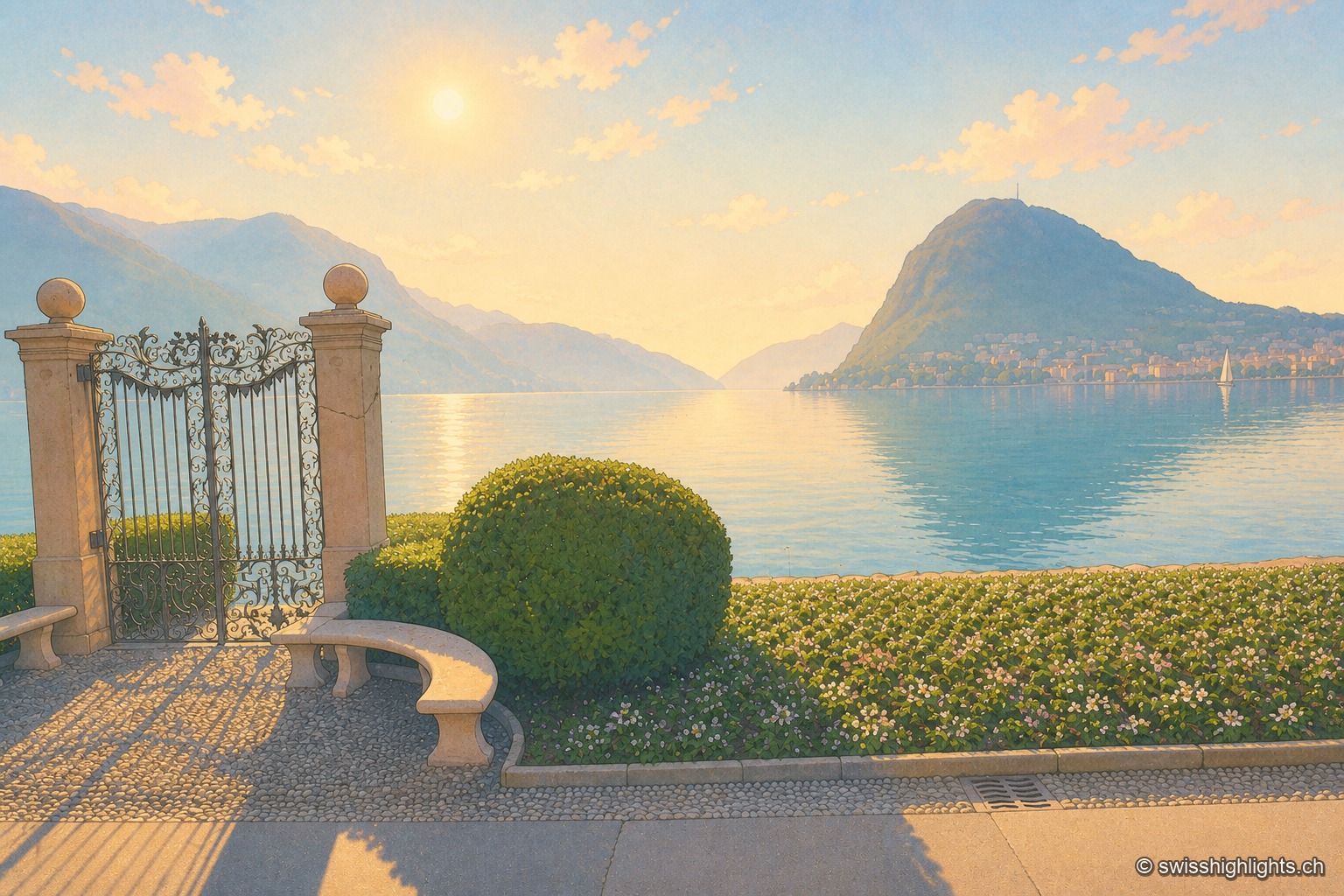
Wrought-iron gate open onto the shore of Lake Lugano, shot against the light, the low sun blazing between the two stone pillars; in the distance, the bluish silhouette of Monte San Salvatore dominates the town and the calm lake water reflecting the light.

Lakeside city · Ticino

Lugano

The country's third financial centre, Lugano hosted the first Eurovision Song Contest in 1956 and has, since the mergers of 2004, 2008 and 2013, an agglomeration of about 150,000 inhabitants on the shore of Lake Lugano.
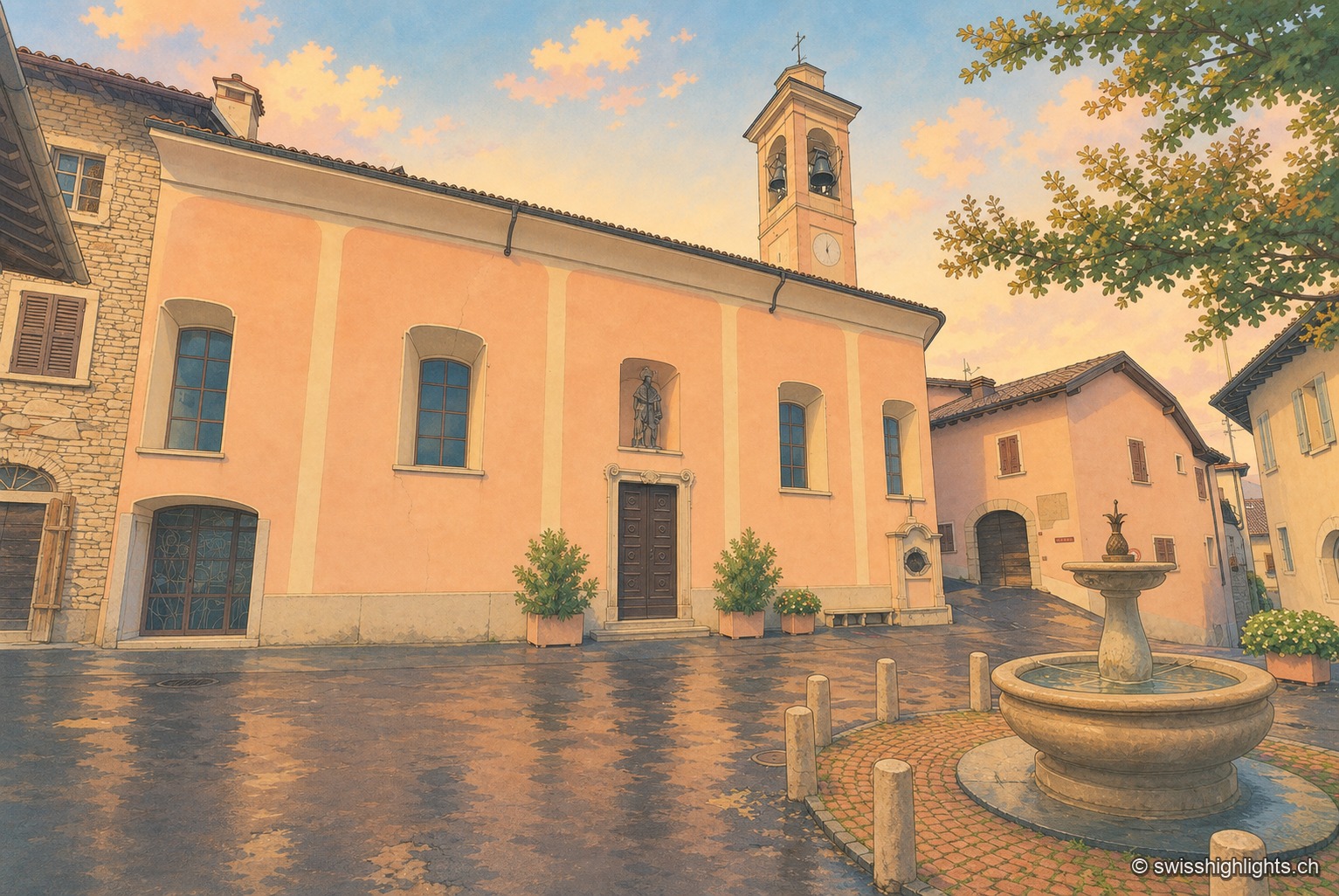
The ochre façade of the village church of Meride, flanked by its bell tower with an onion-domed steeple and a statue in a niche above the portal; on the wet paved square reflecting an end-of-day sky, a stone fountain and flower pots stand before the entrance, a tree on the right.

Village · Ticino

Meride

Recorded as early as 852, Meride long lived off the departure of its stucco workers and painters for northern Europe. Its land runs up to the summit of Monte San Giorgio, World Heritage listed in 2003 for its fossils.

An aerial view of Morcote: the houses lined up along the shore of Lake Lugano, the church of Santa Maria del Sasso and its bell tower on the wooded slope above the village.

Ticino · Lake Lugano

Morcote

Morcote is strung along the shore of Lake Lugano, facing Italy. Above the roofs stands the church of Santa Maria del Sasso; between them, a stairway of 404 steps and a cemetery of 1750.
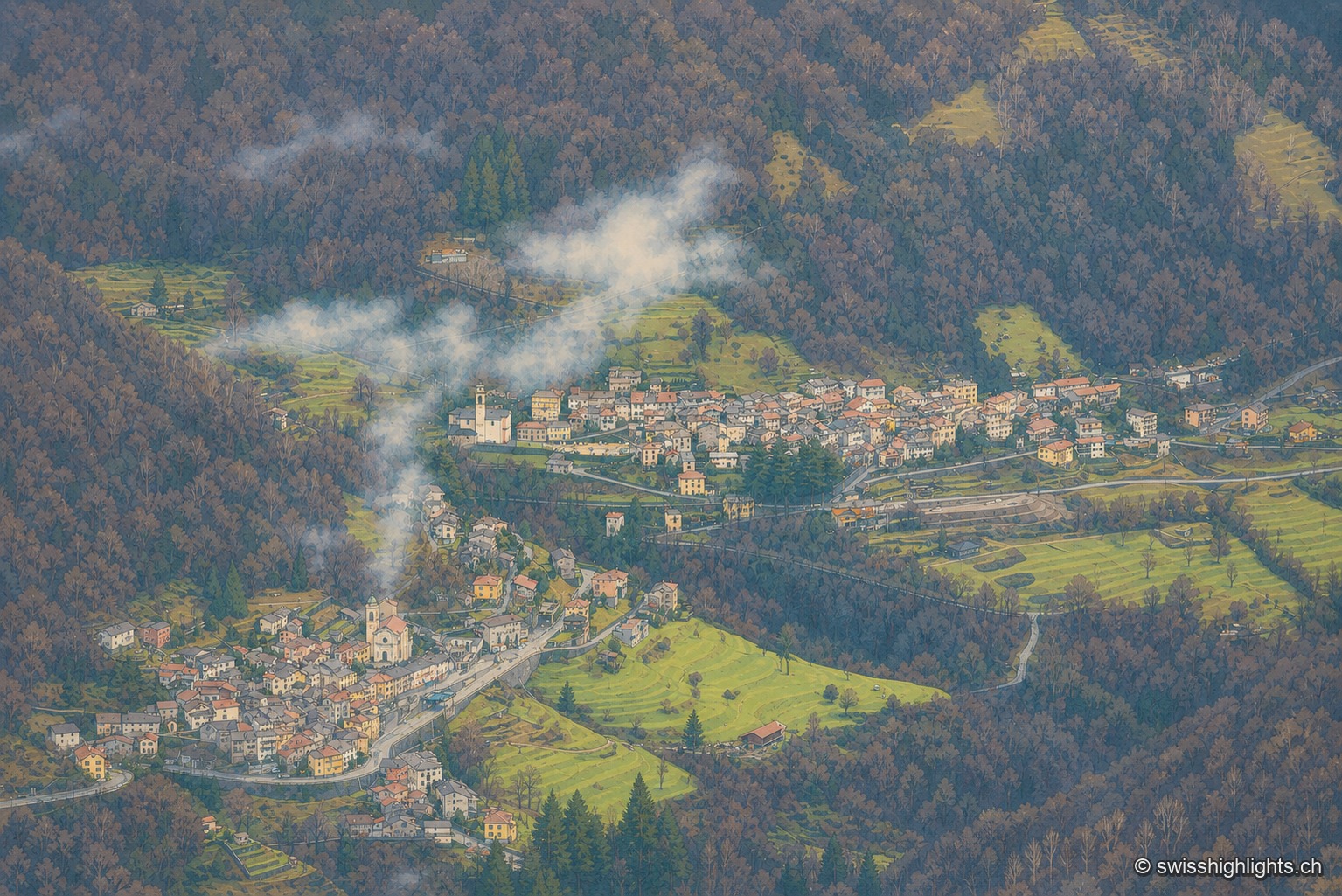
The Valle di Muggio seen from above, from the slopes of Monte Generoso: two villages with tightly packed roofs are terraced one above the other on the valley's flank, their church towers to the fore, surrounded by flat patches of green meadows and terraces; wisps of mist rise from the reddish late-autumn woods covering the rest of the slopes, and the raking light picks out the pale façades against the dark hillside.

Village · Valle di Muggio, Ticino

Muggio

Recorded in 852, it gave its name to the Valle di Muggio. In the fifteenth century its craftsmen cut the long oars of the Duchy of Milan's fleet; its church of San Lorenzo was rebuilt in 1760.

Hamlet listed by ISOS · Ticino

Osignano

On the old mule track linking Agno to Bellinzona, at the foot of Monte Tamaro, the hamlet lines up two rows of stone or rendered rural houses, the oldest from the 17th-18th centuries, around a chapel dedicated to Saint Roch.