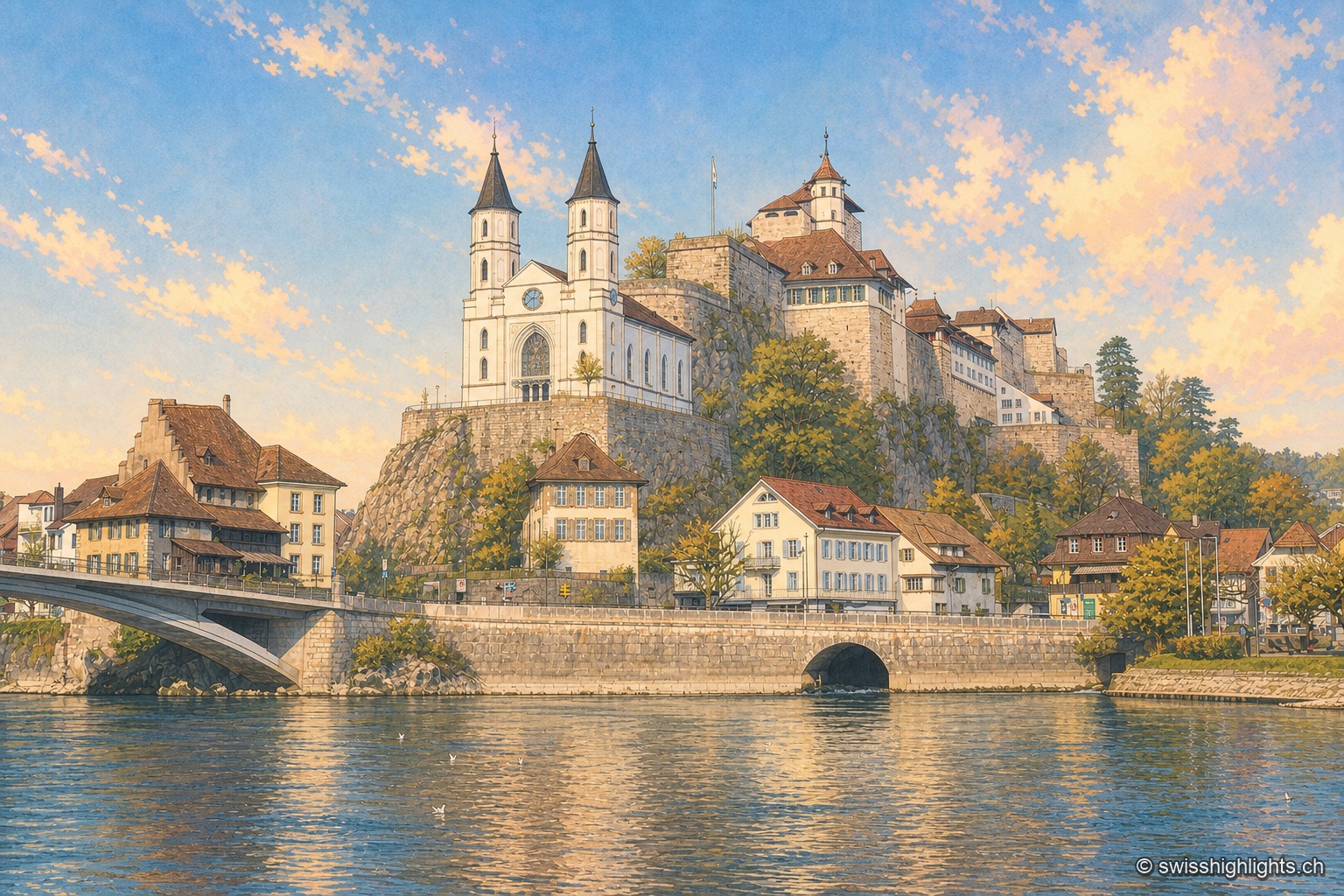
Aarburg seen from the bank of the Aare: the white Reformed church with two black spires stands on its rocky spur, the fortress and its long buildings occupy the ridge above, and the town's houses line the riverbank under a blue winter sky.

Best Swiss Villages members

Collections

54 member places · AG, AR, BE, BL, FR, GE, GR, JU, LU, NE, SG, SO, SZ, TG, TI, UR, VD, VS, ZH

Selection: places whose membership in the Best Swiss Villages association is verified in the corpus data.

Family suggestions

Couple suggestions

AarburgAlbinenArlesheimAsconaAvenchesBergün/BravuognBönigenBosco/GurinBreil/BrigelsBremgartenBüren an der AareBursinsChampéryDardagnyDiessenhofenErlachErnenÉvolèneGersauGiornicoGrandsonGrandvillardGrimentzGrüningenGruyèresHospentalLa NeuvevilleLe LanderonLichtensteigLuthernMadulainMorcoteMoudonMuggioNiedergestelnPorrentruyPoschiavoRomainmôtierRossinièreRougemontSaillonSaint-SaphorinSaint-UrsanneSedrunSimplon VillageSoglioSolothurnSplügenTrogenTschlinUrnäschValanginYvorneZofingen
Interactive map — schematic view of Switzerland.

Places in this collection

Aarburg seen from the bank of the Aare: the white Reformed church with two black spires stands on its rocky spur, the fortress and its long buildings occupy the ridge above, and the town's houses line the riverbank under a blue winter sky.

Fortified small town · Aargau

Aarburg

Bern took the town on 20 April 1415 and turned the castle into a fortress. It still holds the spur commanding the valley, above an old town rebuilt after the fire of 4 May 1840.
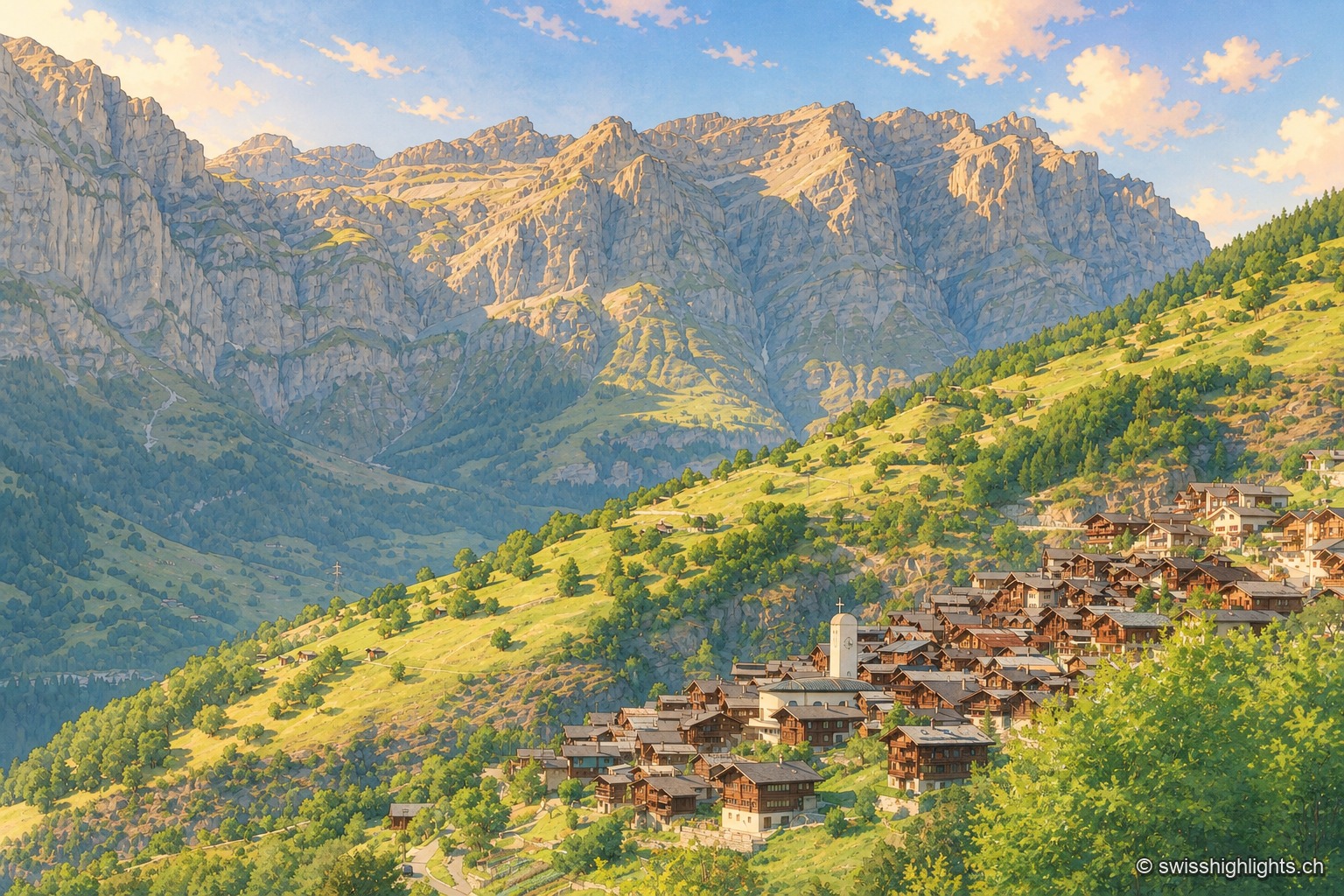
The village of Albinen clustered on its grassy shoulder, its brown wooden houses huddled around the church's white bell tower, with sloping meadows and larches in front of it and, in the background, the long limestone wall that closes off the Dala valley in a bluish morning light.

Mountain village · Valais

Albinen

Until the road of 1956, eight wooden ladders fixed to the cliff were the only way to Leukerbad. They are still there, and the village counts 259 inhabitants.
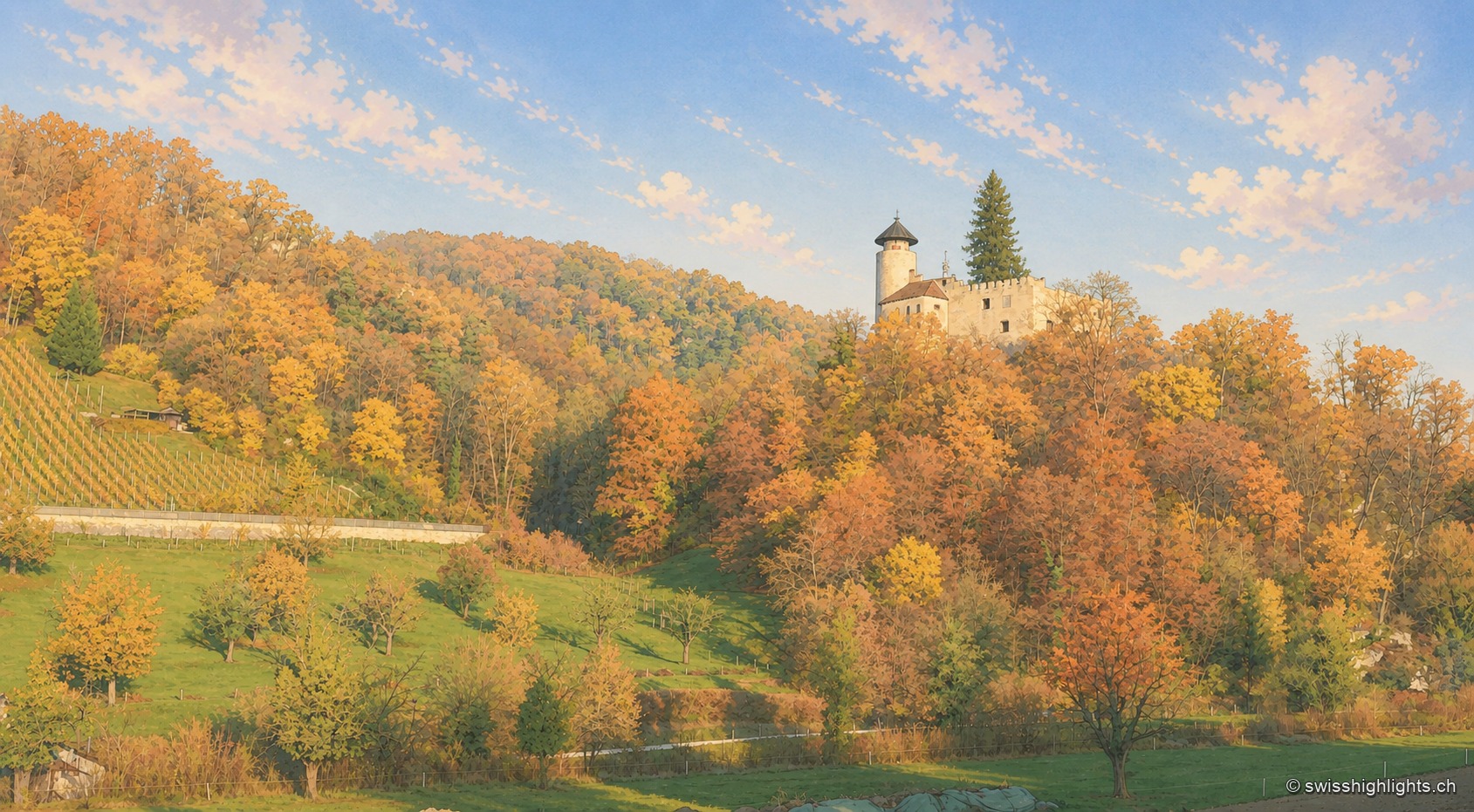
Ermitage pond in Arlesheim in autumn: a white wooden footbridge extends over the water covered with water lilies, in front of a wooded slope with yellow, orange and red foliage.

Village and garden · Basel-Land

Arlesheim

The collegiate church and the canons' houses, built from 1679, close a square laid out in one design. Beyond the village, the Ermitage spreads its grottoes, ponds and paths over some forty hectares.
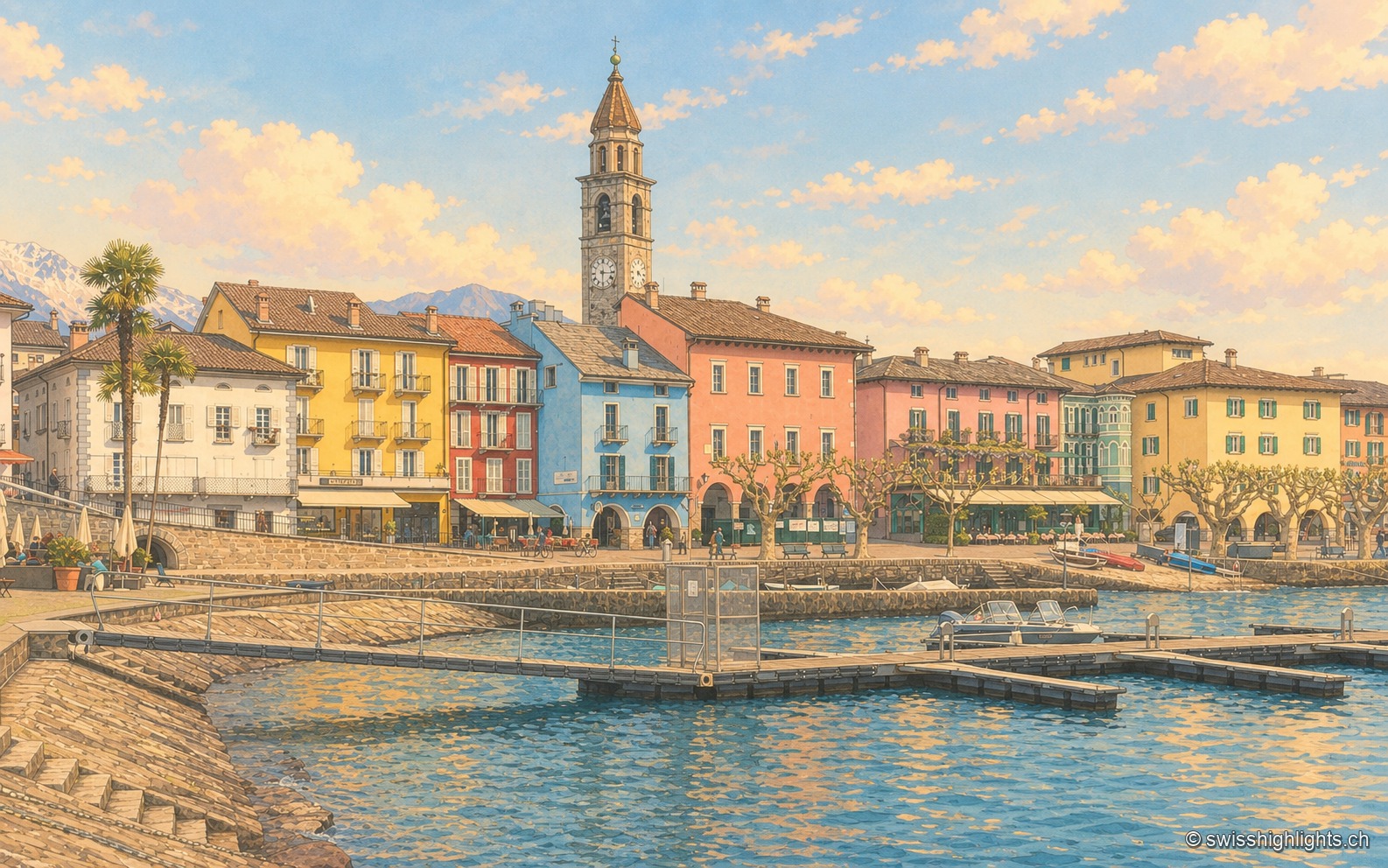
The Ascona lakefront seen from a jetty: a row of yellow, red, blue and pink houses lining the Piazza Motta, the bell tower of the Santi Pietro e Paolo church in the center, a palm tree on the left, and the mountains of Lake Maggiore in the background.

Lakeside town · Ticino

Ascona

A row of painted houses closes the square that opens onto the lake, behind the campanile of Santi Pietro e Paolo. On the hill stand the light-and-air huts of 1901-1902 and the hotel of 1926-1928.
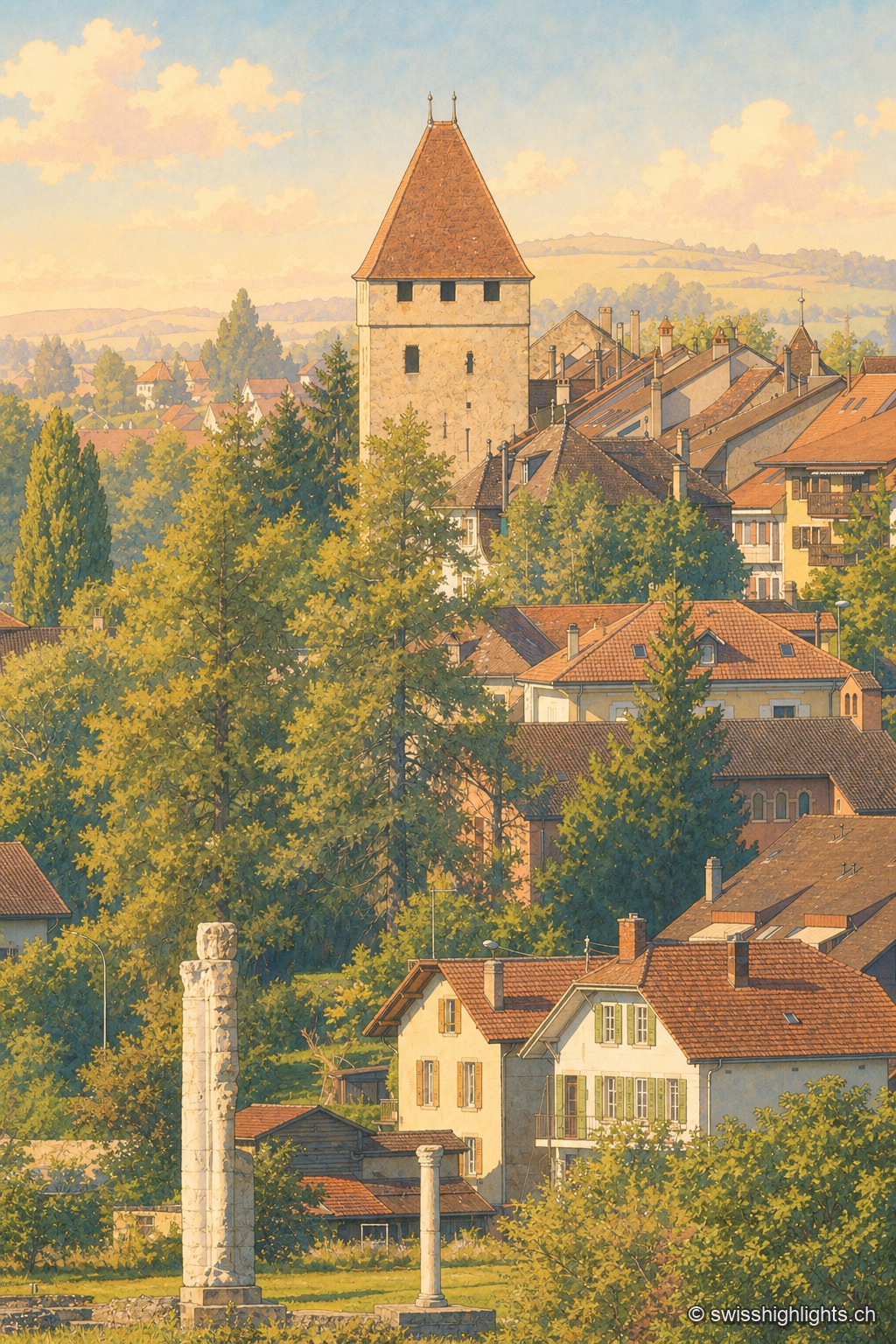
Late afternoon view of the old town of Avenches: in the foreground, two Roman columns standing in the grass, remnants of the Cigognier sanctuary; beyond the rooftops, the Tornallaz, a square tower with a pointed roof from the ancient wall, rises above the Vaud houses with light-colored facades and colorful shutters.

Roman capital · Vaud

Avenches

Aventicum had more than 20,000 inhabitants under the High Empire before the Alamanni devastated it in 258. The town hall, rebuilt in 1753, stands over the square; the IENA, opened in 1999, made it Switzerland's horse town.
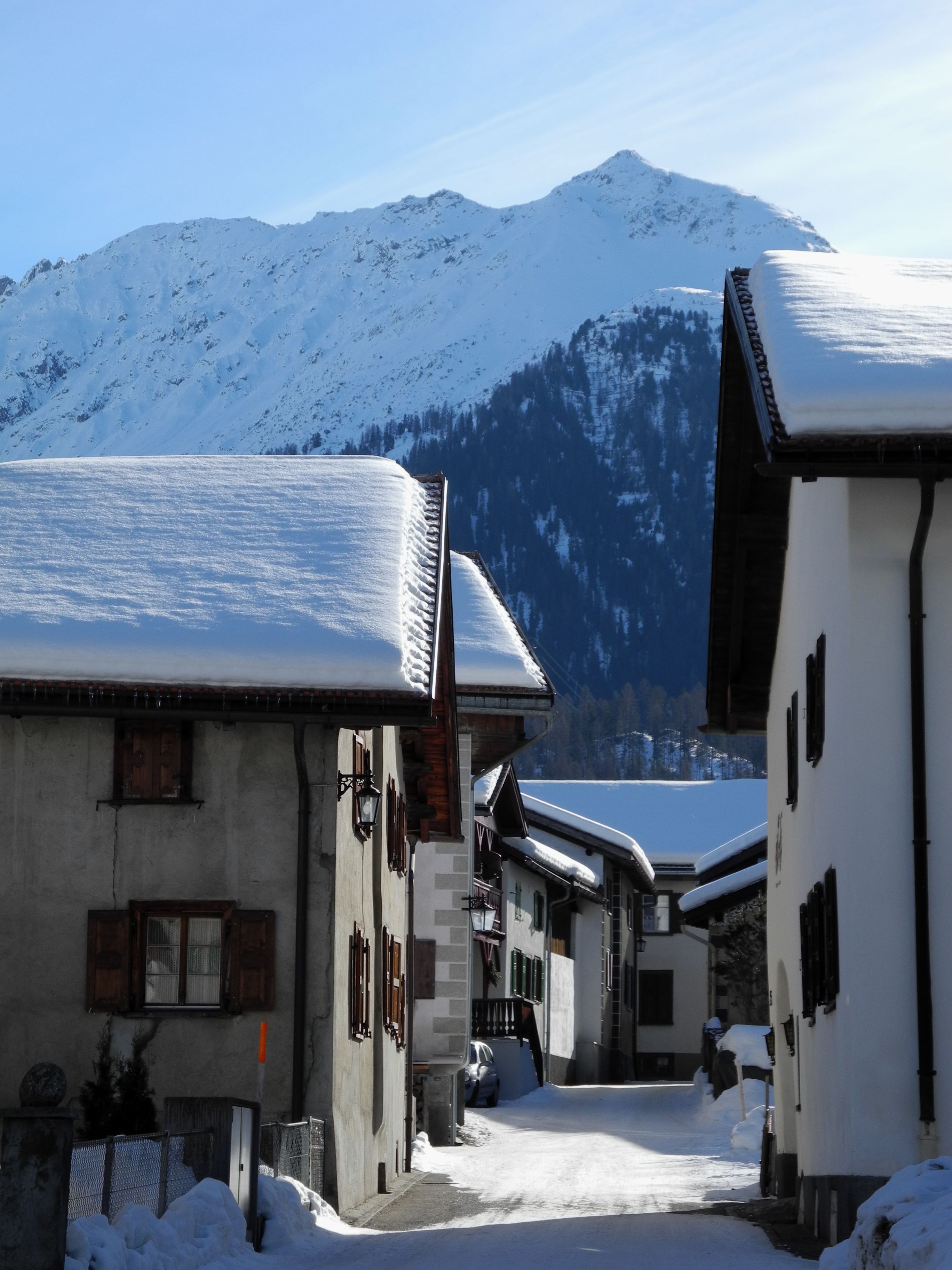
Snow-covered street in Bergün lined with Engadine houses with snow-laden roofs; in the background, a snowy mountainside under a clear sky.

Graubünden · Albula Valley

Bergün/Bravuogn

At 1,367 metres in the Albula Valley, Bergün lines its sgraffito-decorated Engadine houses along one climbing street. Its Romansh name, Bravuogn, has been official since 1943.
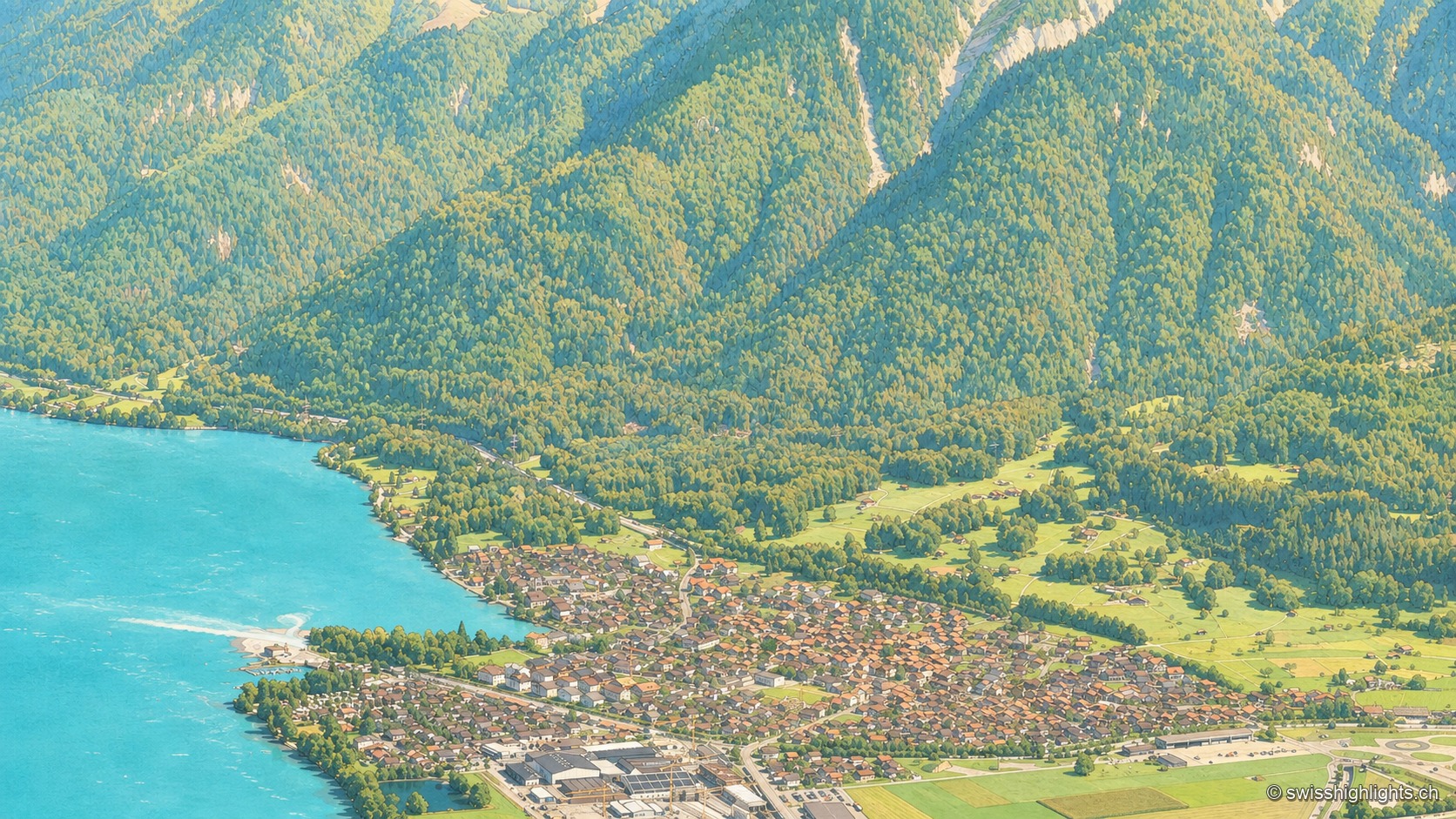
An aerial view from the Harderkulm over the village of Bönigen, nestled at the turquoise mouth of the Lütschine where it flows into Lake Brienz; the village roofs line up between the turquoise water and green meadows, at the foot of steep, fully wooded slopes rising toward the head of the valley.

Bernese village · Lake Brienz

Bönigen

Bönigen, at the mouth of the Lütschine into Lake Brienz, was an imperial fief of the barons von Eschenbach ceded to Interlaken convent in 1261; the village refused the Protestant Reformation in 1528 and today has 2,786 inhabitants.
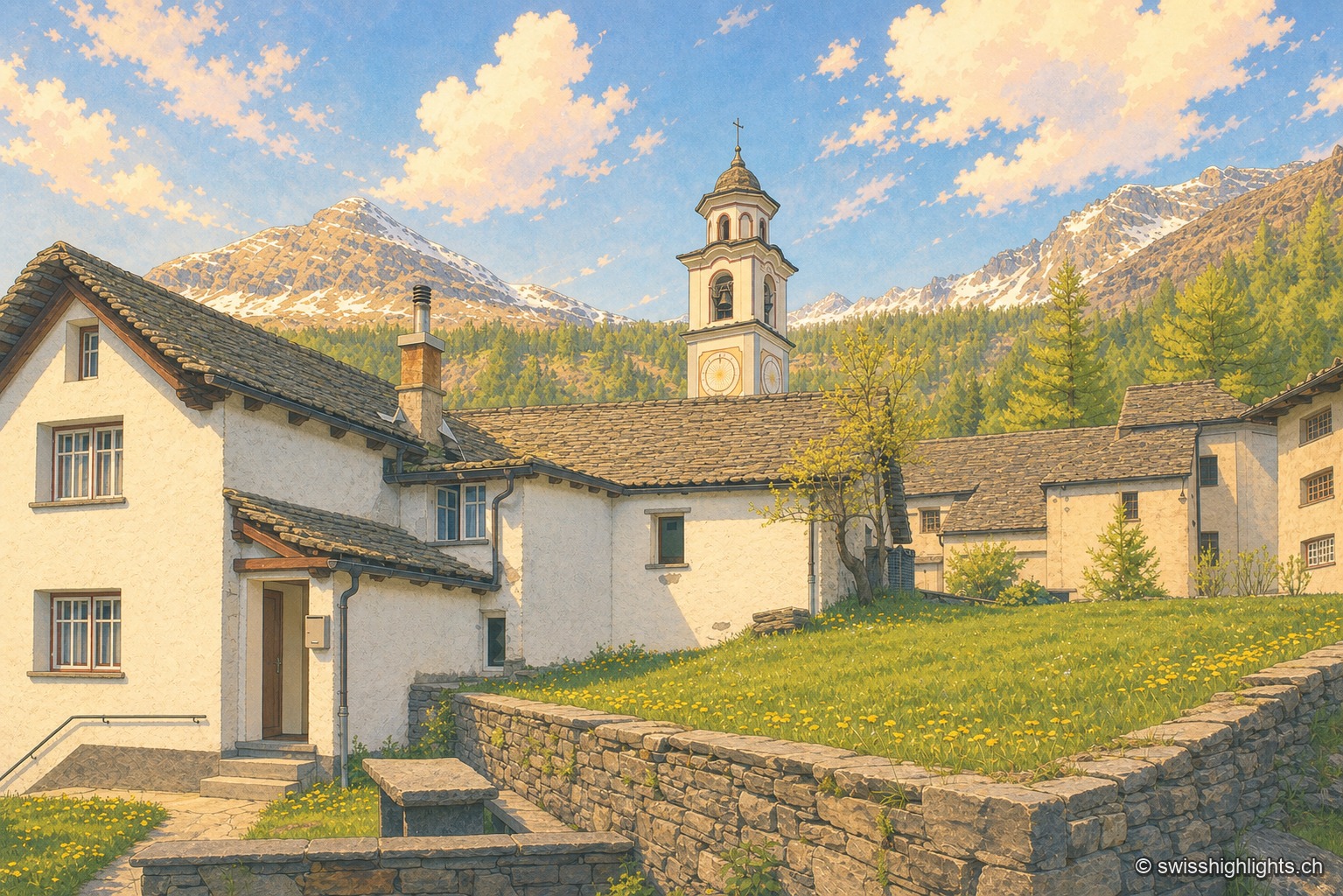
In the foreground, a dry-stone wall and a meadow of blooming dandelions; behind, the houses of Bosco/Gurin, whitewashed and covered with wide stone slabs, line up around the onion-domed church steeple; in the background, light-colored larches and two still snow-covered ridges under a May sky.

Village · Val Rovana, Ticino

Bosco/Gurin

Walser settlers arrived here in the thirteenth century and brought an Alemannic speech that isolation kept archaic. At 1,506 metres, Bosco/Gurin is still the highest village in Ticino — and the only German-speaking one by tradition.
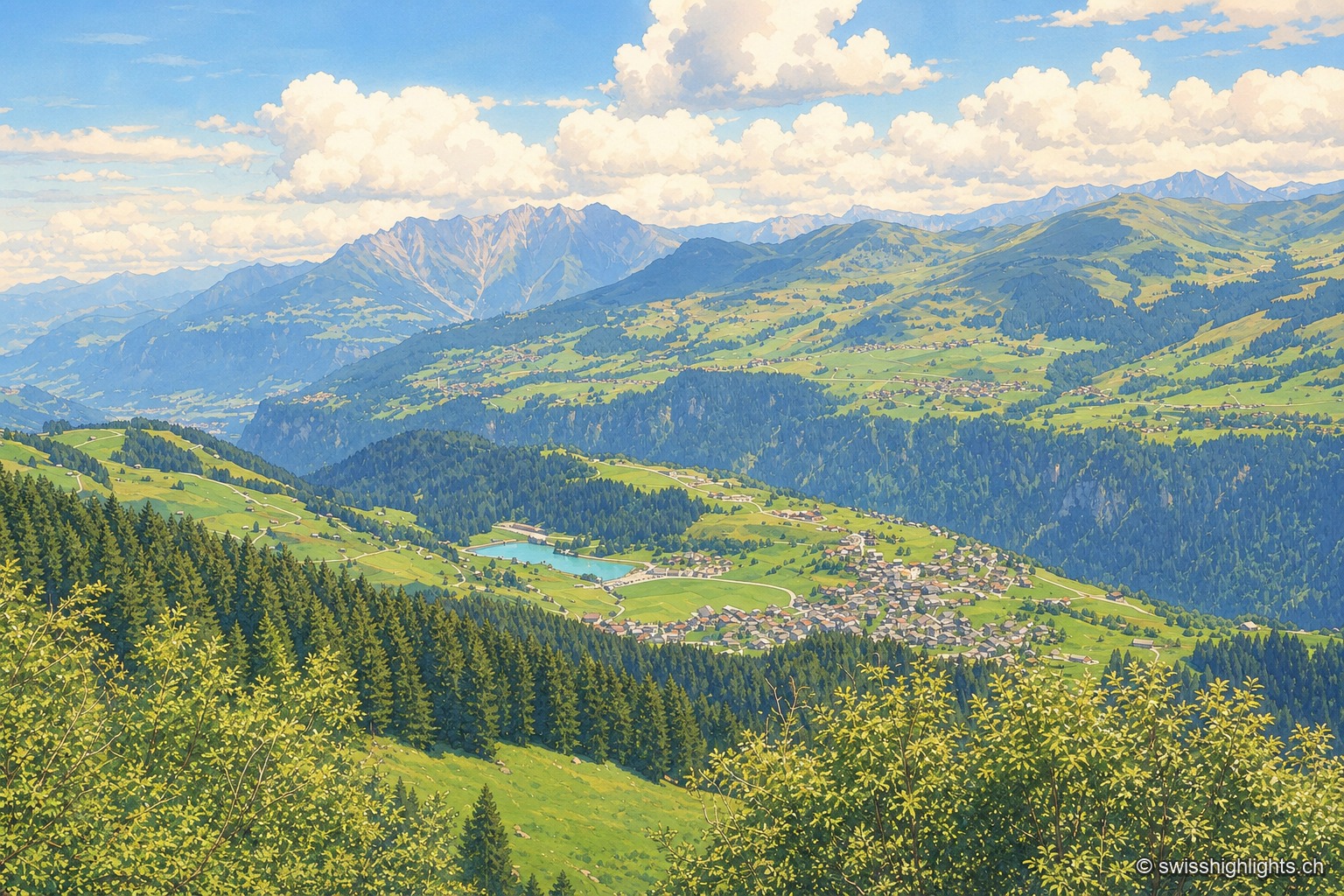
Summer view taken from the opposite slope, above the forest: the village of Breil/Brigels spreads over its terrace of grass and woodland, light-colored houses clustered along the slope, with a small turquoise lake to its left; in front, fir trees descend toward the void of the Vorderrhein valley, and in the background the ranges of the Surselva rise in tiers under a sky of cumulus clouds.

Surselva village · Grisons

Breil/Brigels

Recorded in 765 as Bregelo, the village has carried its double Romansh and German name since 1943. Above it a spruce forest has been left unlogged since 1911, between 1,580 and 2,015 metres.
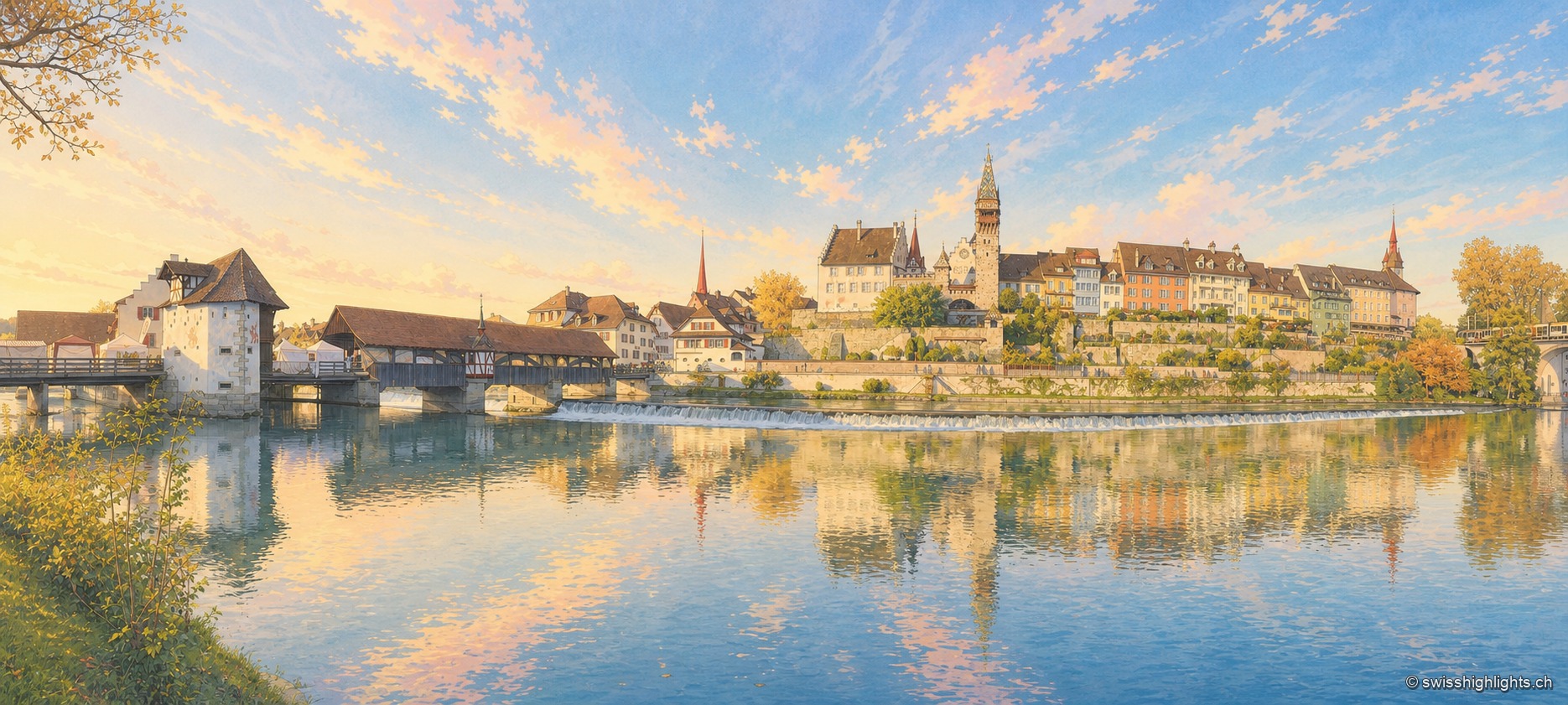
Panorama of Bremgarten from the opposite bank of the Reuss, at the end of an autumn day: on the left, a covered wooden bridge with a long tiled roof crosses the river from a white gate tower; a foaming weir crosses the current along its full width; above the embankment wall, the town's houses line up in ochre, yellow and white facades, dominated by a tall clock tower with a red roof and two church spires. The river, smooth and dark, reflects the whole town in the lower half of the image.

Small town · Aargau

Bremgarten

The old town sits in a bend of the Reuss, still crossed by a covered wooden bridge. Four great markets set the year: those of Easter and Whitsun are over 750 years old, and the Christmas market, begun in 1995, lines up more than 300 stalls.
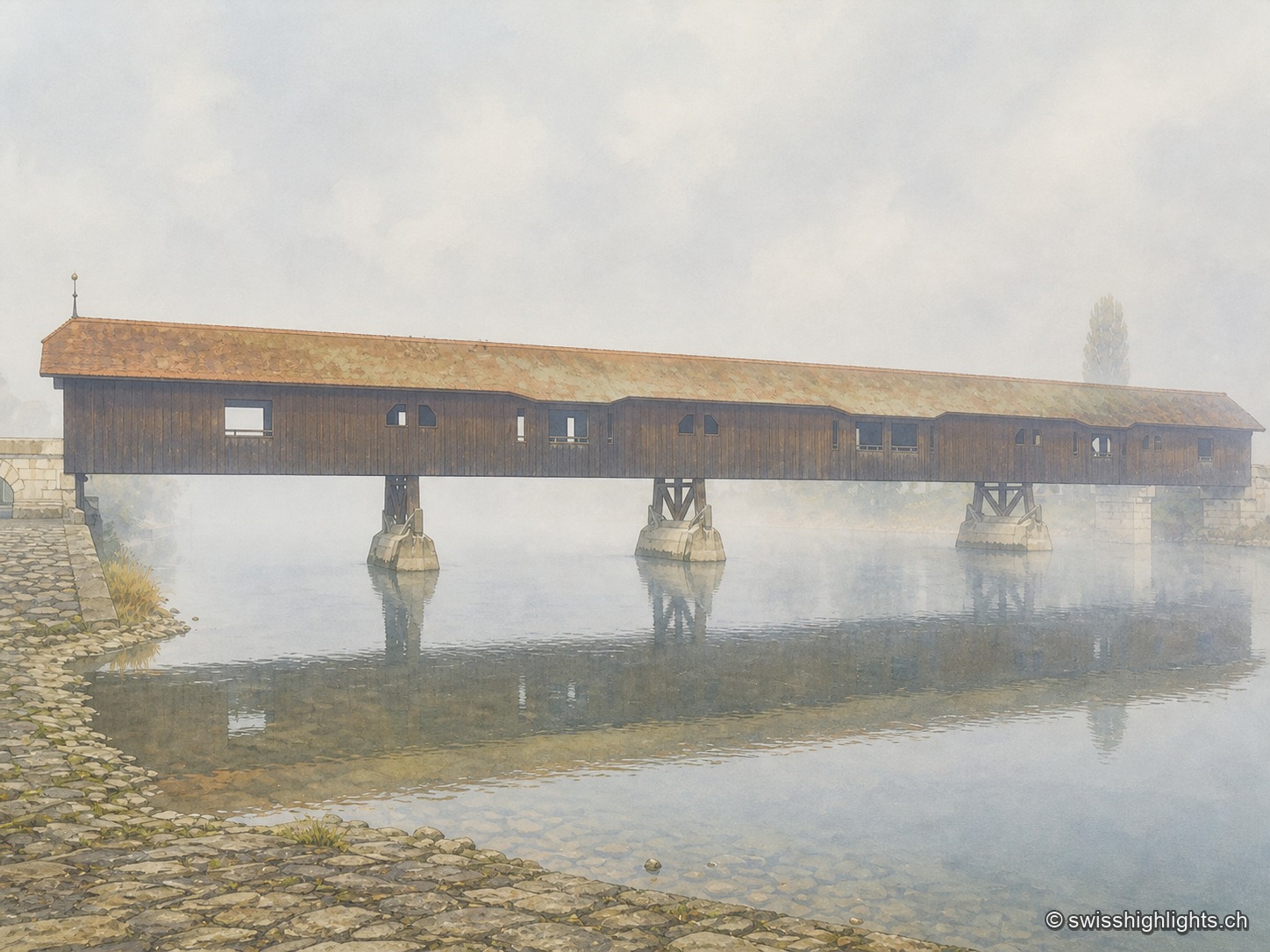
The covered wooden bridge of Büren an der Aare seen from the side on a foggy morning: a long dark wooden deck under an ochre tiled roof, carried on masonry piers in the middle of the Aare, above which mist rises over the calm water; in the foreground, the paved riverbank.

Medieval small town · Seeland

Büren an der Aare

A timber crossing has linked the two banks since the 13th century. Destroyed eight times by floods, ice or fire, it is now in its ninth version, opened in 1991 after the arson of 1989.
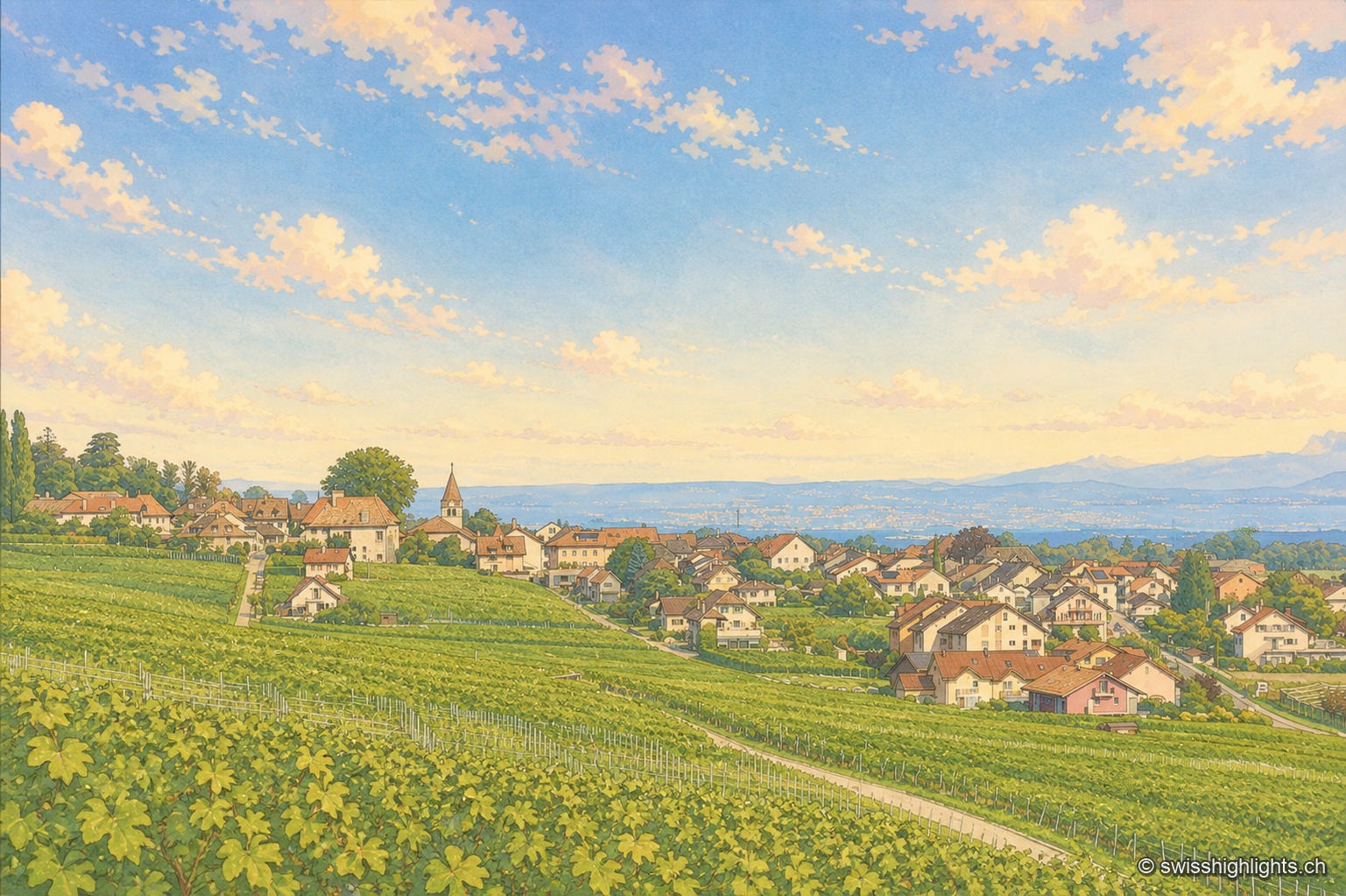
The village of Bursins seen from the vineyards at the end of the day: rows of vines fill the entire foreground, the houses and bell tower huddle in the middle of the hillside, and behind them the plain, Lake Geneva and the opposite shore fade into the heat haze.

Wine village · La Côte, Vaud

Bursins

The church of Saint-Martin, built in the 11th century and a priory of Romainmôtier from 1238, holds the upper end of the village. Below it the vines run down towards the plain and the lake.
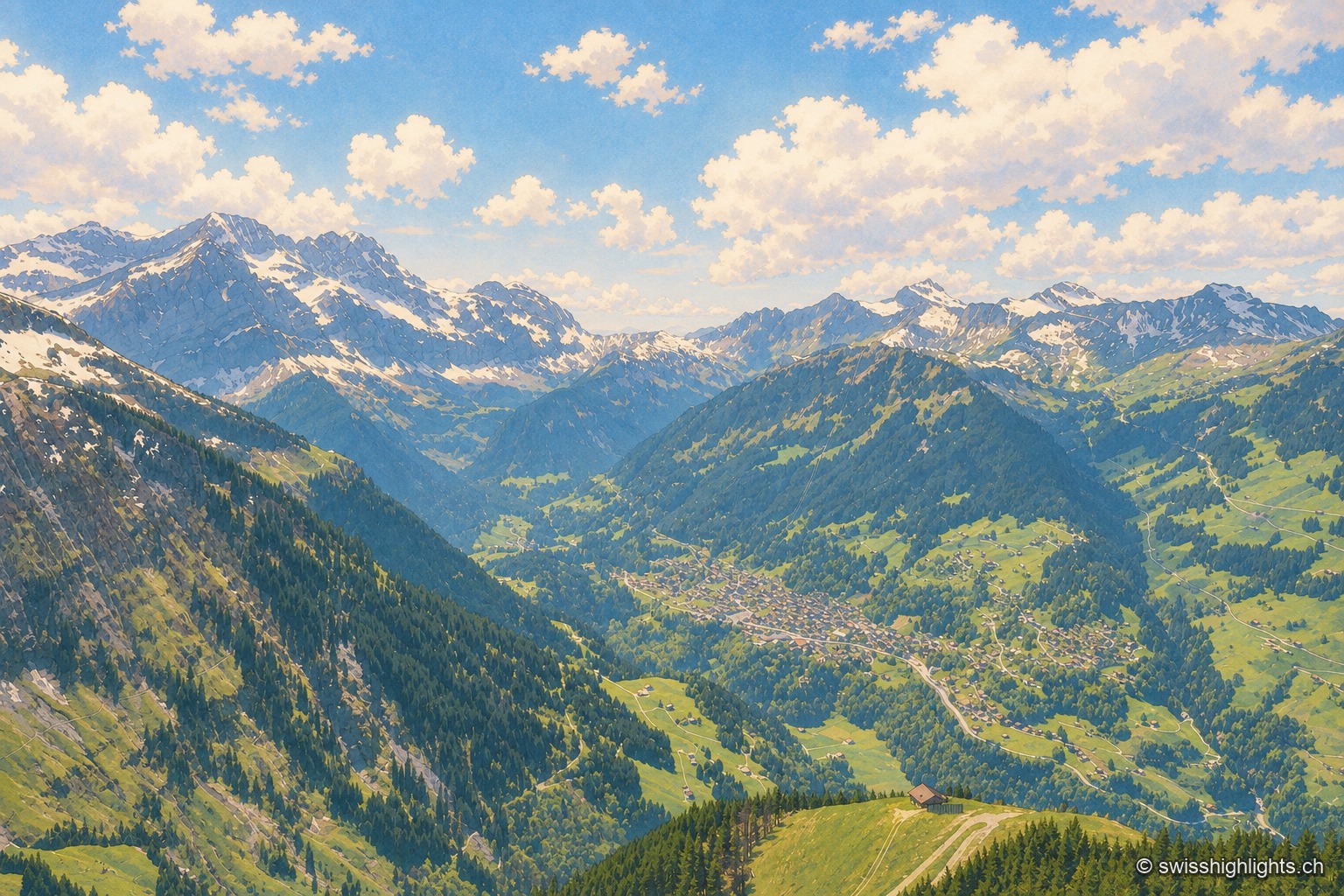
High-angle view over the valley from a wooded slope: dark fir trees and an alpine pasture ridge crossed by a path in the foreground, at the bottom of the valley the village spread along its road, its roofs clustered among the meadows. On the left, a still snow-capped limestone ridge bares its jagged teeth above the forests; on the right, grassy slopes dotted with chalets climb toward other summits. The sky fills the upper third, full of fair-weather cumulus clouds.

Mountain village · Valais

Champéry

Tourism began here in 1857 with the opening of a first hotel. From its church of 1725 Champéry kept a bell tower ended by neither roof nor spire but by four stone arches shaped like a crown, listed in 1974.
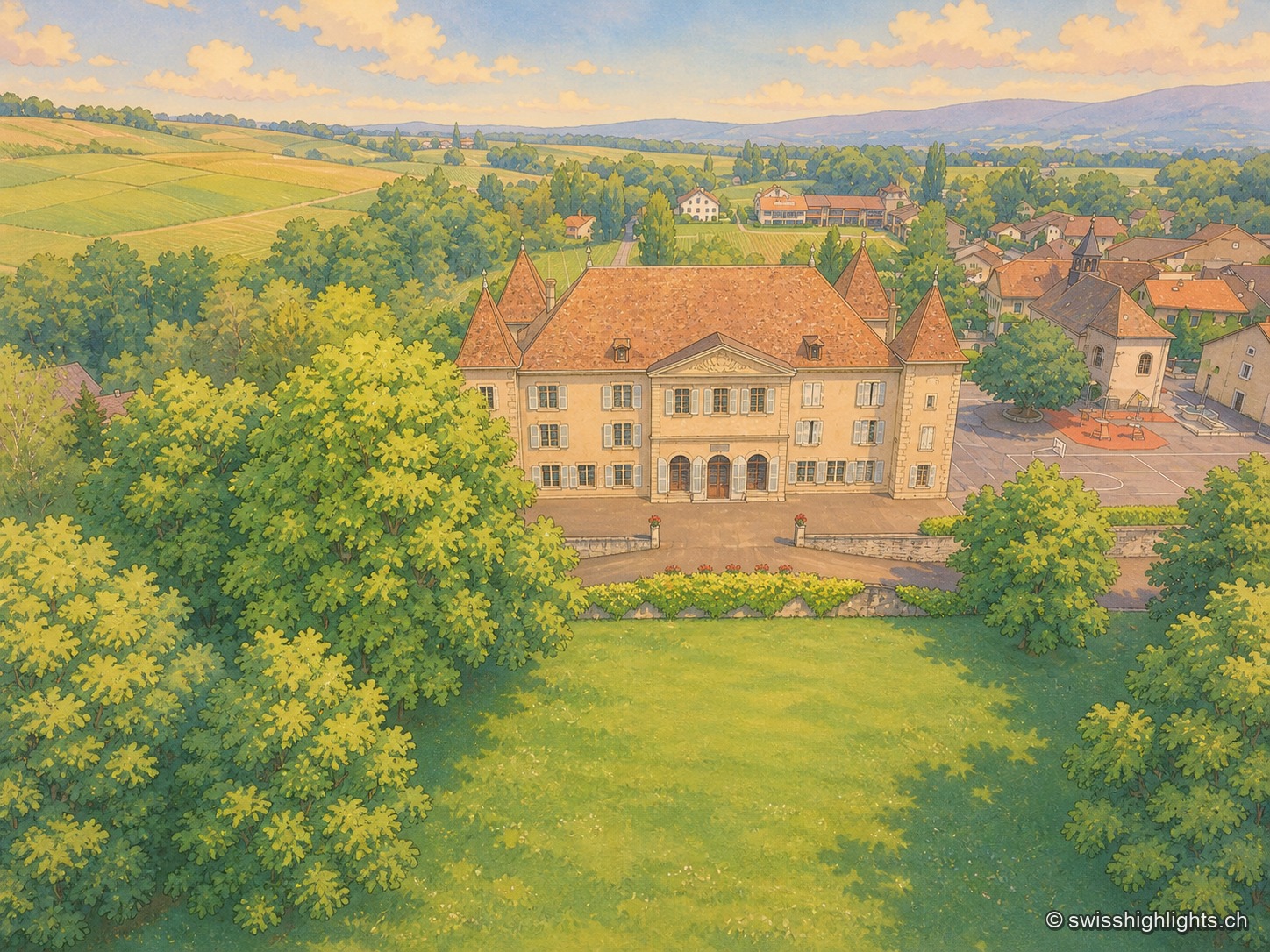
A drone aerial view of the village of Dardagny taken in late afternoon: the Genevan château, with its slate roof and central turret, occupies the center of the image, surrounded by the church tower and the village's tiled roofs; all around stretch rows of vines, cultivated fields and copses, under a low, raking light that lengthens the shadows.

Wine-growing village · Geneva

Dardagny

The largest château in the canton of Geneva, rebuilt by the banker Jean Vasserot in 1723, holds the centre of the village; in 1978 the Wakker Prize honoured the conservation of the site, a member since 2021 of the Most Beautiful Villages of Switzerland.
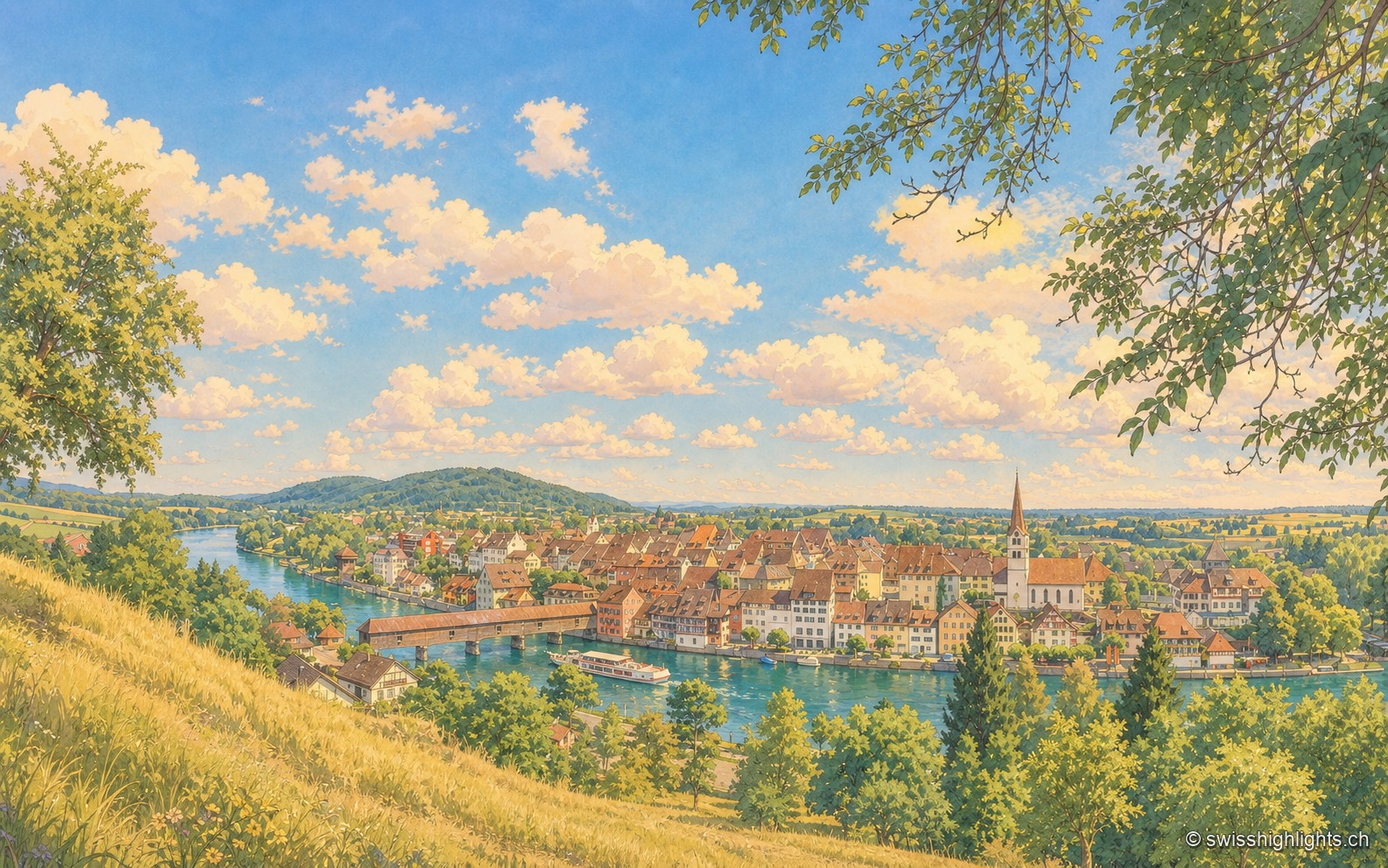
Elevated view of Diessenhofen from a height on the opposite bank: the Rhine looping through, the covered wooden bridge on the left, a passenger boat before the quay, the tightly packed roofs of the town and the church bell tower at the center, under a summer sky with cumulus clouds.

Rhine town · Thurgau

Diessenhofen

Raised to town status in 1178 by the counts of Kyburg, Diessenhofen has kept its medieval street plan, its Seal Tower with a zodiac dial, and its covered wooden bridge across the Rhine into Germany.
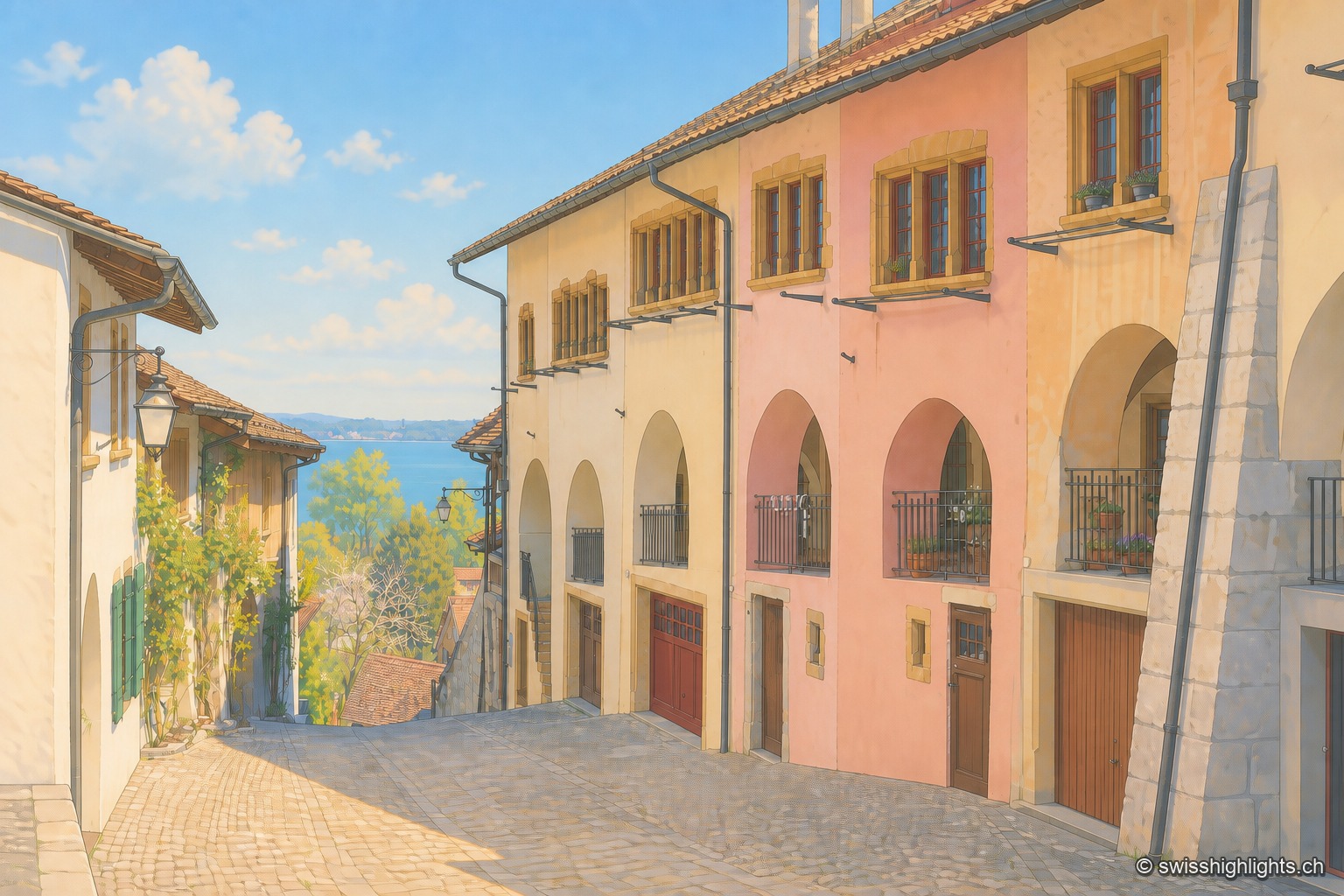
Cobbled lane in Erlach's old town running down toward Lake Biel: on the right, a row of houses with pink, cream and ochre façades pierced by round arches and wrought-iron balconies; in the distance, the lake's surface glitters under a clear blue sky.

Medieval town · Lake Biel

Erlach

The castle that has overlooked Erlach since the year 1100 gave its name to the patrician von Erlach family; the town, a member of Switzerland's Most Beautiful Villages since 2017, looks out from Jolimont hill toward St Peter's Island.
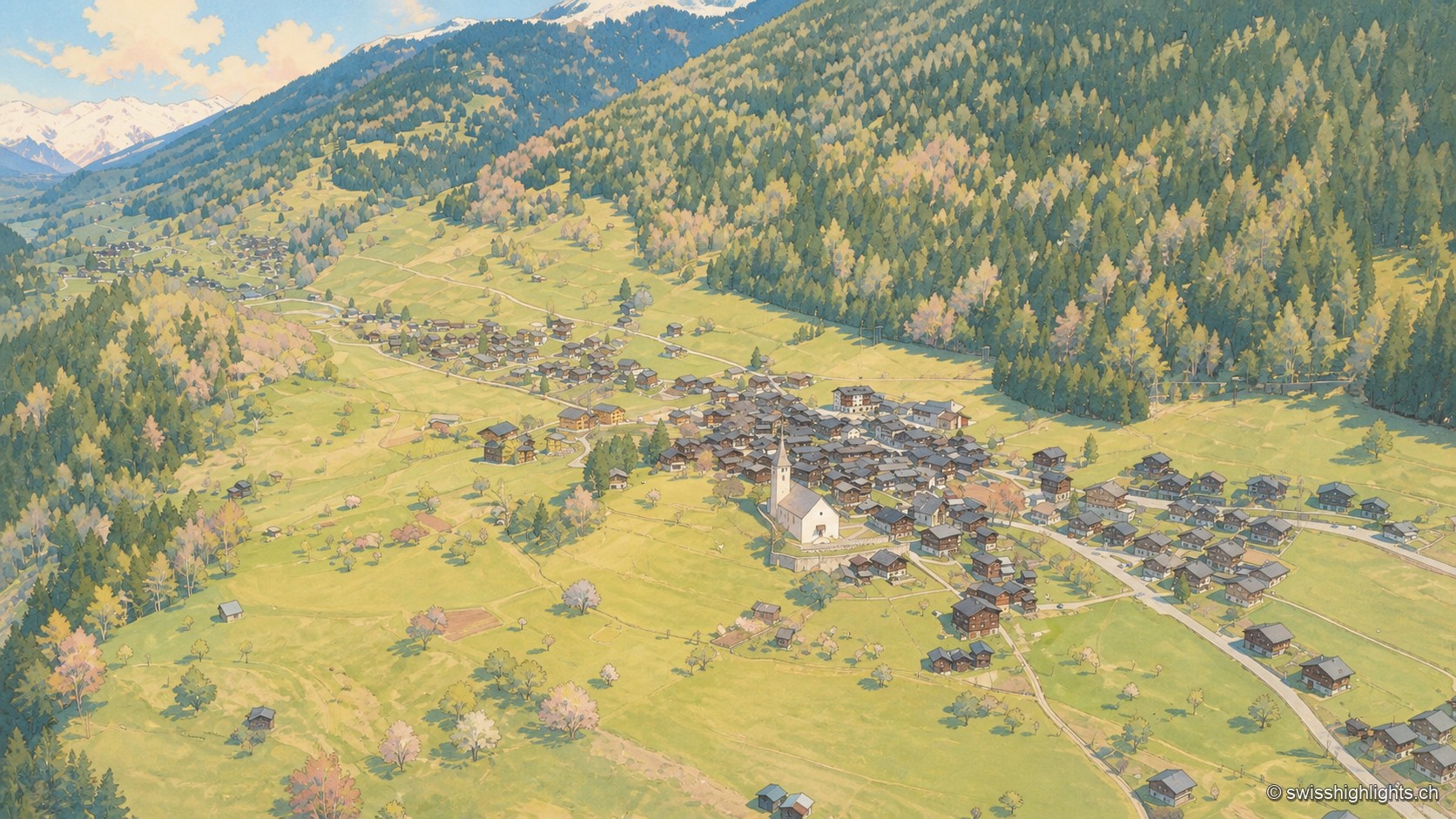
An aerial view of the village of Ernen in spring: the brown houses clustered around the white church occupy a terrace of short grass, bordered above by a larch forest and open on the left to the Rhône valley and snow-capped peaks.

Goms village · Valais

Ernen

Around a square lined with houses dated from 1511 to 1762 stand a church whose choir was finished in 1518 and the Tellenhaus of 1576, which carries a William Tell scene painted in 1578.
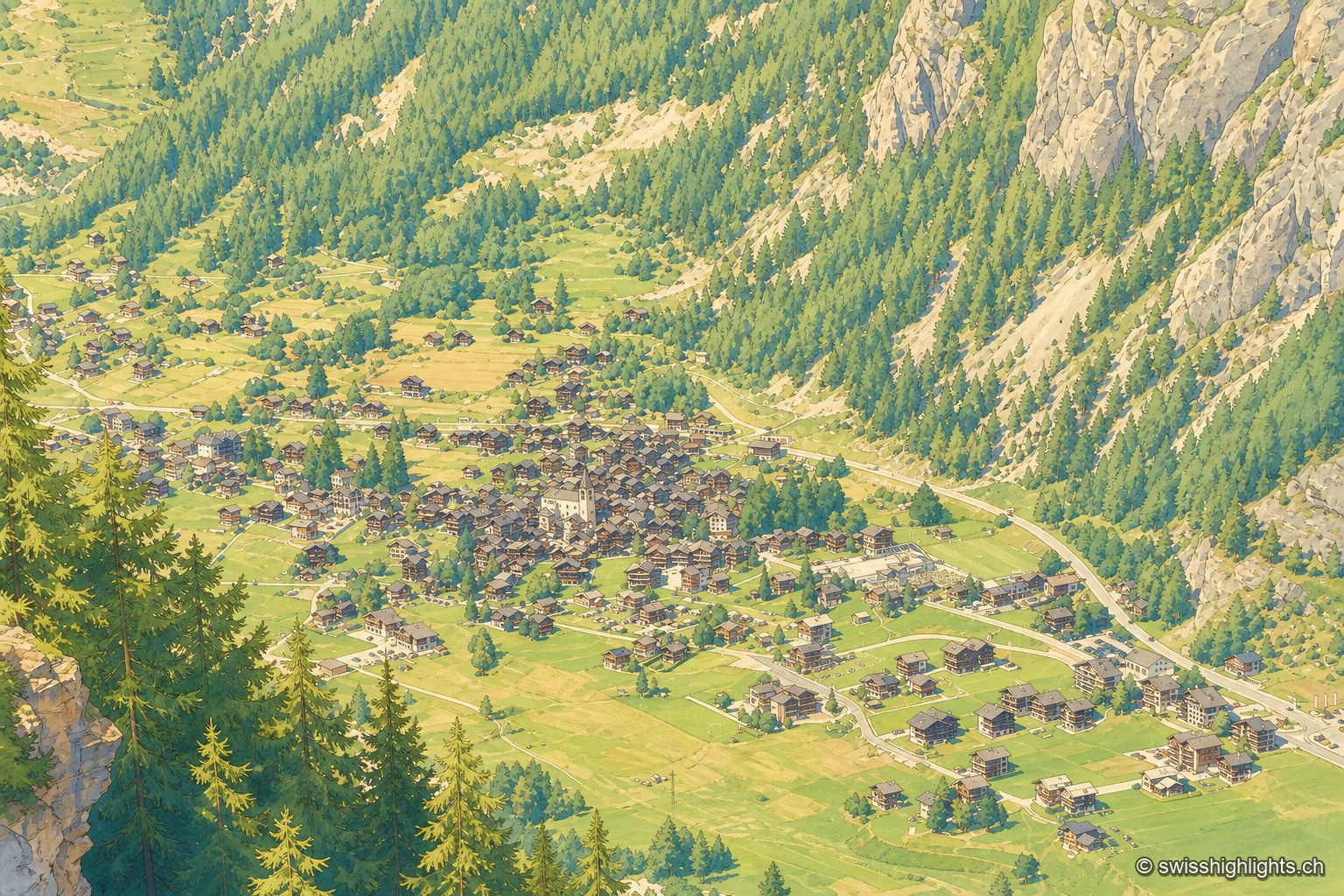
High-angle view over the village of Évolène nestled at the bottom of a deep valley: browned larch-wood houses clustered among green meadows, with wooded slopes and steep rock walls on either side.

Mountain village · Valais

Évolène

Nearly 800 inhabitants, a main street of timber houses on stone bases, a parish whose first church dates from 1446. With no carriage road before 1862, the village kept its dialect and its costume longer.
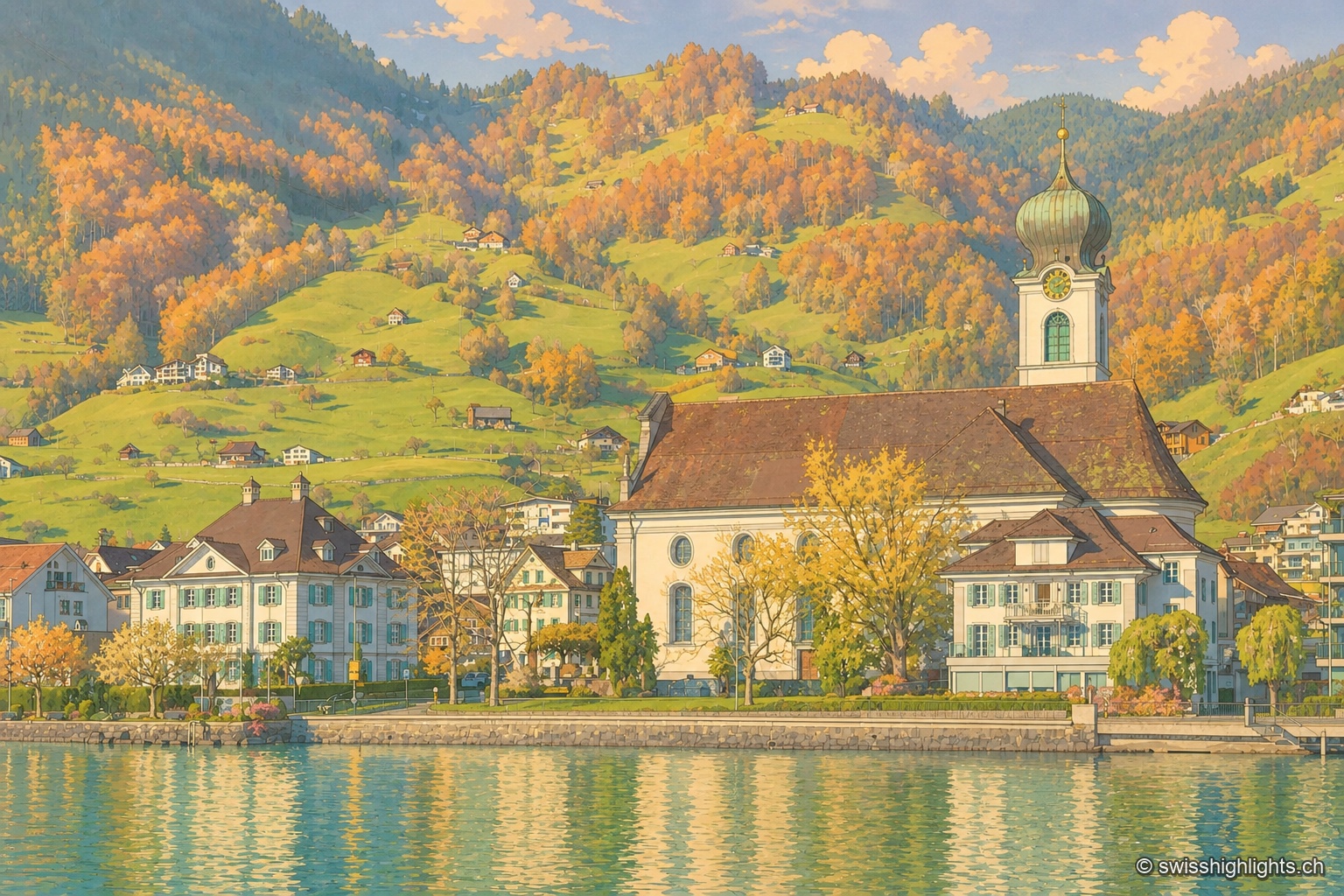
View from the shore of Lake Lucerne toward the parish church of Saint-Marcel in Gersau, with its green onion dome and golden clock tower; the white building with light-colored shutters, surrounded by a few village houses, is reflected in the calm water, beneath a wooded hillside in autumn colors rising toward the Rigi.

Former republic · Schwyz

Gersau

Gersau was a sovereign republic from 1390 to 1817, recognised by Emperor Sigismund in 1433; sheltered by the Rigi on Lake Lucerne, it keeps its mild climate and its church of St Marzellus, attested from 1179.
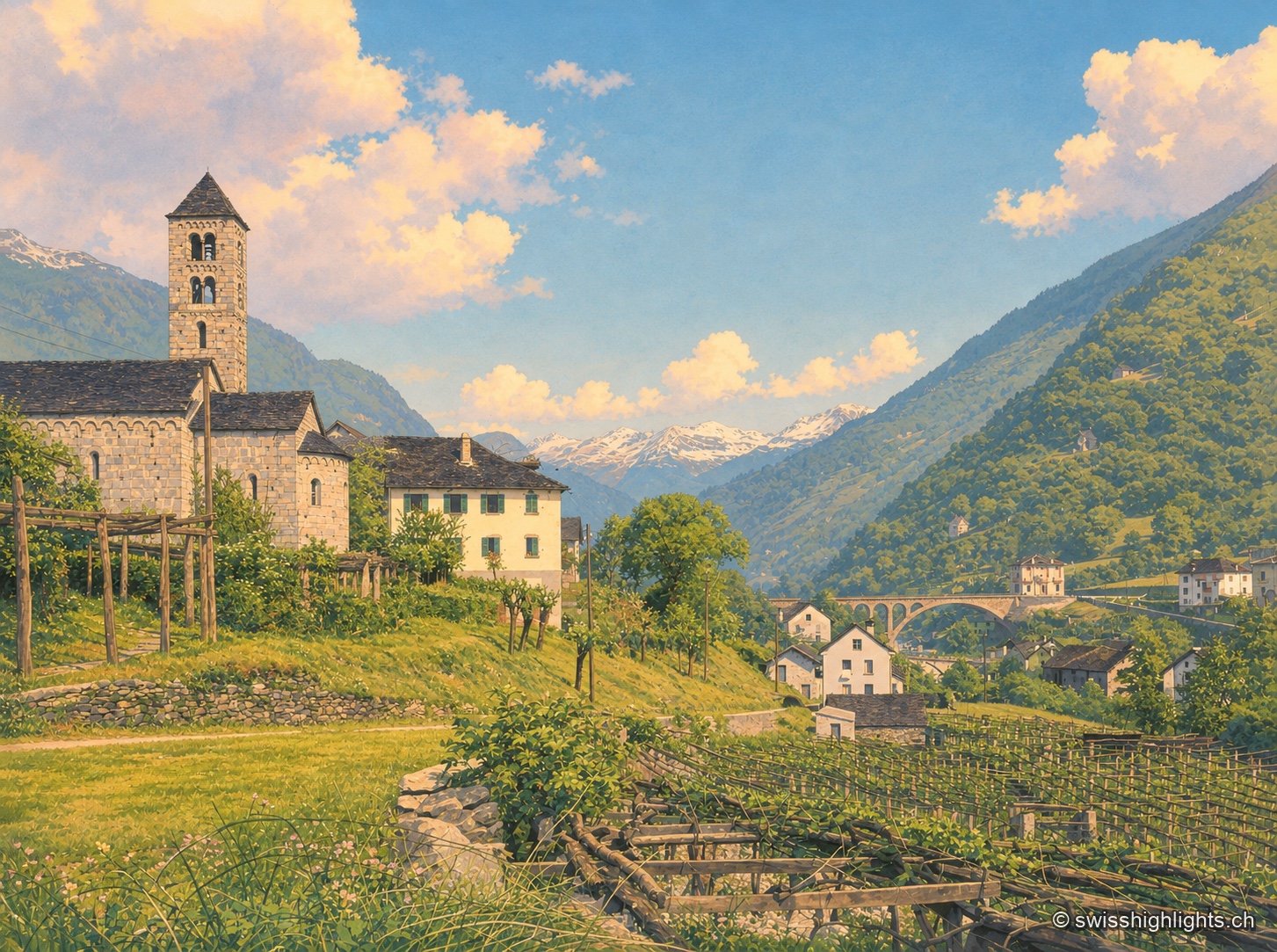
Old black-and-white photograph, taken from a vine-planted slope. On the left, a stone church with a rounded apse and square bell tower, pierced by narrow twin windows, overlooks vine pergolas and a few dark-roofed houses, including a large light-colored building with shutters. At the center, the valley opens toward a snow-capped range, under a sky where large cumulus clouds are building. On the right, a stone bridge with a large arch spans the riverbed in front of a wooded slope and a few houses. In the foreground, low rows of vines and wooden stakes.

Ticino village · Leventina

Giornico

The river holds an island here, reached by two bridges of the Middle Ages. Apart from the village, the La Congiunta museum, built by Peter Märkli, contains nothing but reliefs and sculptures by Hans Josephsohn, made between 1950 and 1991.
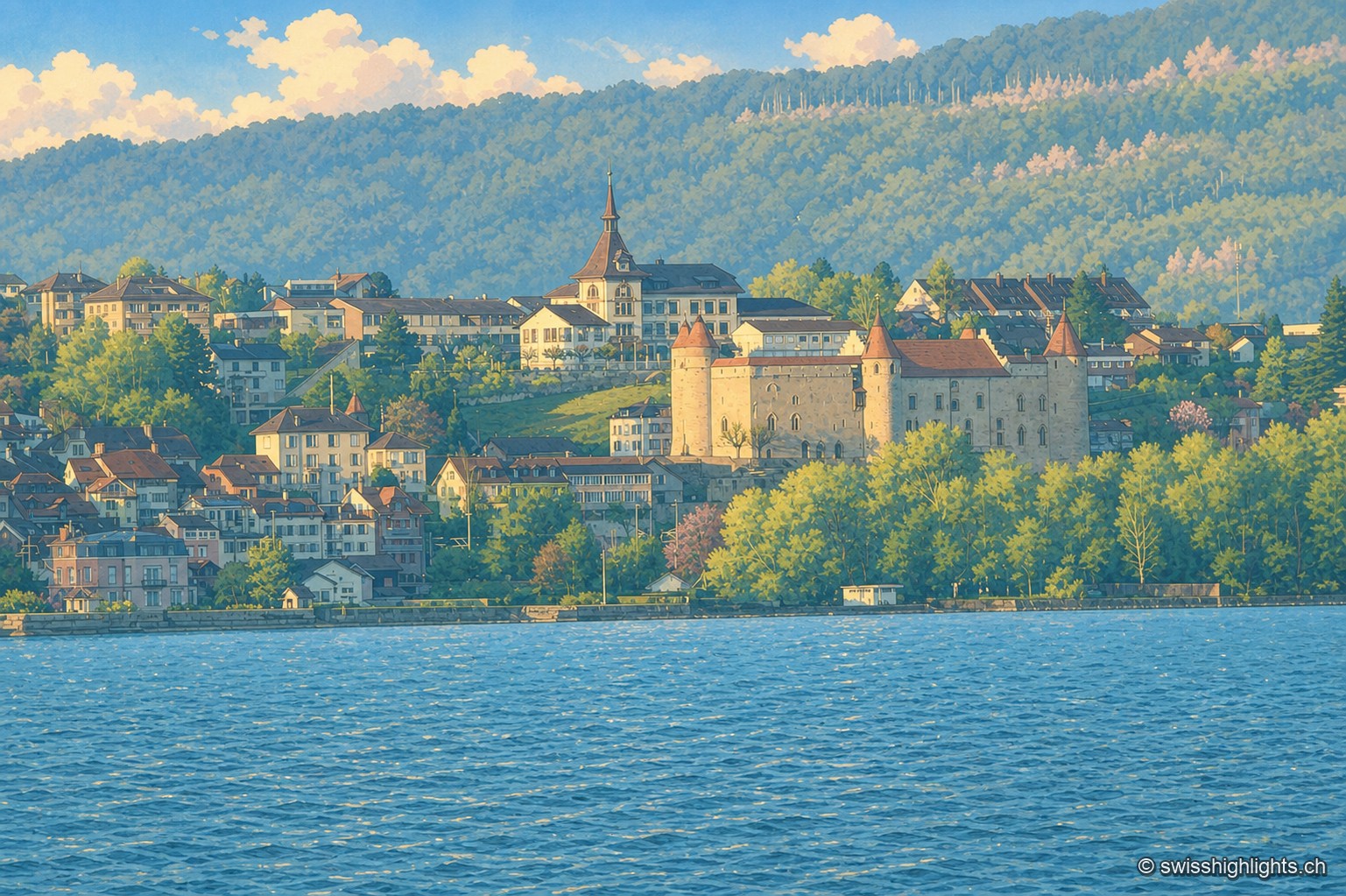
View of the town of Grandson from the opposite shore of Lake Neuchâtel, at the end of the day: the medieval castle, with round turrets and a red roof, overlooks the shore, surrounded by the village rooftops and the pointed spire of the church; in the background, a wooded hillside extends under golden light, and a bird flies over the calm water in the foreground.

Historic town · Vaud

Grandson

The castle of Grandson, at the centre of the town, overlooks the shores of Lake Neuchâtel where the Confederates defeated Charles the Bold on 2 March 1476; Grandson has belonged since 2016 to the Most Beautiful Villages of Switzerland.
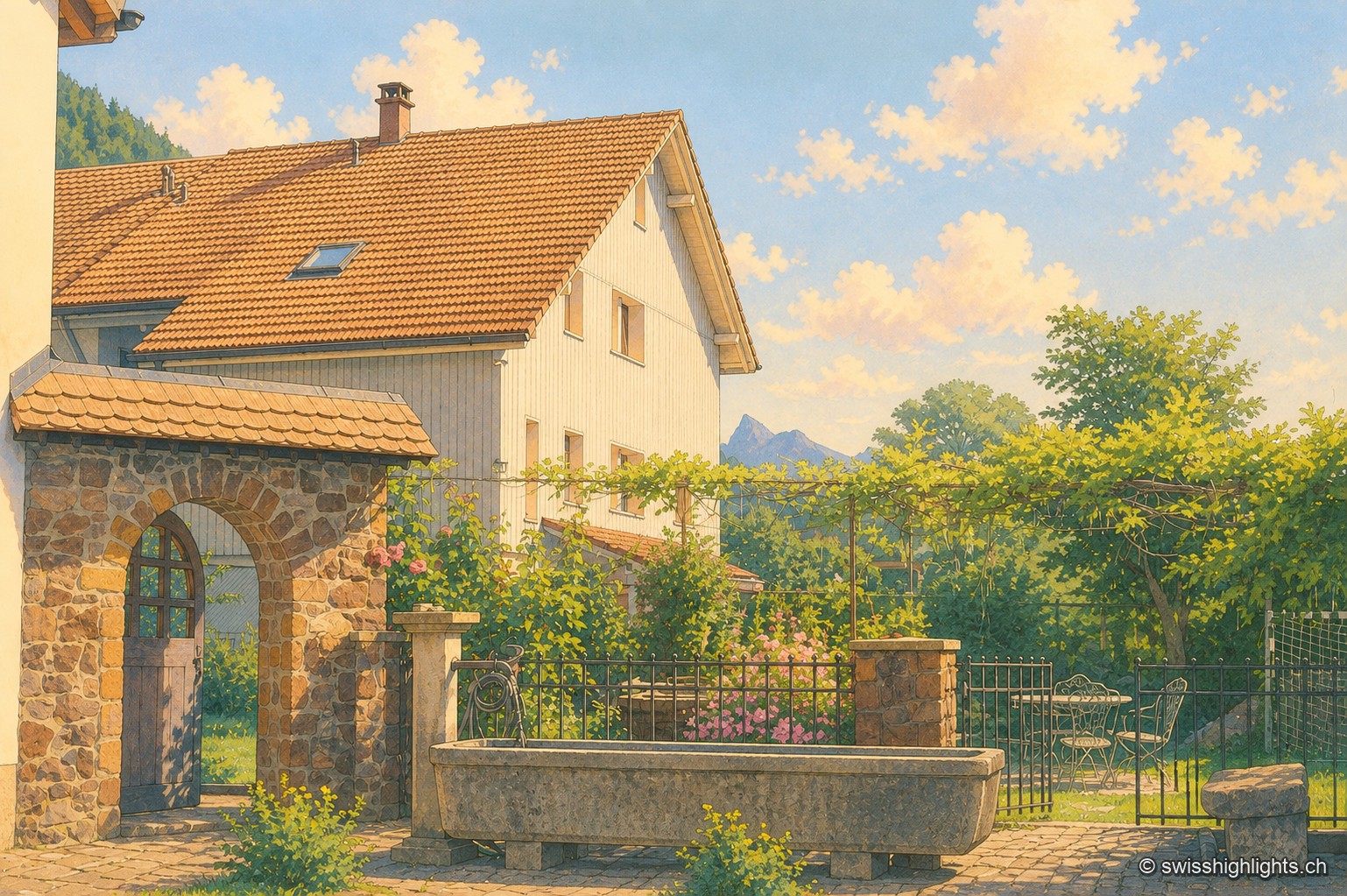
Farmyard in Grandvillard: a round-arched stone porch under a tiled lean-to roof, a climbing rose on a wooden pergola, and an old stone trough in front of a wrought-iron gate; in the background, the white, tile-roofed facade of the house and a peak of the Fribourg Prealps stand out under a summer sky.

Listed village · Gruyère

Grandvillard

Freed from mainmorte in 1388, the commune obtained its charter of liberties in 1439. The present church was consecrated in 1603, the bridge over the Sarine built in 1641. Since 2019, among the Most Beautiful Villages of Switzerland.
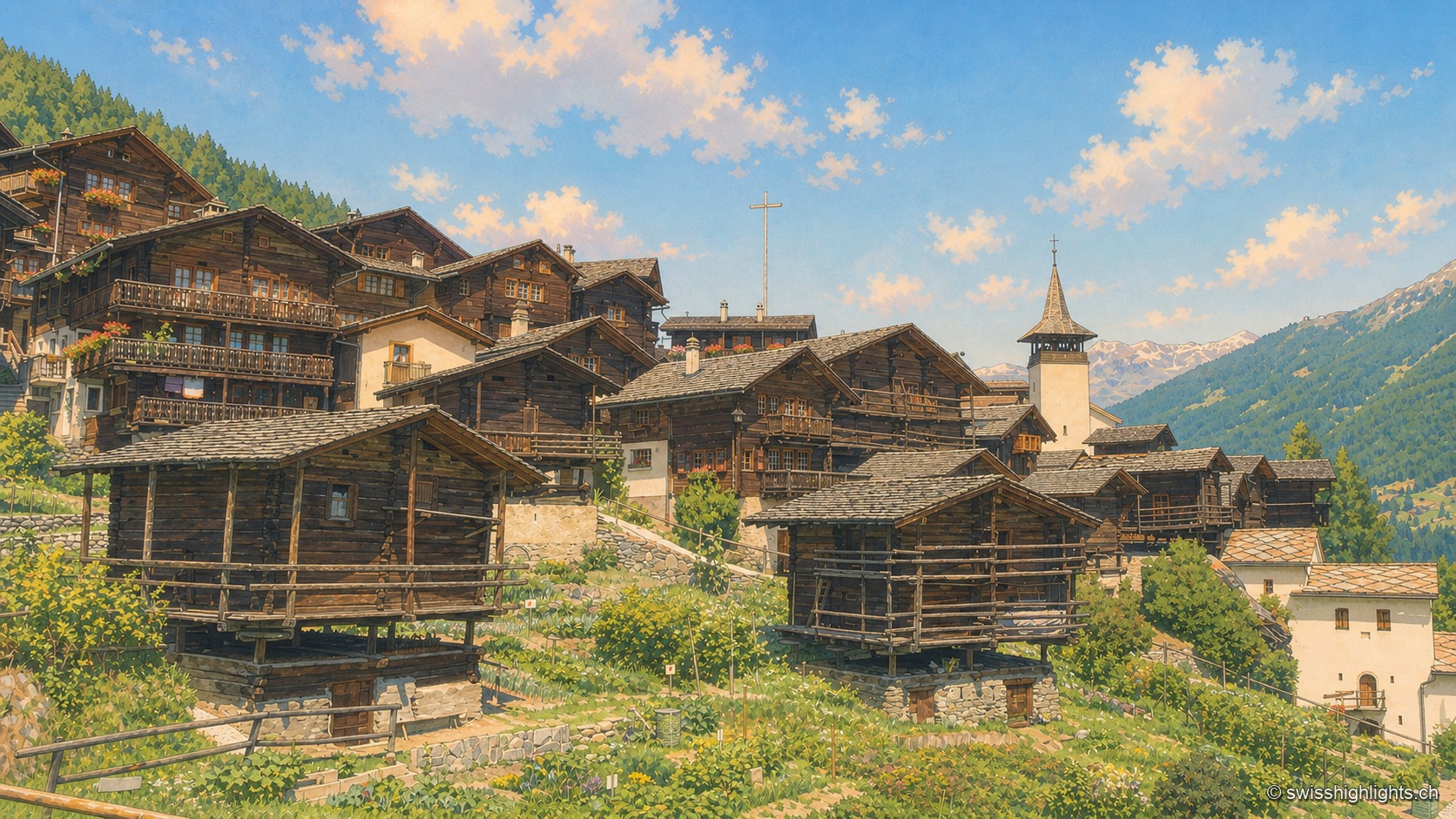
The village seen from the bottom of its slope, in full summer: in the foreground, two blackened wooden granaries (raccards) resting on their stilts and round stone slabs, above vegetable gardens; behind them the larch-wood houses rise in tiers, balconies laden with red geraniums, up to the church's white pointed spire and the tall mission cross jutting above the rooftops. To the right, the wooded slope of the Anniviers valley and a rocky ridge under a cloudless blue sky.

Valais · Val d'Anniviers

Grimentz

Grimentz holds its slope at 1,572 metres above the Val d'Anniviers. Raccards on stilts stand beside the Maison Bourgeoise of 1550, in whose cellars the vin du Glacier ages.
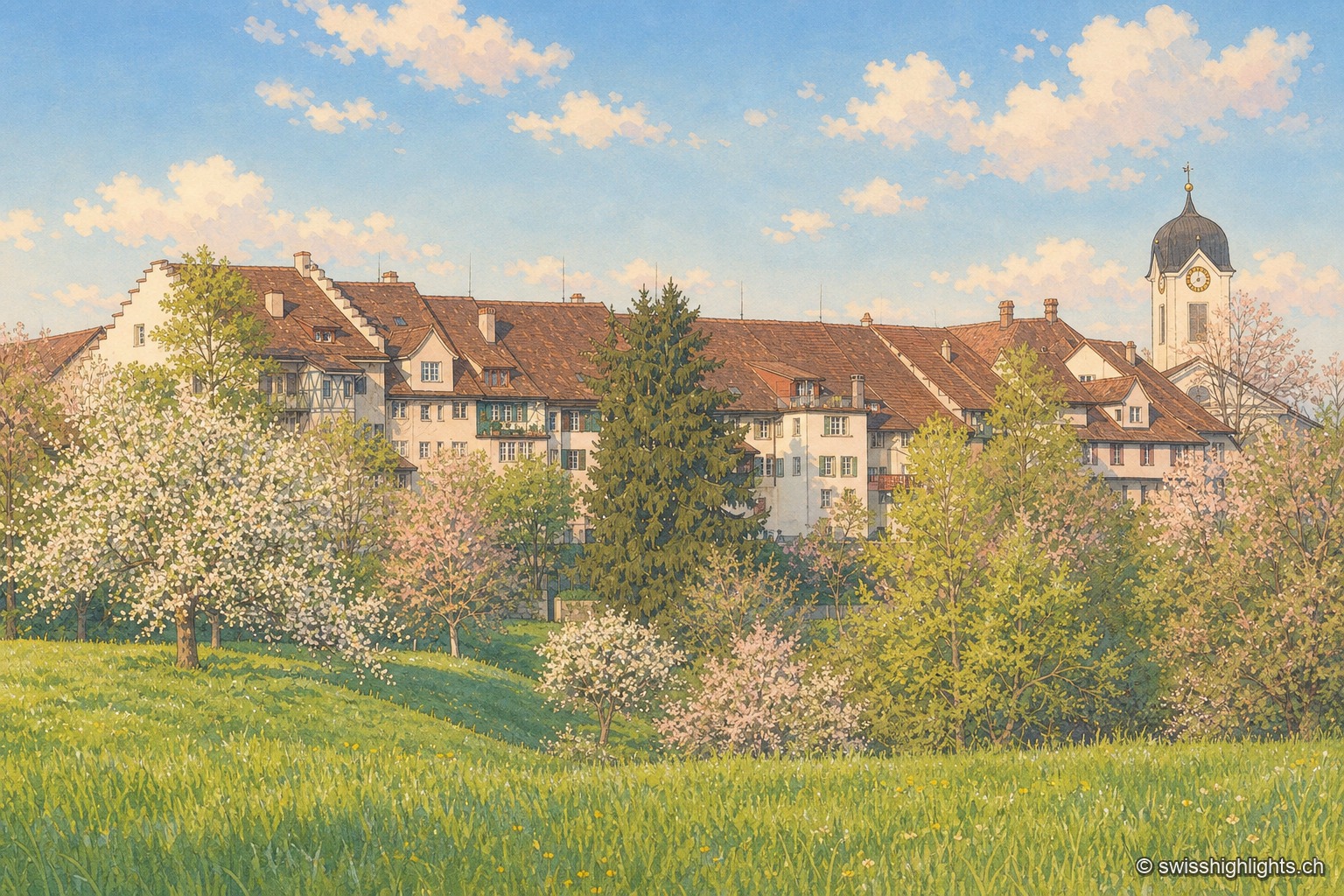
The town of Grüningen seen from a flowering meadow: a row of red-tile-roofed houses stretches behind trees in white blossom, dominated by the onion-domed church steeple, under a blue sky dotted with clouds.

Bailiwick town · Zurich

Grüningen

The castle goes back to the 13th century and housed the Zurich bailiffs until 1798; the Reformed church beside it dates from 1782-1783. A fire struck both in 1970. The commune received the Wakker Prize in 1976.
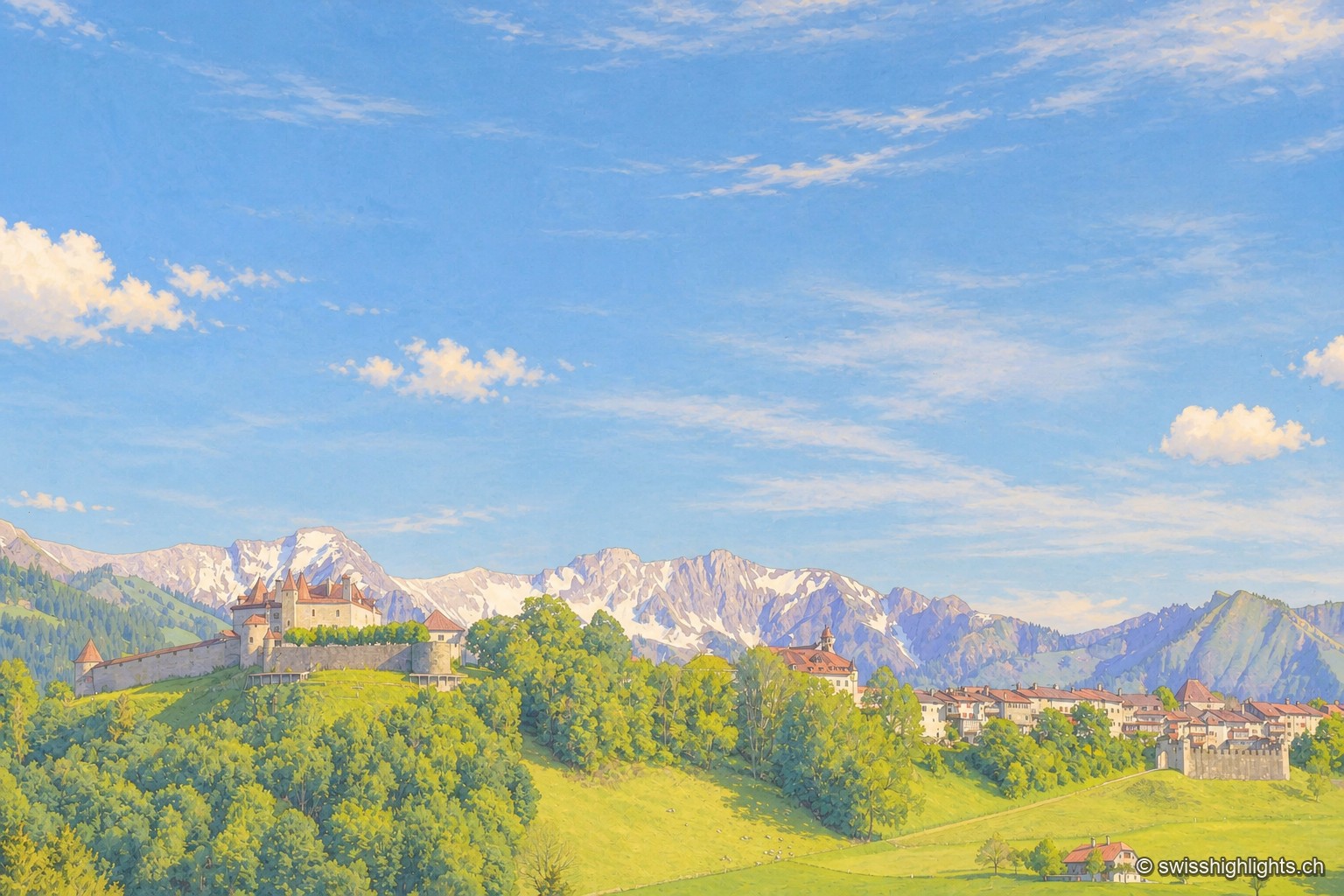
View of Gruyères and its castle perched on a green hill surrounded by ramparts, with the snow-capped peaks of the Fribourg Prealps standing out on the horizon under a blue sky streaked with clouds.

Medieval small town · Fribourg

Gruyères

2,339 inhabitants, a castle shaped by eight centuries of building, a museum of Tibetan art and another devoted to H. R. Giger: Gruyères sits on a rocky spur, its territory ranging between 693 and 2,002 metres.
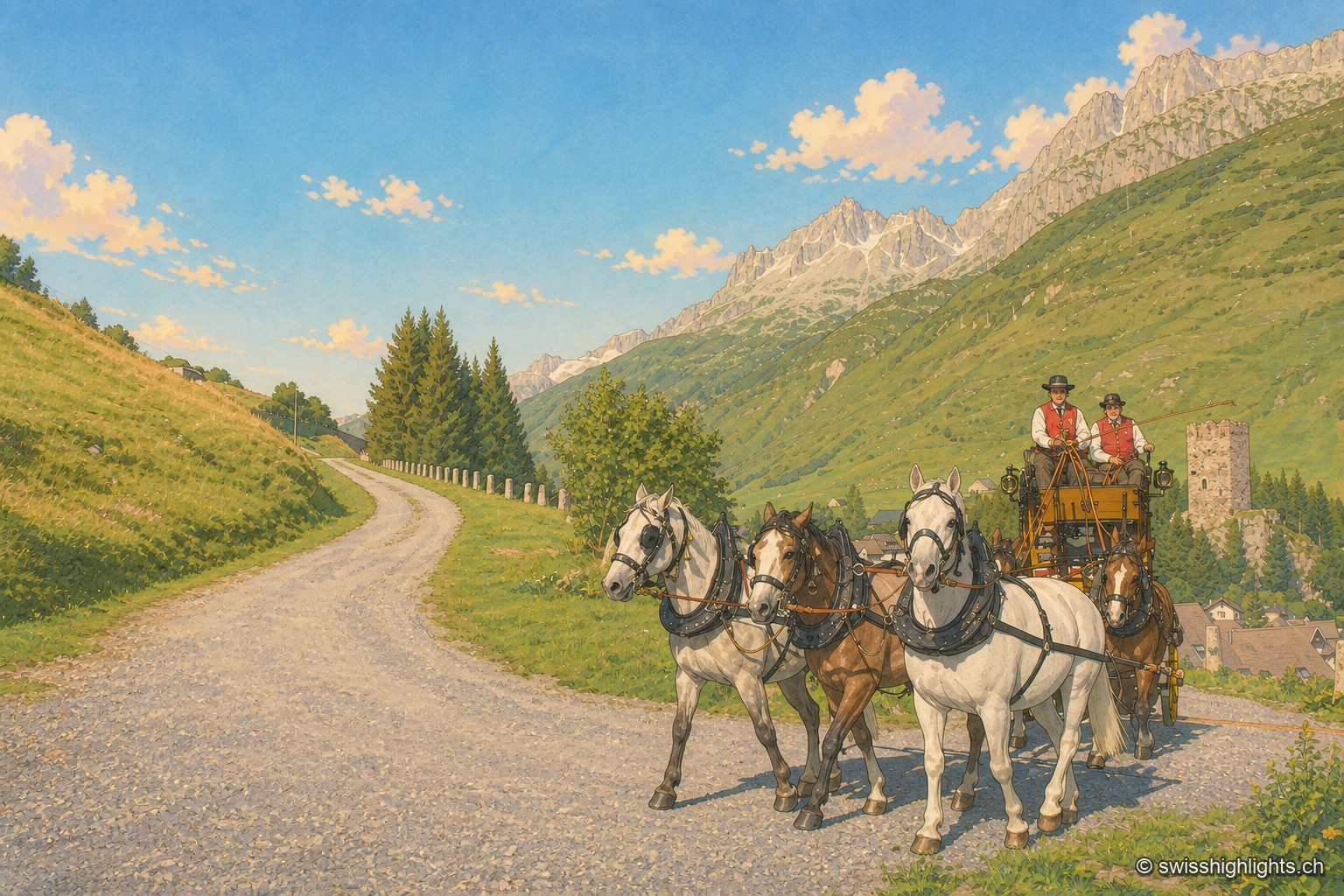
A team of five horses, three dappled grey and two bay, pulls a yellow-and-black stagecoach along a gravel road descending into the Urseren valley; two postilions in red waistcoats and black hats hold the reins. On the right, the ruined square tower of Hospental stands on a grassy knoll above the village rooftops; in the background, rocky ridges and snowfields close off the valley under a cloudless blue sky.

Gotthard village · Uri

Hospental

182 inhabitants, a 13th-century tower emptied of its floors, timber houses rebuilt after the fire of 1669: Hospental stands where two torrents meet to become the Reuss.
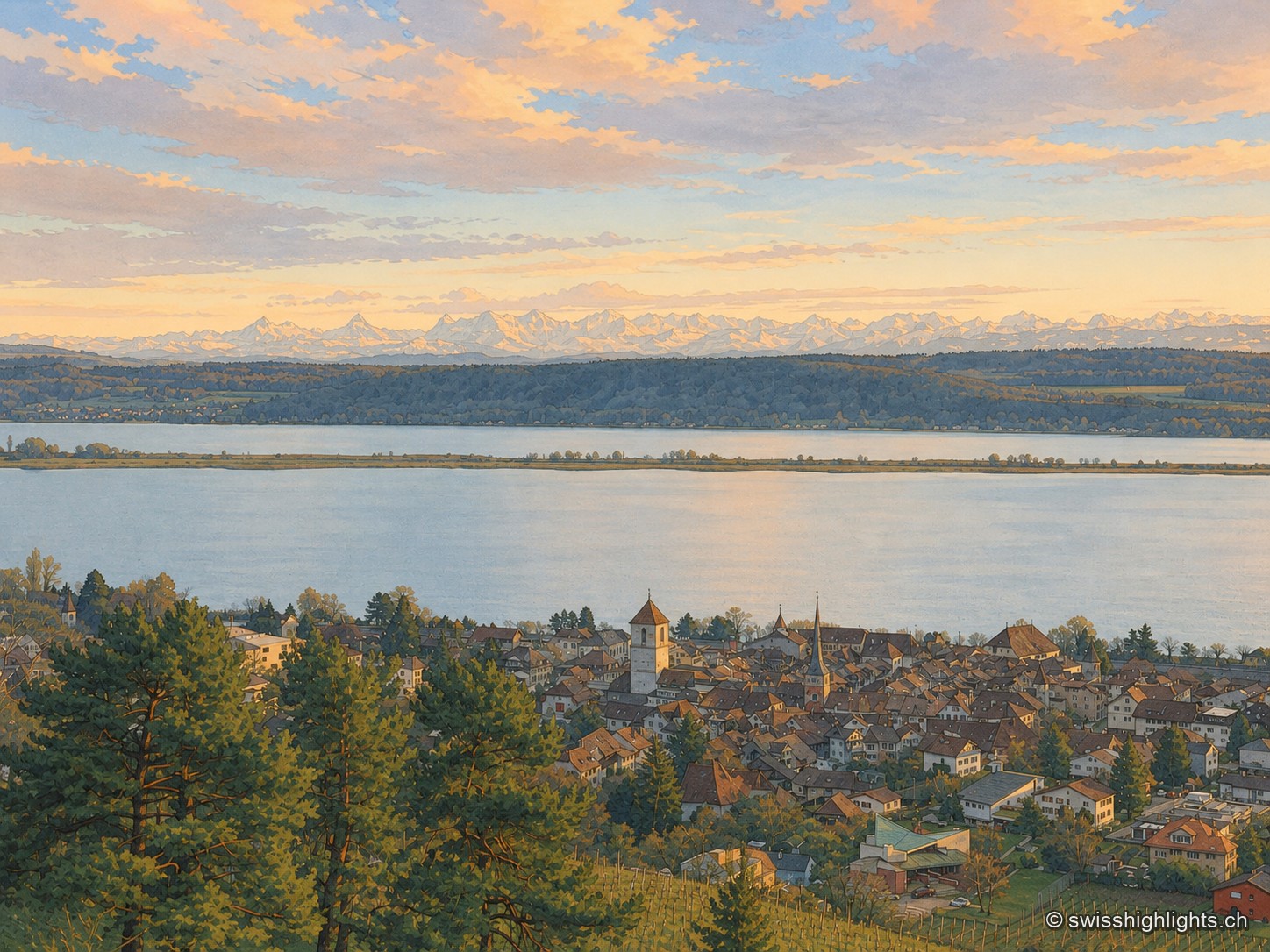
La Neuveville seen from above, from the vineyard, at dusk: the brown roofs of the old town and its two church towers huddle at the edge of Lake Biel, its pale water crossed by the Heidenweg dike; in the distance, under a pink and grey sky, the snow-capped Alps close the horizon. A large pine tree occupies the foreground on the left.

Medieval town · Lake Biel

La Neuveville

Cobbled streets, fountains and coloured shutters between water and vines. The Schlossberg holds the cliff above the roofs; outside the walls, the Blanche-Église keeps frescoes from the 14th and 15th centuries.
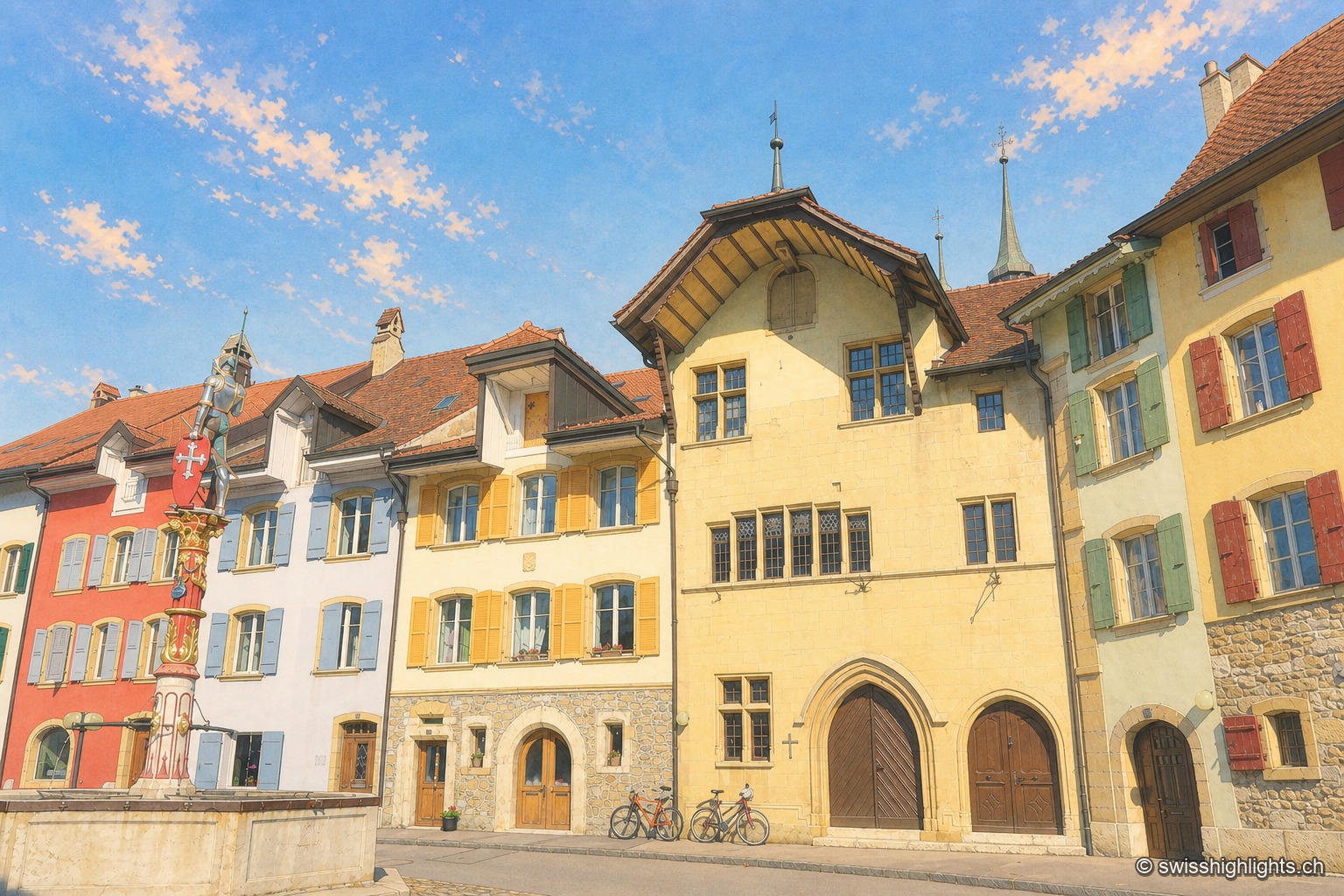
Cobbled street of the town of Le Landeron under a deep blue sky: on the left a red and white heraldic fountain set against a white façade, then a row of pastel-toned houses — yellow, ochre, almond green — up to the Town Hall with its overhanging gable and gothic arched doors, against which several bicycles are leaning.

Fortified town · Neuchâtel

Le Landeron

Catholic while the whole county of Neuchâtel turned Protestant between 1530 and 1562, Le Landeron owed its confessional enclave and its fortified town to the backing of its allies from Solothurn, bound by treaty since 1449.
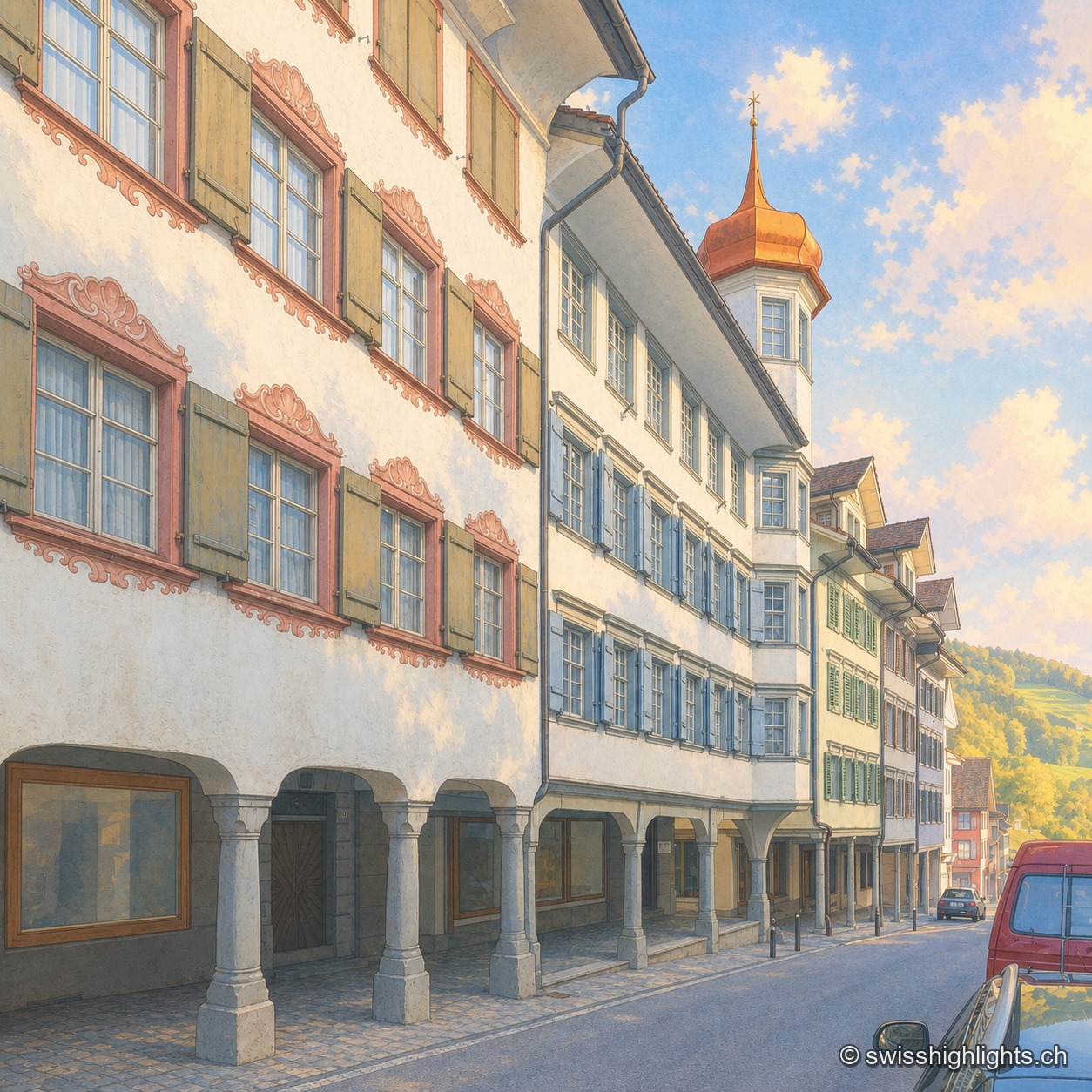
The Hauptgasse in Lichtensteig at the end of the day, in raking golden light: painted facades with colourful shutters and arcades on stone pillars in the foreground; in the centre, a golden onion-domed tower with a red conical roof crowns the former district building (Bezirksgebäude); the cobbled street descends toward more old houses.

Medieval small town · St Gallen

Lichtensteig

Recorded in 1228, the town gained charters of liberties from 1400. The county passed to the Abbey of St Gallen in 1468, which stationed its reeve there until 1798. Wakker Prize 2023, it joined Switzerland's Most Beautiful Villages in 2016.
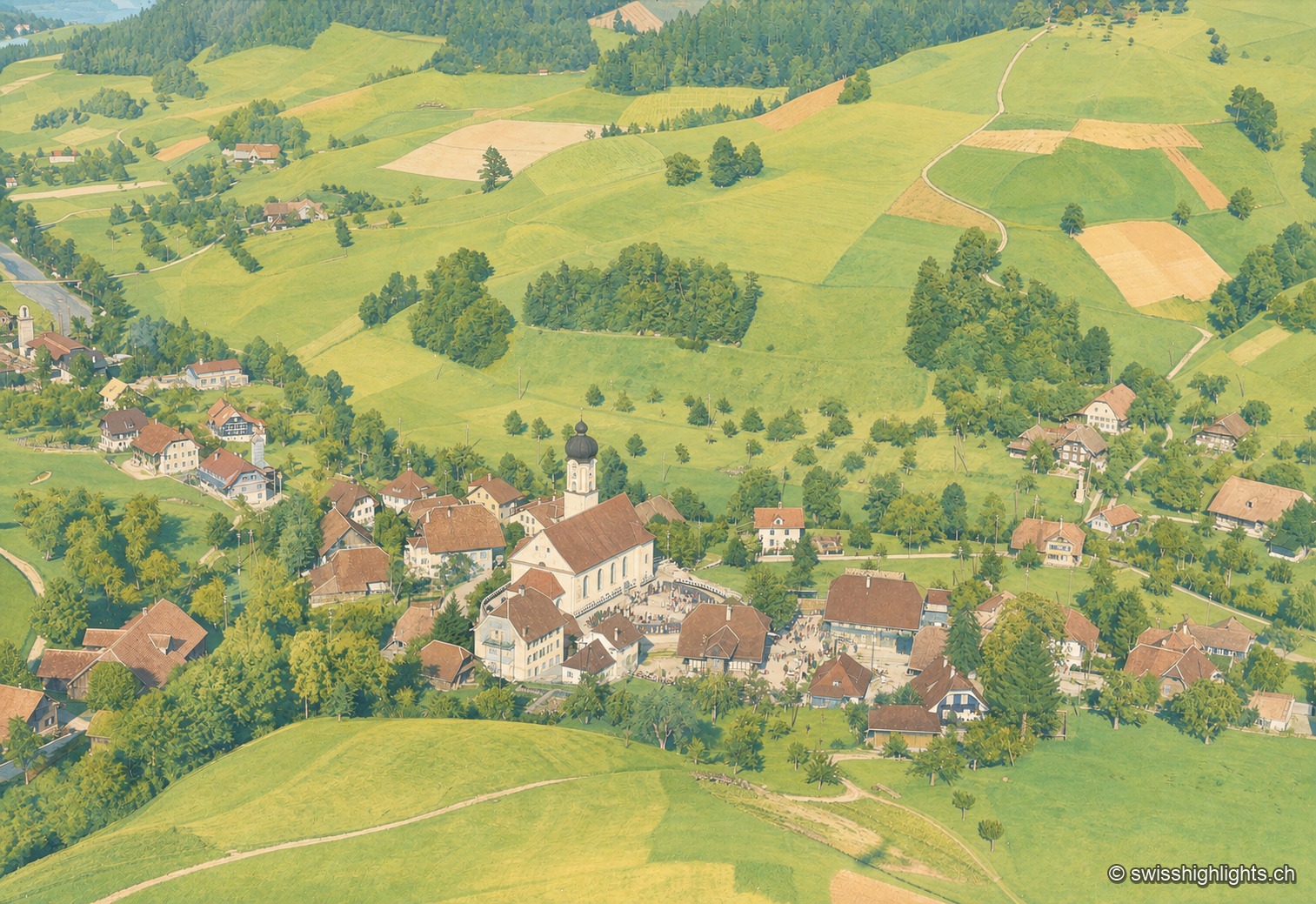
Colorized historical aerial view of Luthern: the village, clustered around its church with a black onion-domed spire, occupies a clearing amid a checkerboard of meadows and groves, nestled in the green hills of the Napf.

Pilgrimage village · Lucerne

Luthern

The church of St Ulrich and the buildings around it form a core raised in one movement between 1752 and 1781. Four kilometres higher up, a spring and its chapel of 1583 still draw pilgrims.
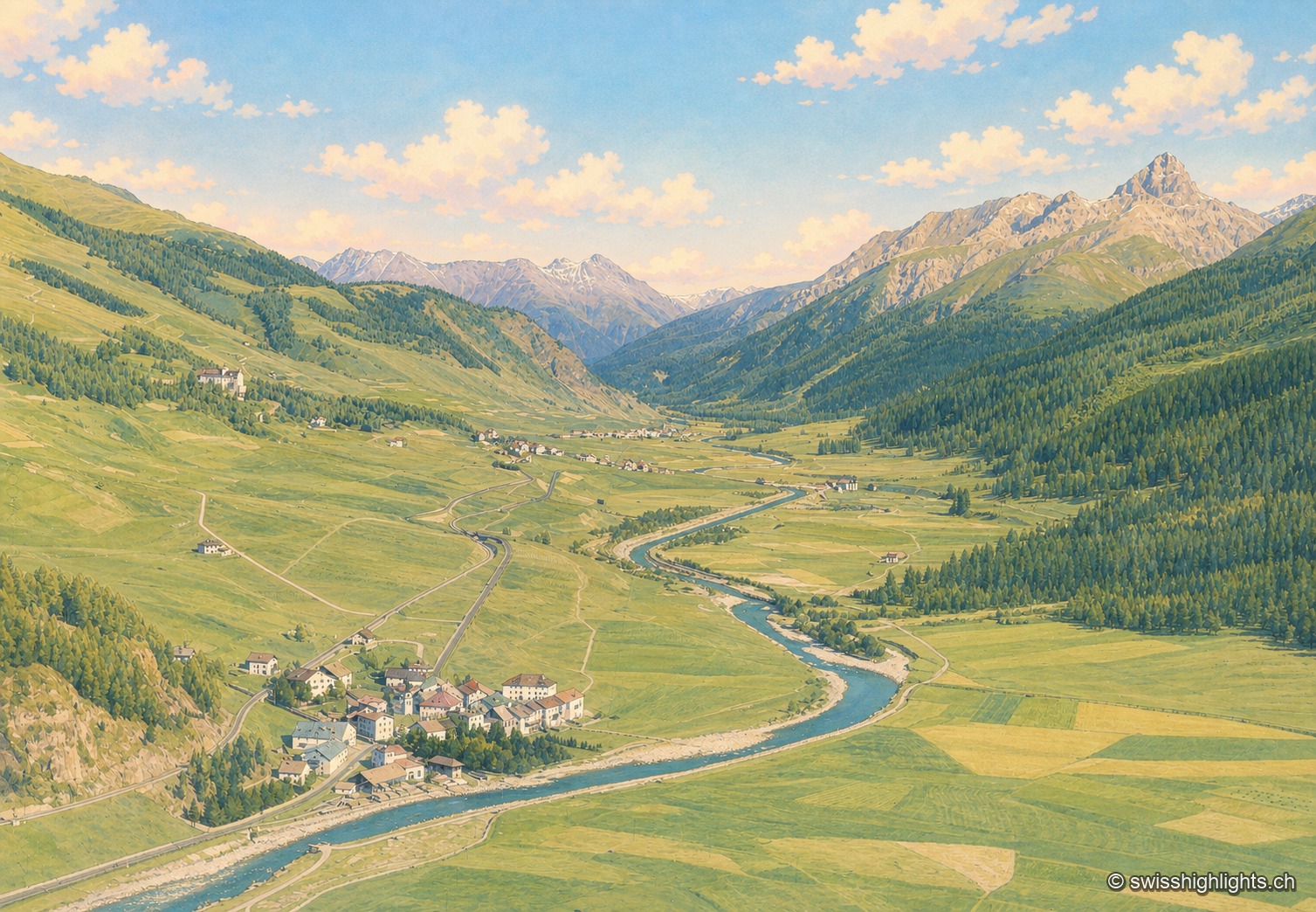
Colorized historical aerial view of the Engadine valley at Madulain: the village lines the Inn river as it winds between meadows, overlooked by wooded slopes and a chain of rocky peaks under a summer sky.

Village · Upper Engadine, Grisons

Madulain

First recorded in 1137-1139 as Madulene, the village is overlooked by the ruins of Guardaval Castle, built in 1251 for the Bishop of Chur. Madulain joined the Les Plus Beaux Villages de Suisse association in 2018.
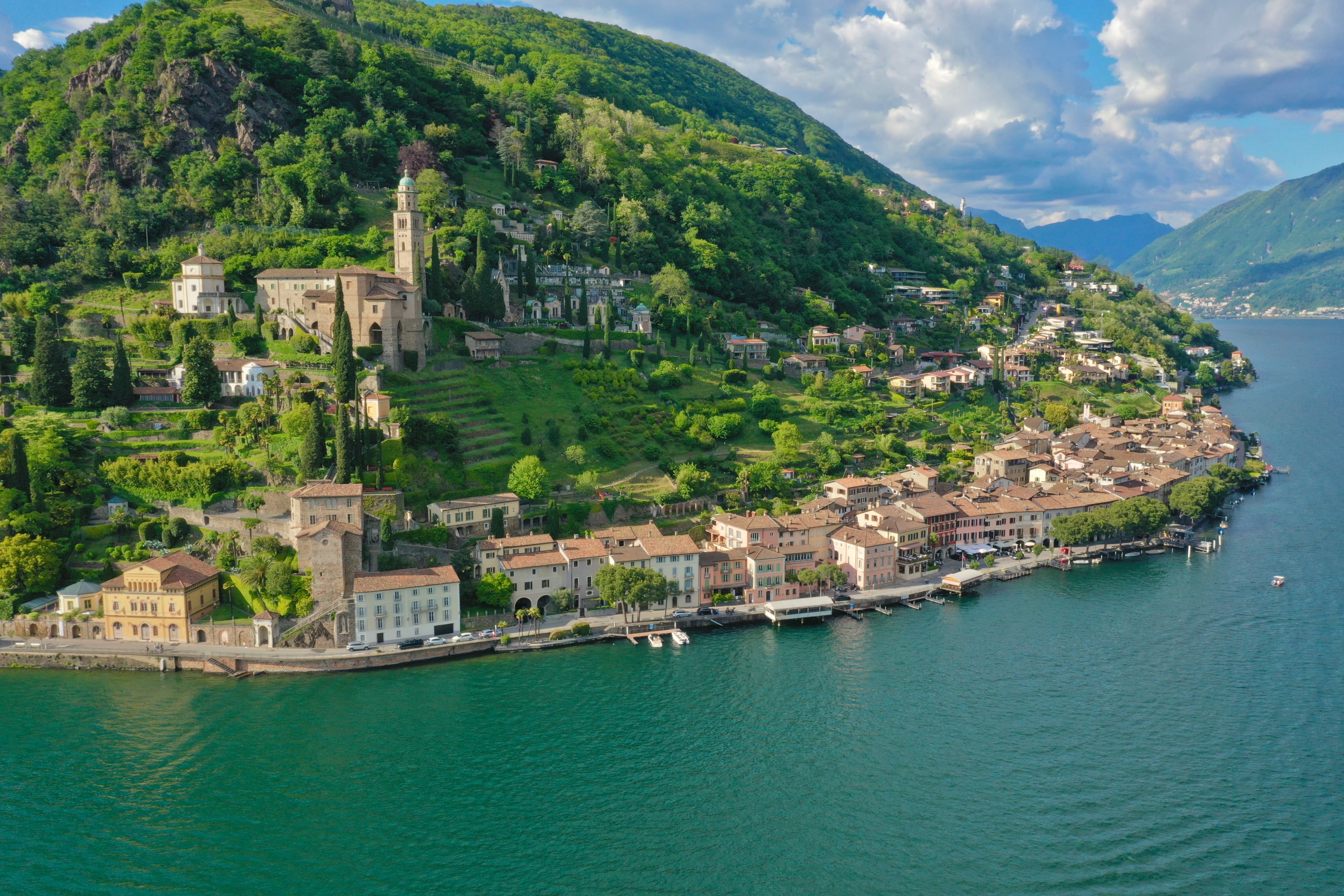
An aerial view of Morcote: the houses lined up along the shore of Lake Lugano, the church of Santa Maria del Sasso and its bell tower on the wooded slope above the village.

Ticino · Lake Lugano

Morcote

Morcote is strung along the shore of Lake Lugano, facing Italy. Above the roofs stands the church of Santa Maria del Sasso; between them, a stairway of 404 steps and a cemetery of 1750.
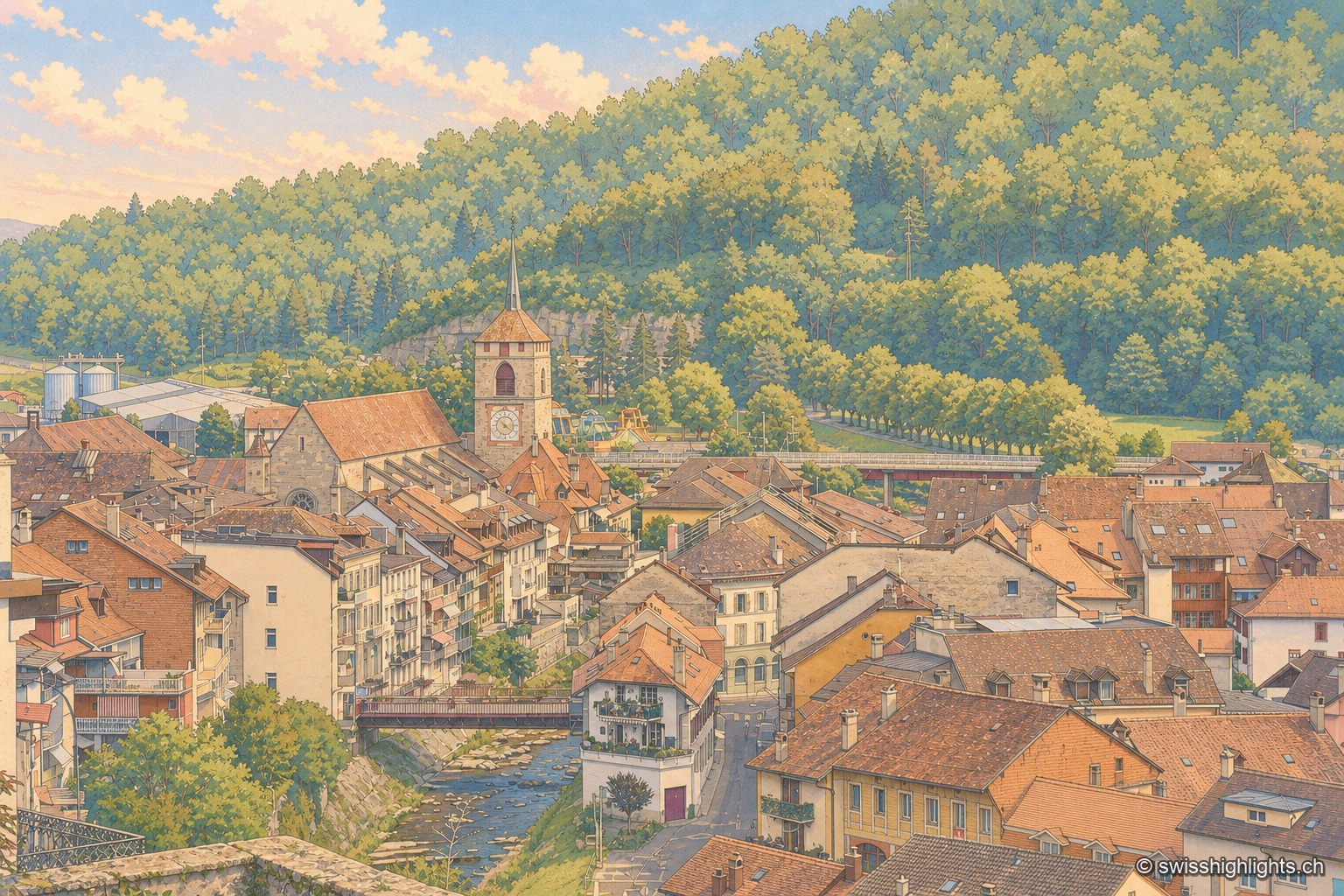
High-angle view over the old town of Moudon from the heights of the castle: the pointed spire of the Church of Saint-Étienne rises above the brown-tiled roofs of the medieval town, nestled against a wooded hillside; in the foreground on the left, a section of castle wall and a wrought-iron railing; below, the Broye river runs alongside the lower town with its more recent buildings, spanned by a road bridge.

Fortified town on the Broye · Vaud

Moudon

Amadeus I of Geneva built a castrum here around 1127; the Savoys installed the Vaud bailiwick around 1260. Under Bern from 1536, the town keeps its medieval old quarter, now an ISOS heritage site, above the river.
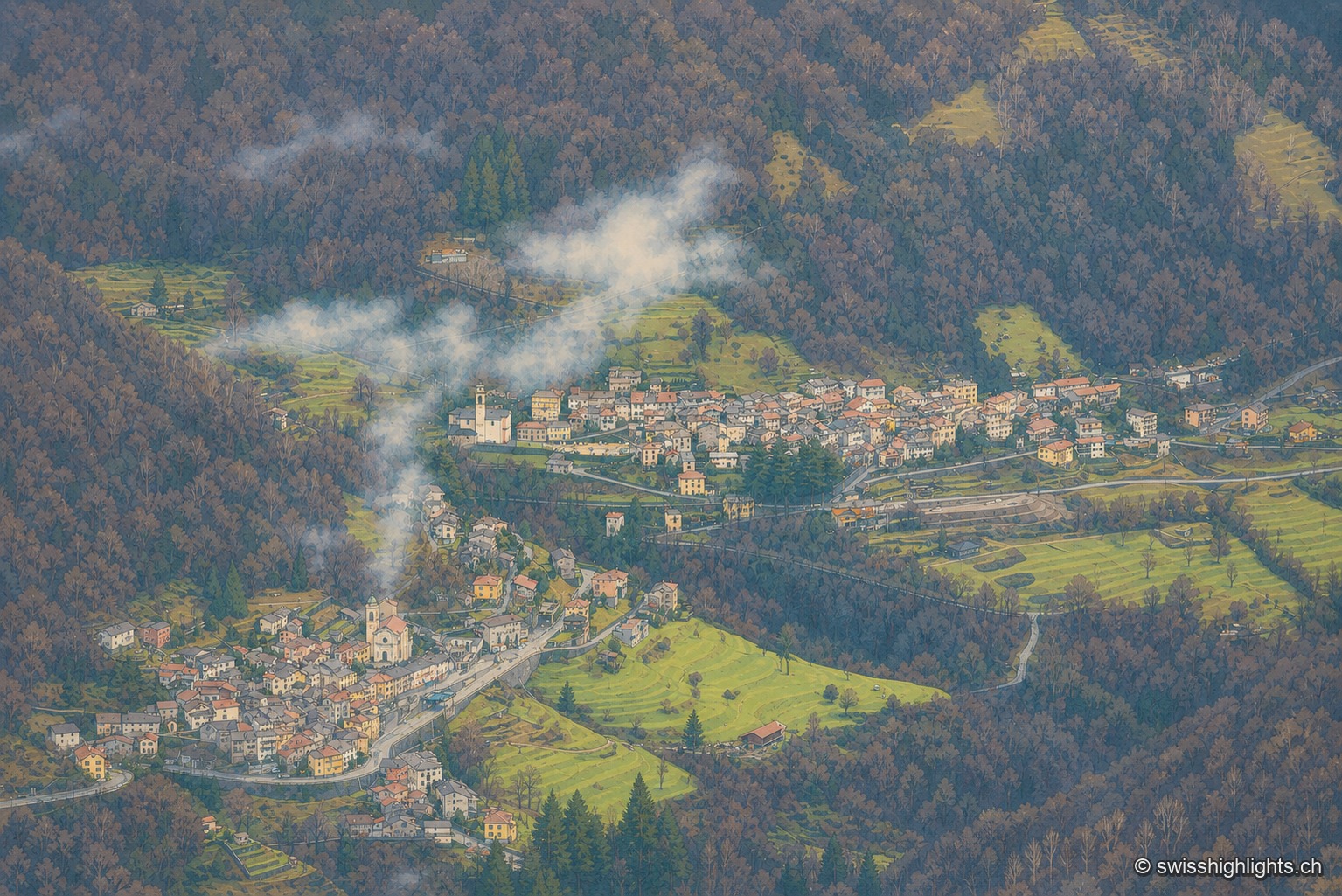
The Valle di Muggio seen from above, from the slopes of Monte Generoso: two villages with tightly packed roofs are terraced one above the other on the valley's flank, their church towers to the fore, surrounded by flat patches of green meadows and terraces; wisps of mist rise from the reddish late-autumn woods covering the rest of the slopes, and the raking light picks out the pale façades against the dark hillside.

Village · Valle di Muggio, Ticino

Muggio

Recorded in 852, it gave its name to the Valle di Muggio. In the fifteenth century its craftsmen cut the long oars of the Duchy of Milan's fleet; its church of San Lorenzo was rebuilt in 1760.
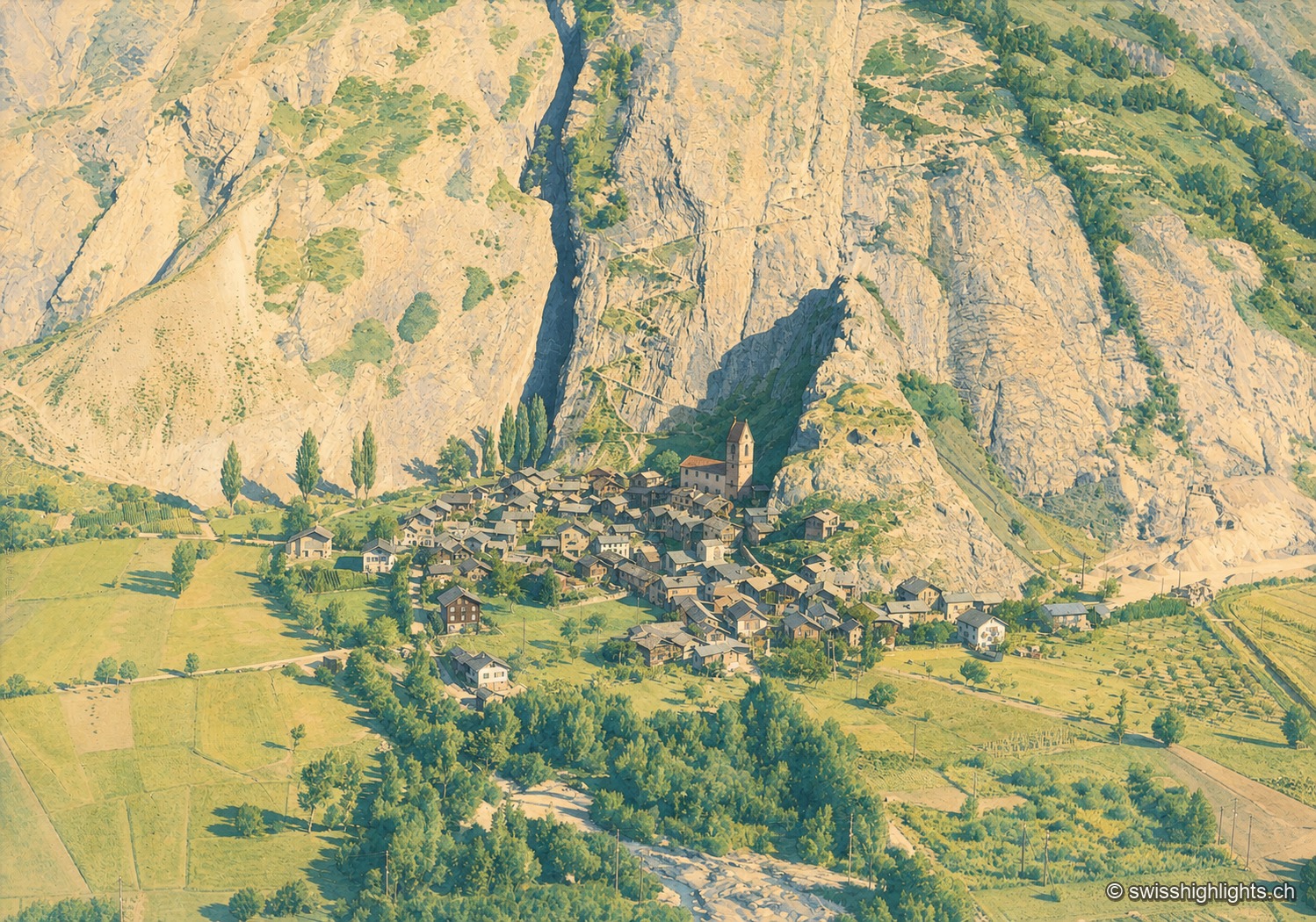
The village of Niedergesteln nestled at the foot of an immense rock face streaked with gullies, its pointed bell tower rising above the grey rooftops amid the meadows and orchards of the Rhone valley, in a soft historic tone.

Valais village · Western Raron

Niedergesteln

The name comes from the Latin castellum: a stone castrum once guarded the old road on the right bank. The Valais tithings destroyed the castle in 1384; the community bought back its rights in 1790.
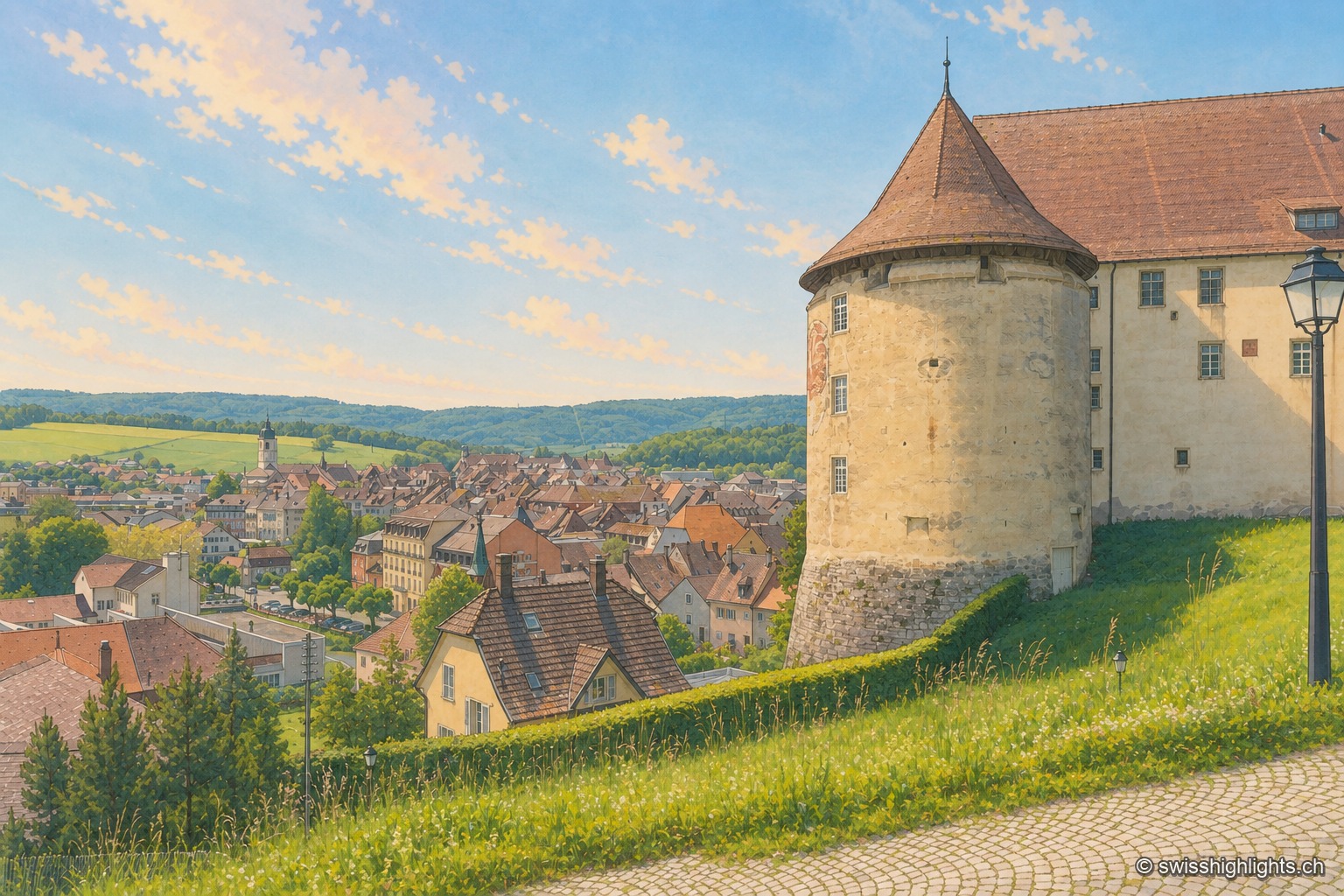
From the castle terrace, the large round tower with a conical roof occupies the right of the frame, against the long whitewashed building; below spread the brown and red roofs of the old town of Porrentruy, the light-colored church steeple, and behind them the wooded hills of the Jura under a pale blue summer sky.

Town · Ajoie, canton of Jura

Porrentruy

Driven from Basel by the Reformation, the prince-bishops settled in Porrentruy after 1528; their supposedly provisional residence lasted until 1828. Castle, Jesuit college, hôtel-Dieu and stone fountains still hold its measure.
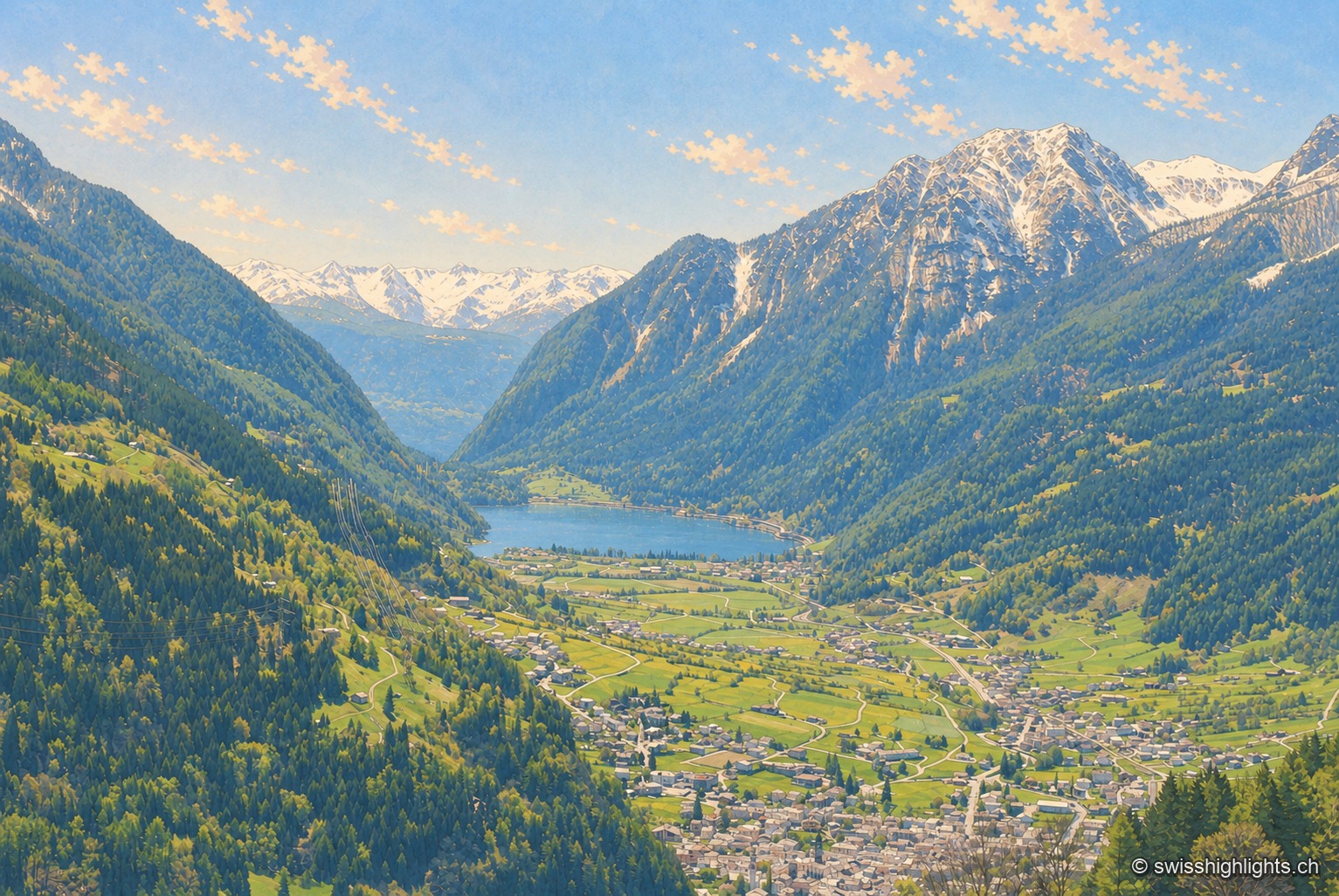
High-angle view over the valley from a wooded slope in spring: in the foreground the tightly packed roofs of the town of Poschiavo, then the valley floor forming a checkerboard of meadows and orchards crossed by roads and paths, an elongated dark lake in the middle, and beyond it the valley continuing southward between two slopes. On the right, a long, still snow-covered ridge descends in gullies to the forest; on the left, the slope remains in shadow. Clear sky.

Italian-speaking town · Grisons

Poschiavo

South of the Alpine watershed, Poschiavo looks to Italy more than to Switzerland: a Gothic collegiate church on a Romanesque base, the tower of the former Milanese bailiffs, a street of houses built by emigrants who came home.
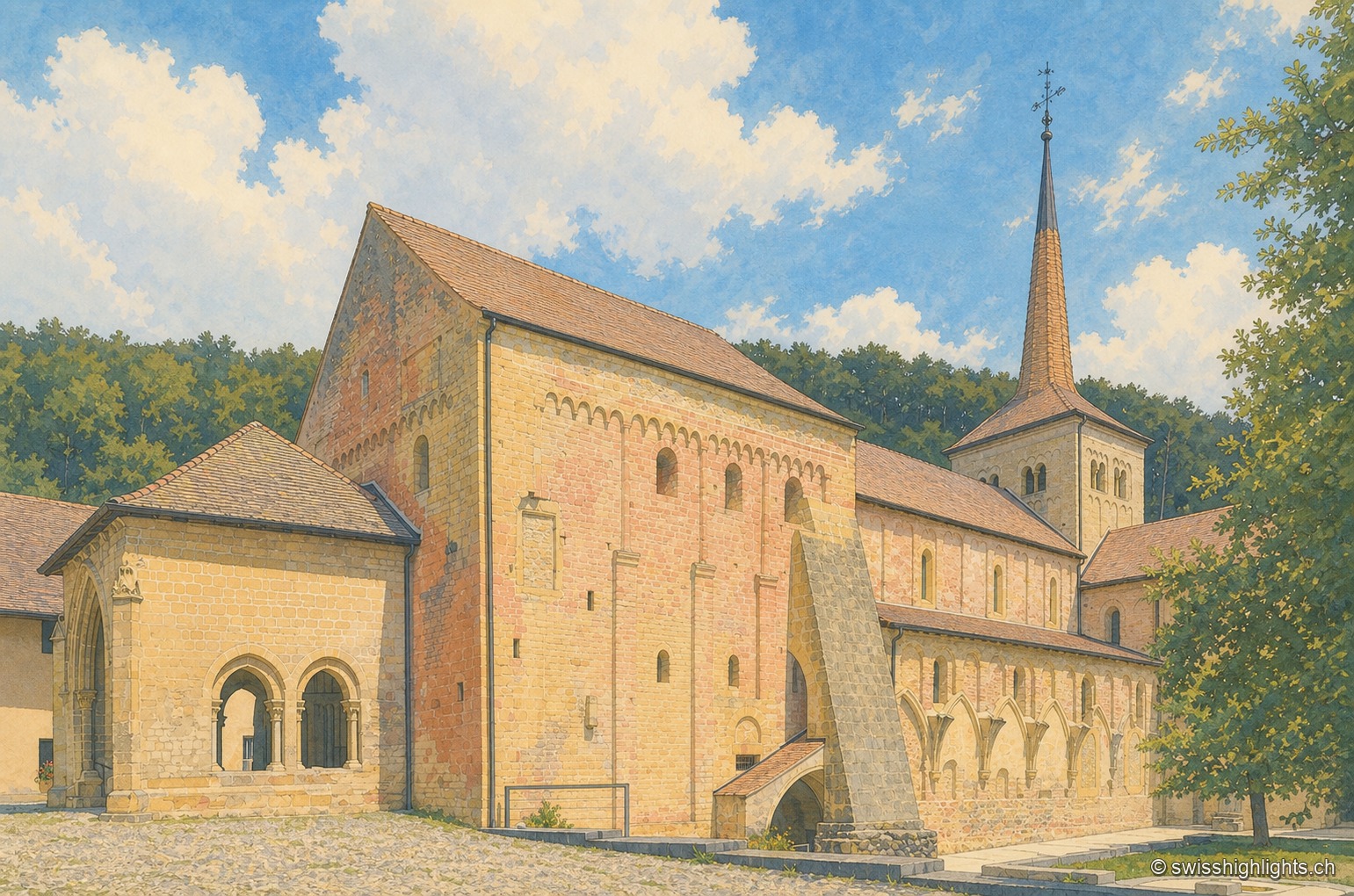
The former abbey church of Romainmôtier seen from the southwest on a summer afternoon: the tall gable of golden stone, marked by a frieze of blind arcades, is buttressed by a long slanting support; behind it stand the low nave, the gallery of Gothic arches and the square bell tower with twin bays topped by a slate spire, against a blue sky filled with large white clouds and a wooded hill.

Cluniac village · Vaud

Romainmôtier

The former abbey church of Saint Peter and Paul towers over a few sloping streets in the bottom of the Nozon valley. Handed to Cluny around 929, the Romanesque church is now a Reformed temple and a cultural property of national importance.
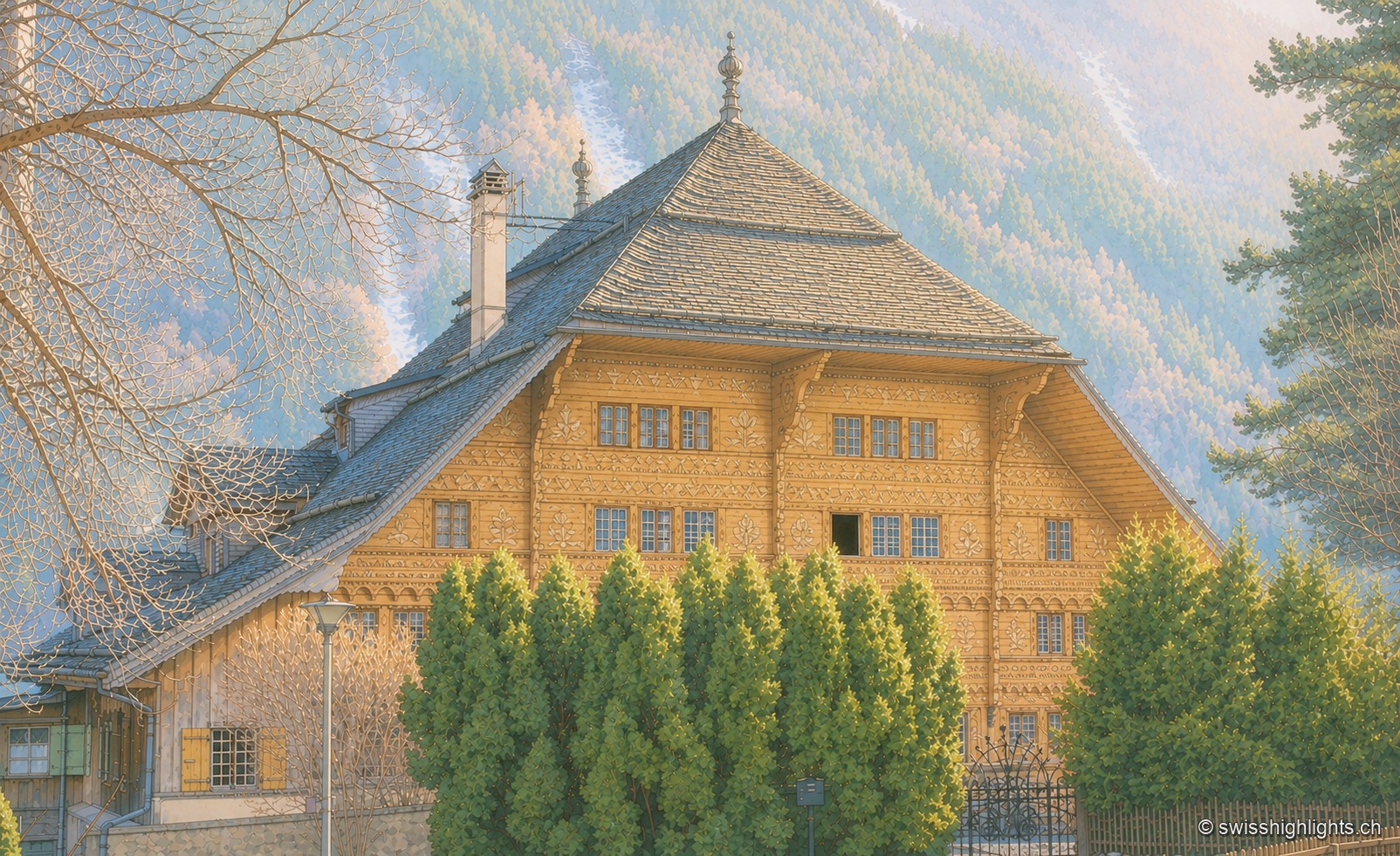
The Grand Chalet of Rossinière, a vast brown wooden building with a grey roof of wide sloping panels, its façades pierced by rows of windows with yellow shutters, surrounded by fir trees against a mountain backdrop.

Village in the Pays-d'Enhaut · Vaud

Rossinière

The Grand Chalet, 113 windows built for David Henchoz between 1752 and 1756, housed the painter Balthus until his death in 2001. Rossinière has 499 residents at the end of 2024; its population grew 4.1% since 2010, against 18.6% in Vaud.
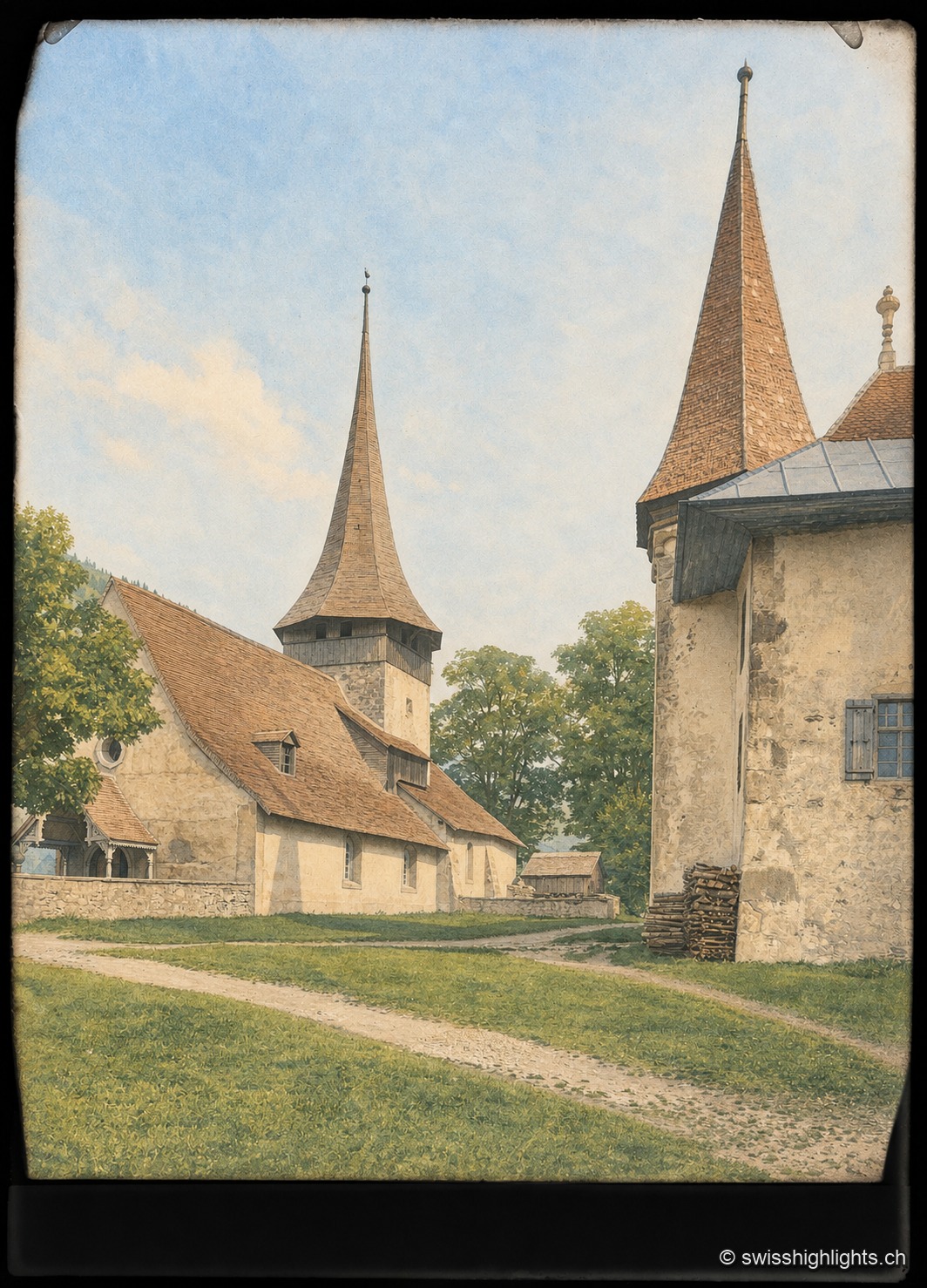
The Romanesque church of Rougemont: the octagonal bell tower, with its sawtooth cornice and pointed spire, rises above the brown-tiled nave, adjoined by a neighbouring farm building, under a pale blue sky.

Pays-d'Enhaut village · Vaud

Rougemont

Founded around 1073-1085 around a Cluniac priory, Rougemont keeps an 11th-century Romanesque church and chalets with carved façades; a member since 2017 of the Most Beautiful Villages of Switzerland.
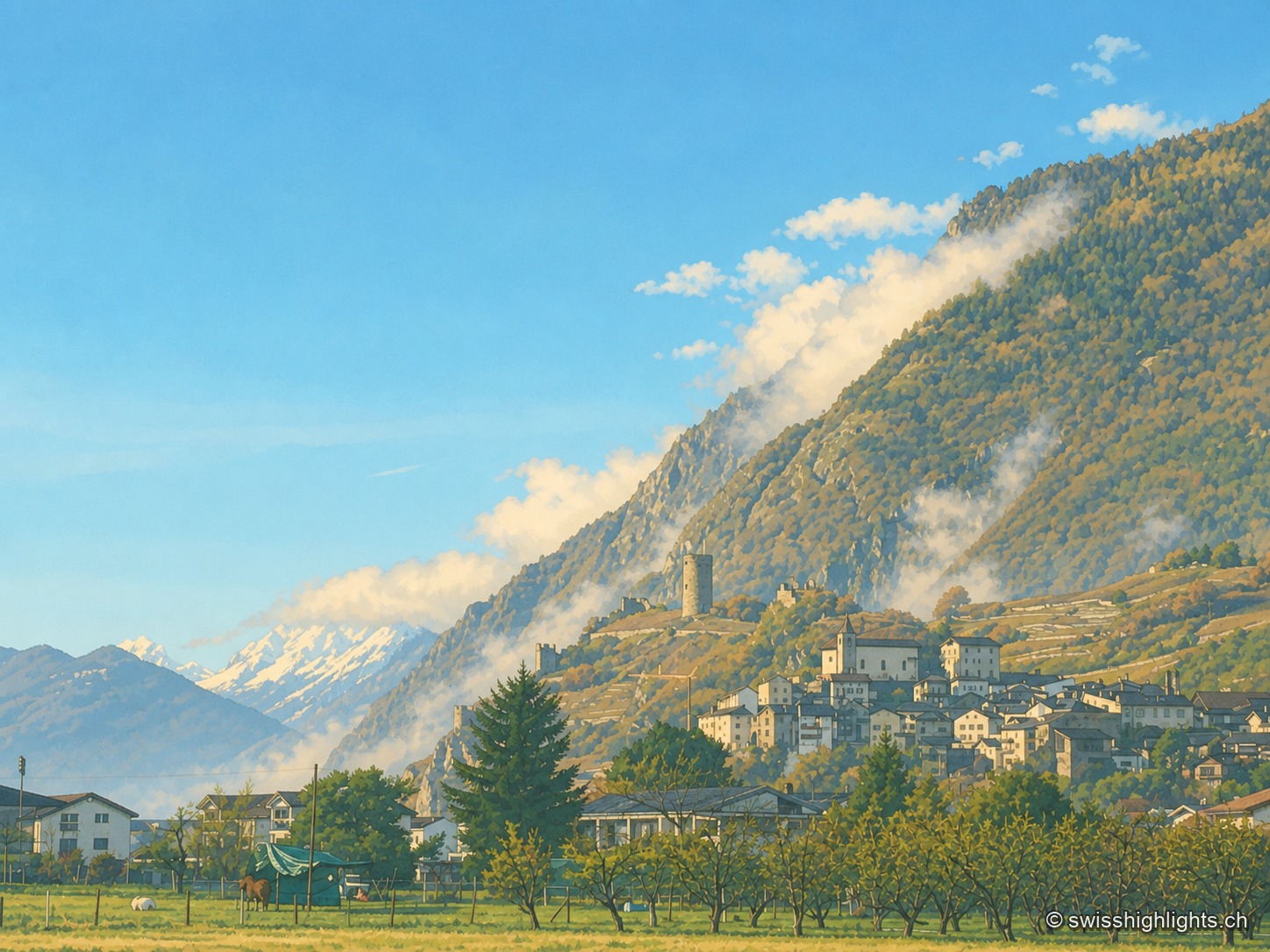
The medieval village of Saillon clinging to its hillside, dominated by its round tower, with the snow-capped peaks of the Valais Alps outlined behind clouds, above orchards and vineyards.

Medieval town · Valais

Saillon

The keep stands outside the walls: the castle hill was too narrow to take it. Below, the quarry yielded from 1873 a banded marble that Charles Garnier had laid in the Paris Opera the following year.
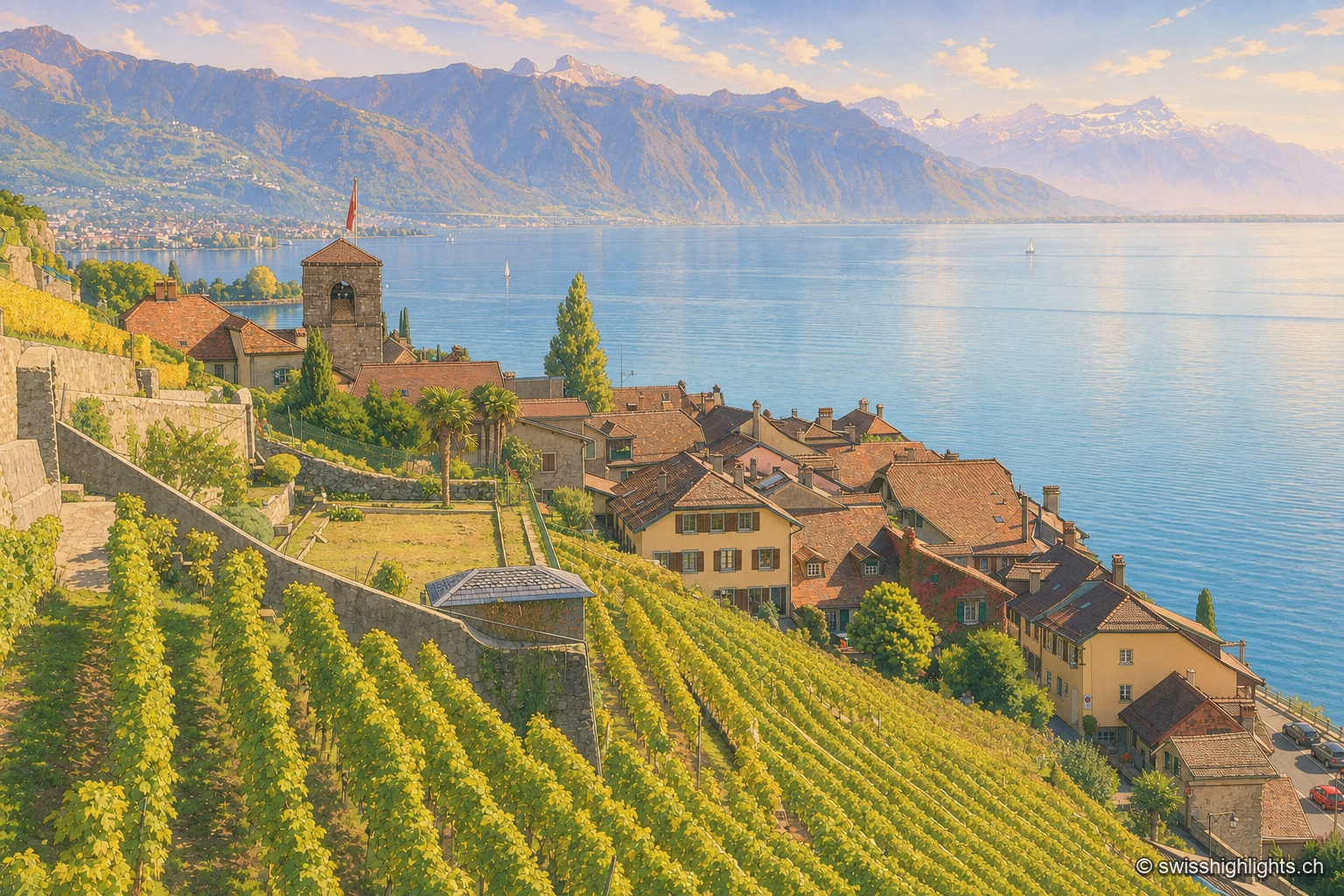
The village of Saint-Saphorin nestled between the terraced vineyards of Lavaux and Lake Geneva, gathered around its church bell tower, with the Alpine range rising in the background beyond the lake.

Wine village · Vaud

Saint-Saphorin

The original village, at the water's edge, was destroyed by the Tauredunum landslide in 563. Rebuilt higher up, it gathered around a church raised between 1517 and 1521, whose floor still covers Roman remains.
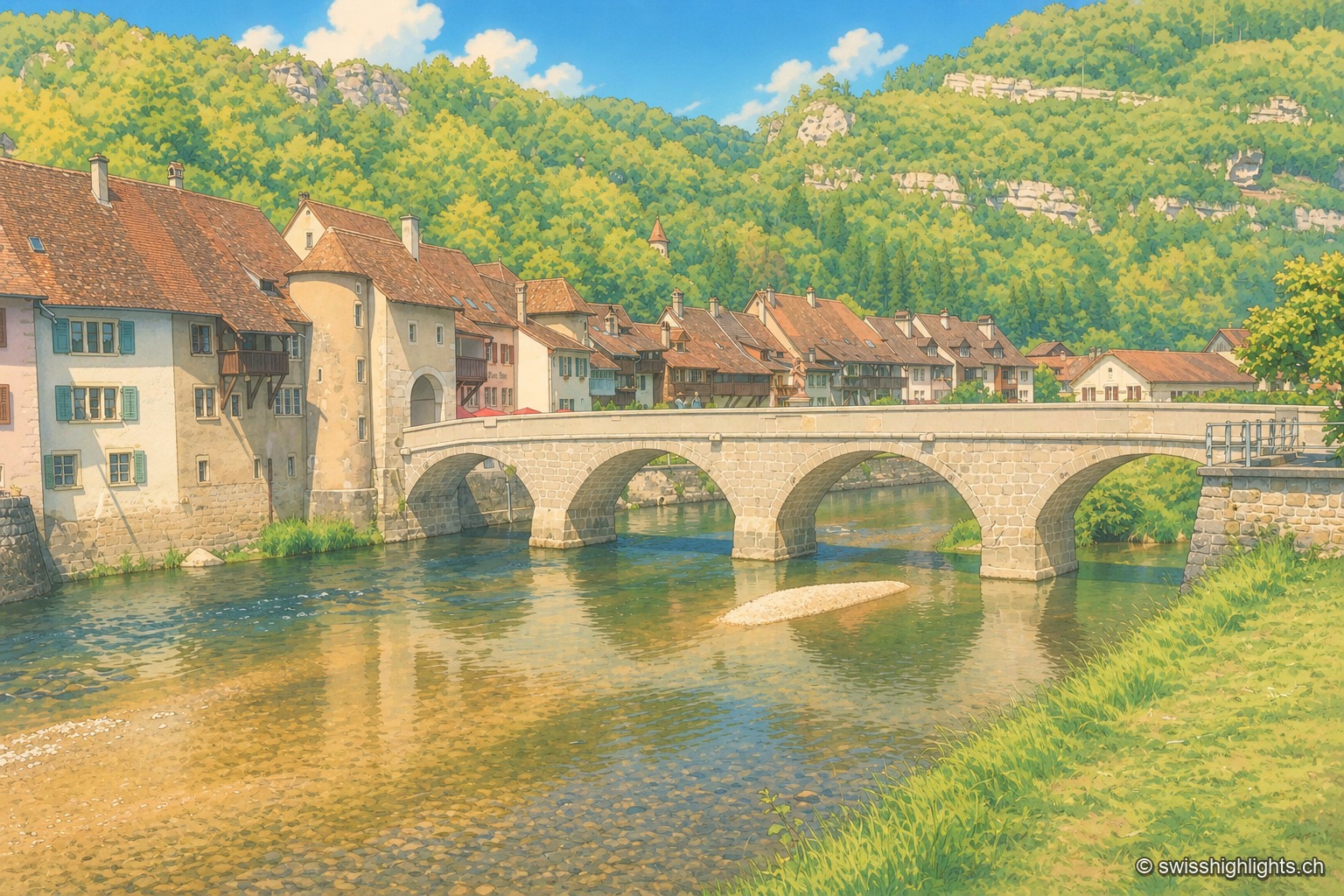
The medieval multi-arched bridge of Saint-Ursanne spans the green waters of the Doubs, in front of the tiled-roof houses and tower of the old town, set against a wooded hillside of the Jura.

Medieval small town · Jura

Saint-Ursanne

Born around a Benedictine abbey, it keeps its Romanesque collegiate church, its cloister and burgher houses from the 14th to the 16th century. At 440 metres, between wooded cliffs and river, it left its isolation only in 1877.
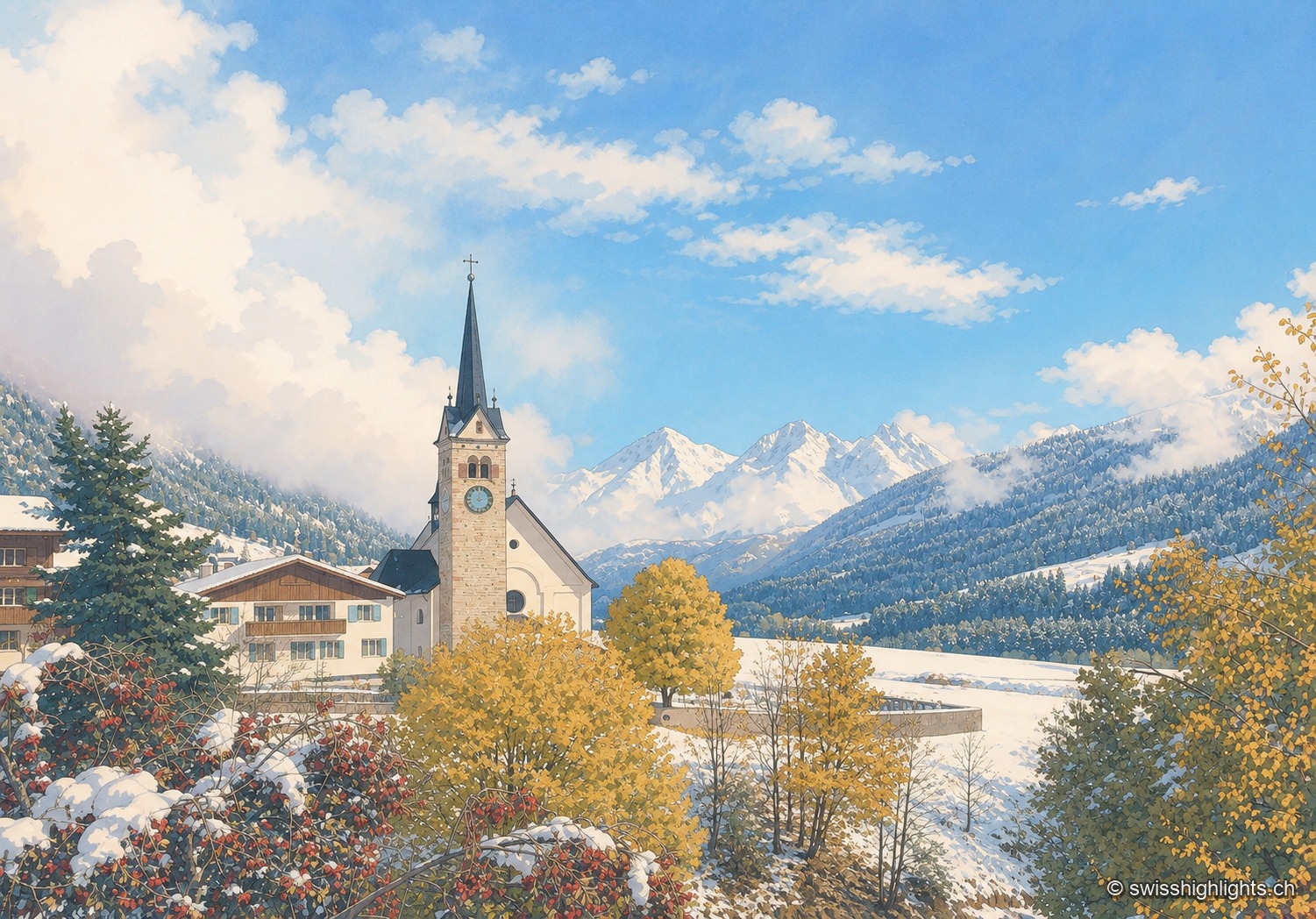
The church of Sedrun with its bell tower, surrounded by village houses and autumn larches, facing the snow-capped peaks of the Val Tujetsch.

Village · Surselva, Grisons

Sedrun

There has never been a village called Tujetsch: it was Sedrun, whose parish church was consecrated in 1205, that became the municipal capital. The Gotthard Base Tunnel runs beneath the municipality.
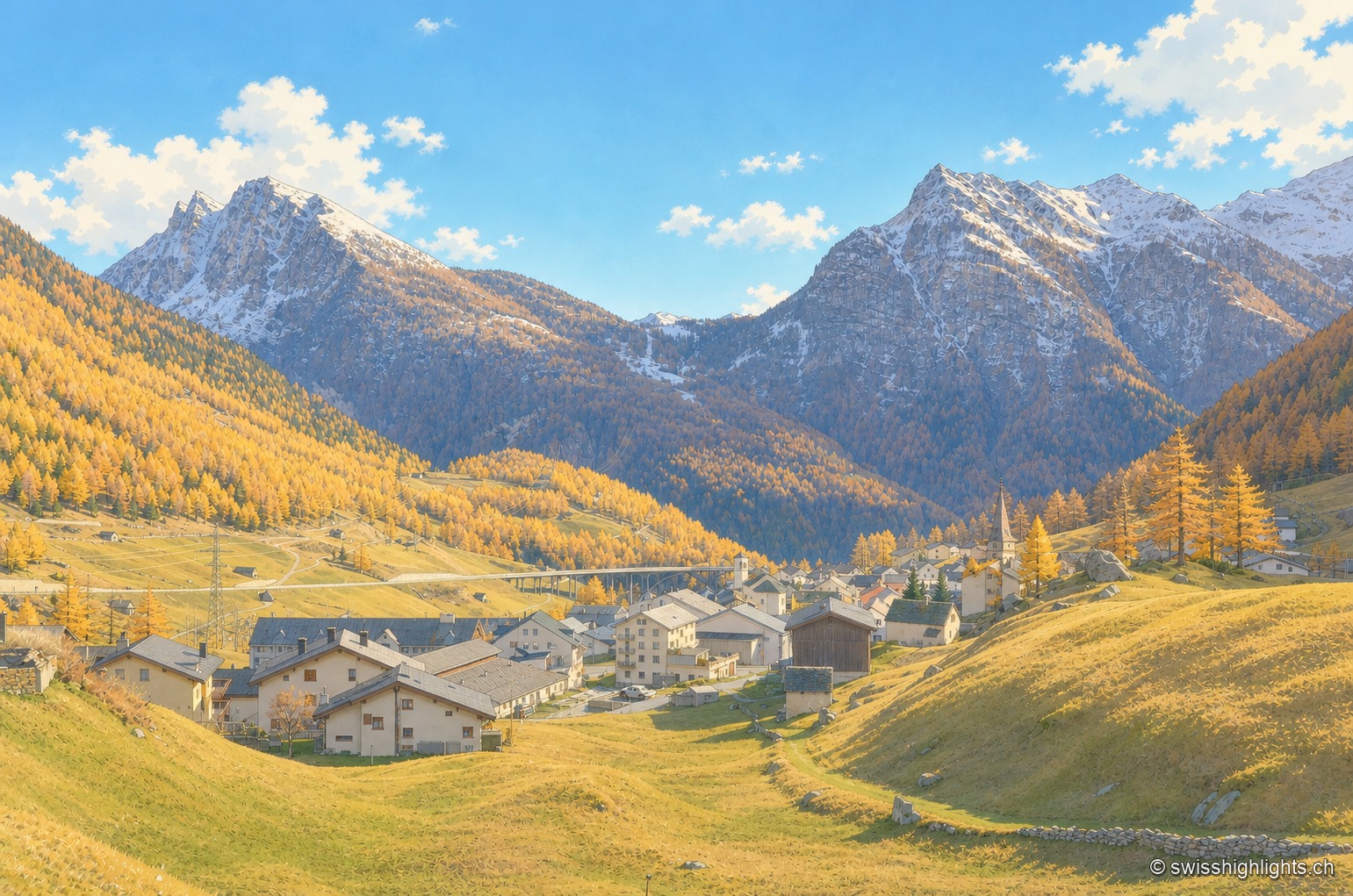
The village of Simplon-Village nestled in the hollow of an Alpine valley dressed in autumn colors: golden larches, scattered chalets and snow-capped peaks spread out under a blue sky dotted with clouds.

Village in the Po basin · Valais

Simplon Village

Simplon and Gondo are the only two Valais villages on the southern side of the Alps. Its 281 residents (end 2024), nicknamed d'Chruitfrässer, are declining by 13.8% since 2010. The village joined Switzerland's Most Beautiful Villages association in 2020.
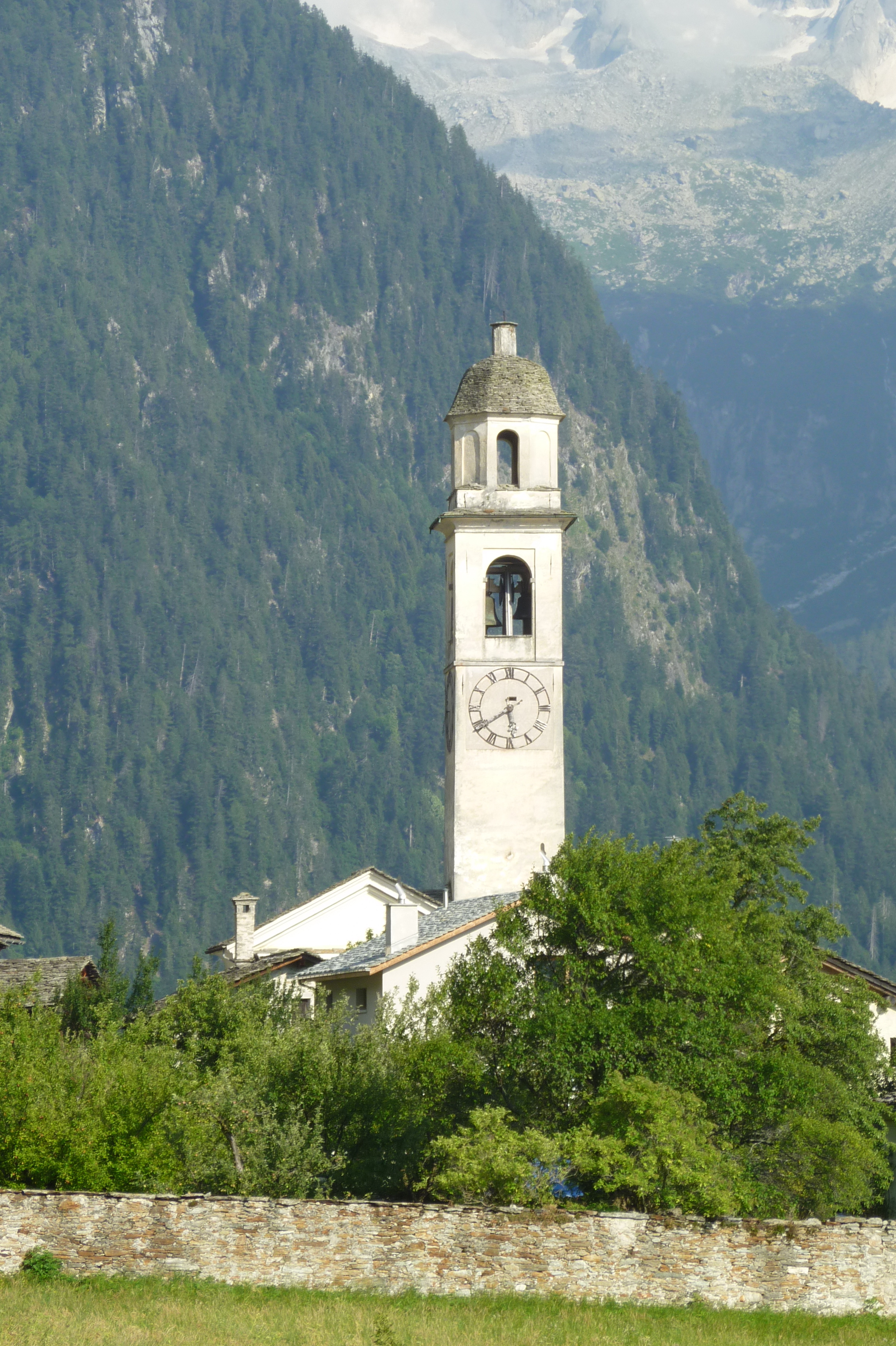
The Soglio bell tower emerges from a cluster of trees, between sloping meadows and the peaks of the Bregaglia valley, with sunlight filtering through the foliage.

Graubünden · Val Bregaglia

Soglio

Set at 1,090 metres on the northern flank of Val Bregaglia, Soglio looks out to the Bondasca glacier. Five palaces of the Salis family stand among the village's stone houses.
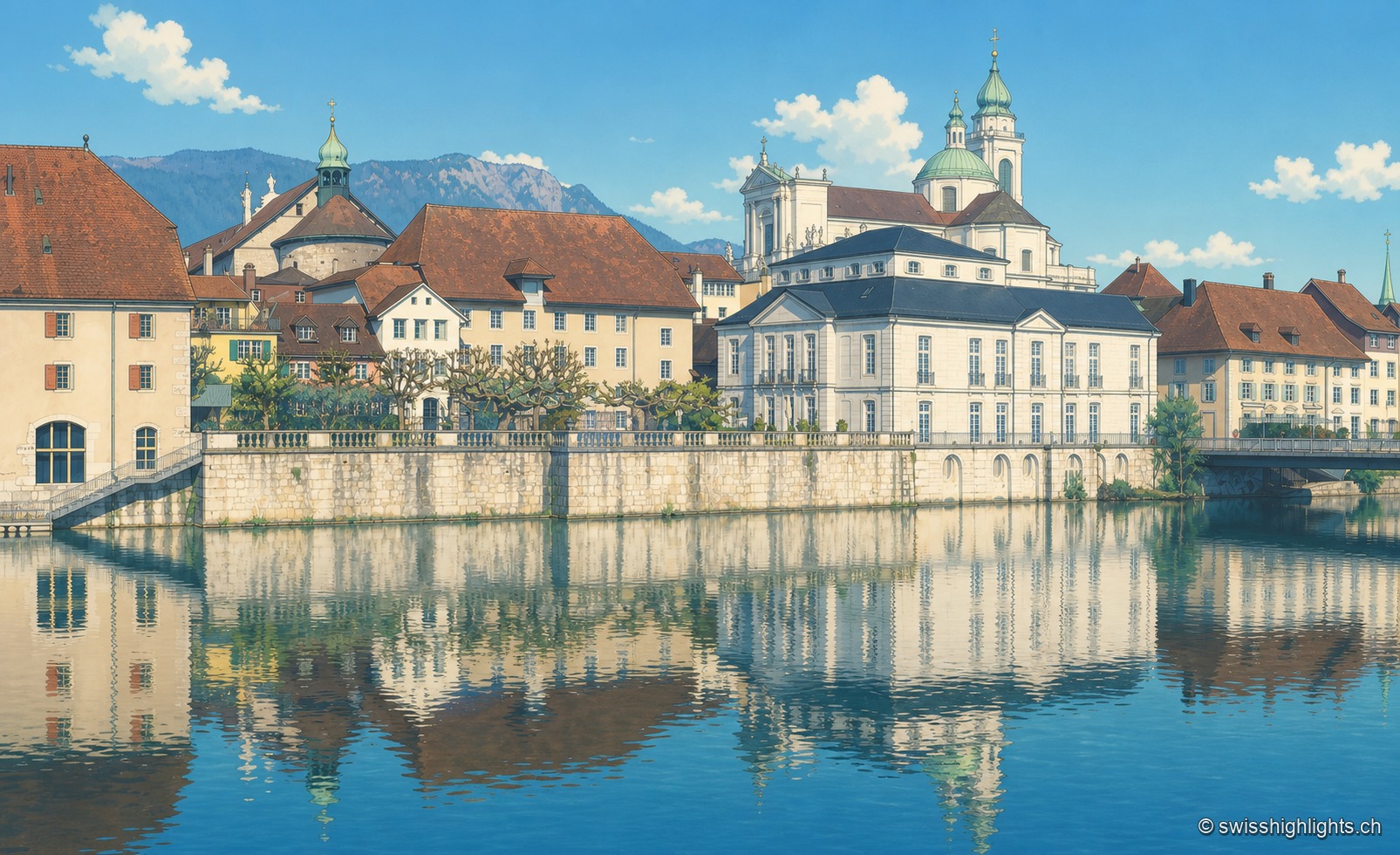
The old town of Solothurn is reflected in the Aare, dominated by the pale towers of St. Ursus Cathedral, under a clear blue sky.

City of ambassadors

Solothurn

Founded by Rome as Salodurum, admitted to the Confederation in 1481, Solothurn keeps towers and gates from the 15th-16th centuries around its baroque cathedral and its town hall, completed in 1711. 16,847 inhabitants at the end of 2024.
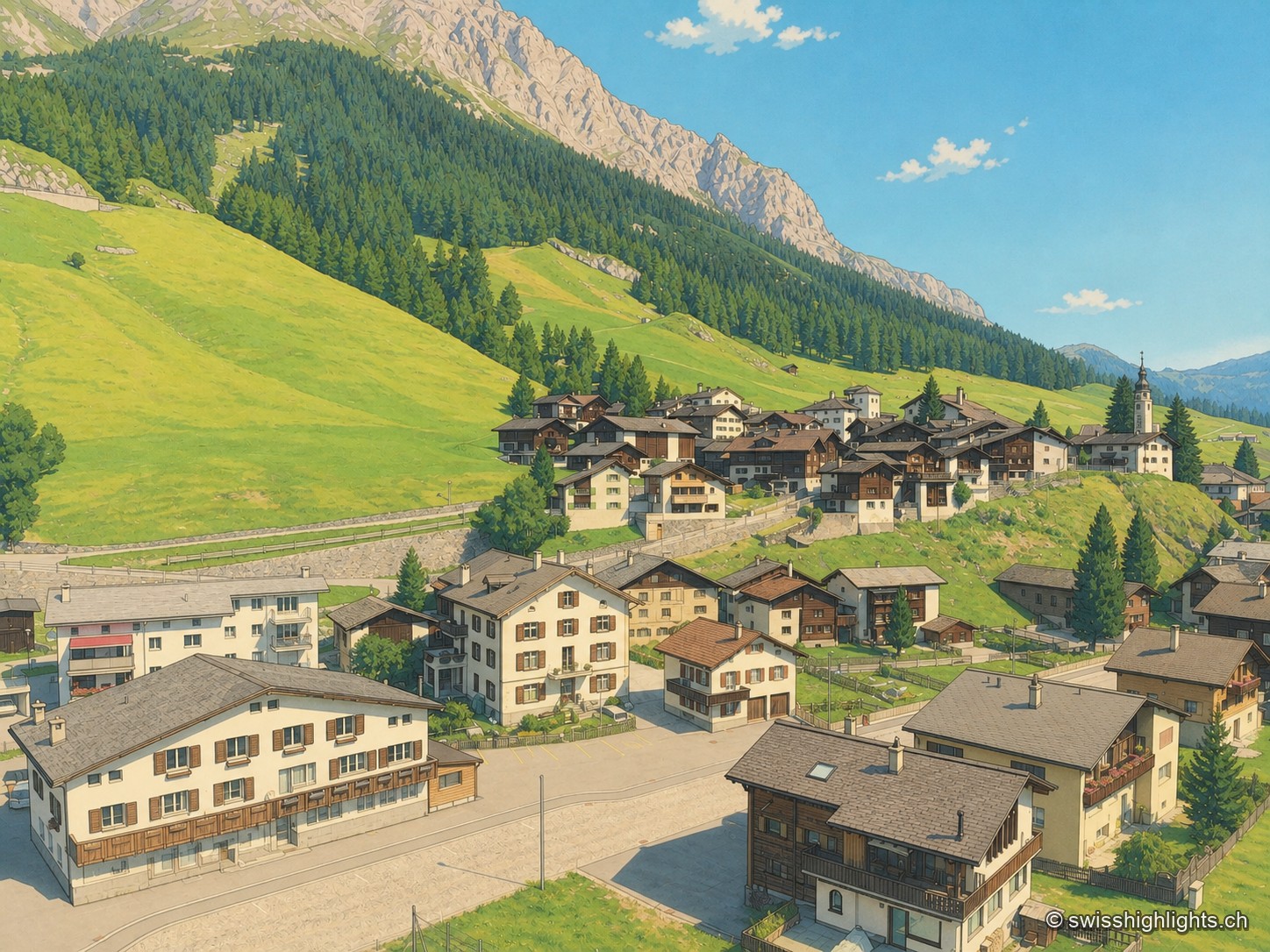
Elevated view of the village of Splügen nestled in the greenery of the Rheinwald valley: brown timber and light-plastered houses clustered around the road, sloping meadows rising toward the larch forest and grey rock walls, under a blue sky dotted with clouds.

Grisons · Rheinwald

Splügen

Splügen holds the floor of the Rheinwald, where the roads to the Splügen and San Bernardino passes part. Its tight-packed houses date from the rebuilding after the fire of 1716.
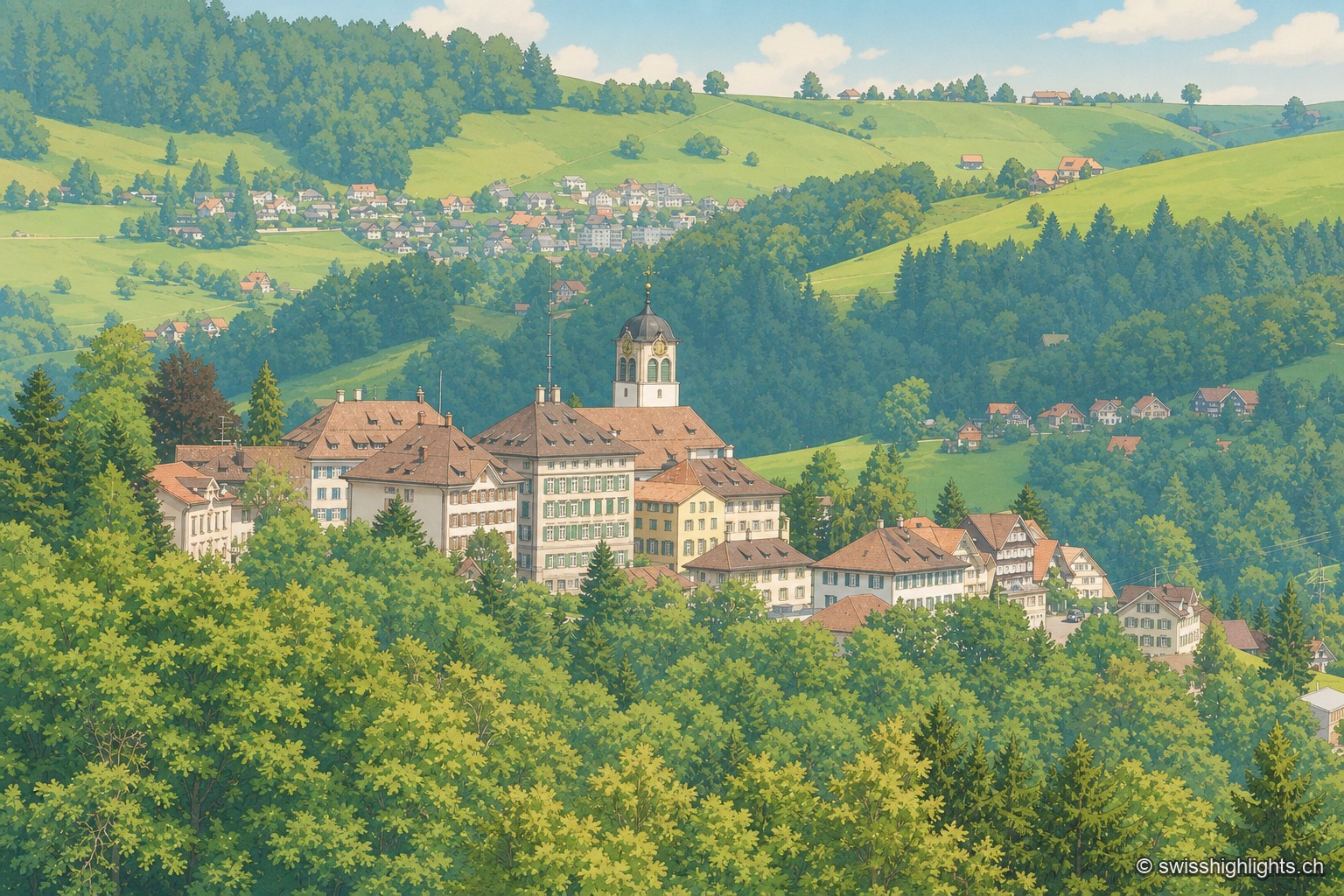
The village of Trogen, dominated by its church bell tower and a large white building with a pentagonal floor plan, stretches along a wooded hillside surrounded by rolling green hills.

Village · Appenzell Ausserrhoden

Trogen

Trogen became the capital of Appenzell Ausserrhoden in 1597 and lines its square with the Zellweger family's palaces, built between 1747 and 1809 from the textile trade. The Landsgemeinde met here until it was abolished in 1997.
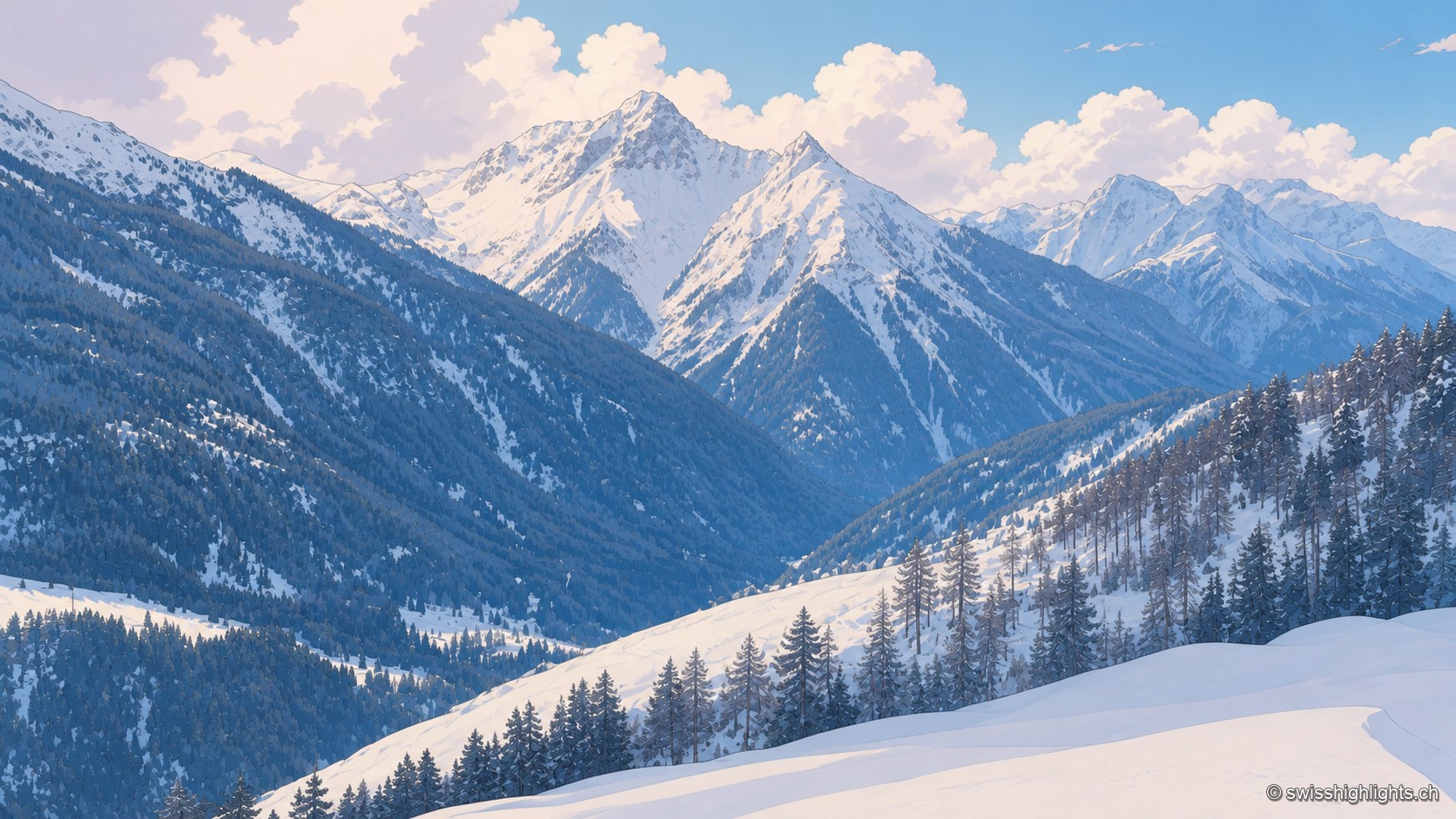
Winter view of an alpine valley near Tschlin: snow-capped peaks rise above forested slopes, with snow-covered fir trees in the foreground under a sky dotted with clouds.

Romansh village · Grisons

Tschlin

The village holds a terrace at 1,553 metres, far above the Inn. Vallader Romansh is spoken here, and the three-country marker at 2,180 metres is visible to the naked eye. A former commune, Tschlin joined Valsot in 2013.
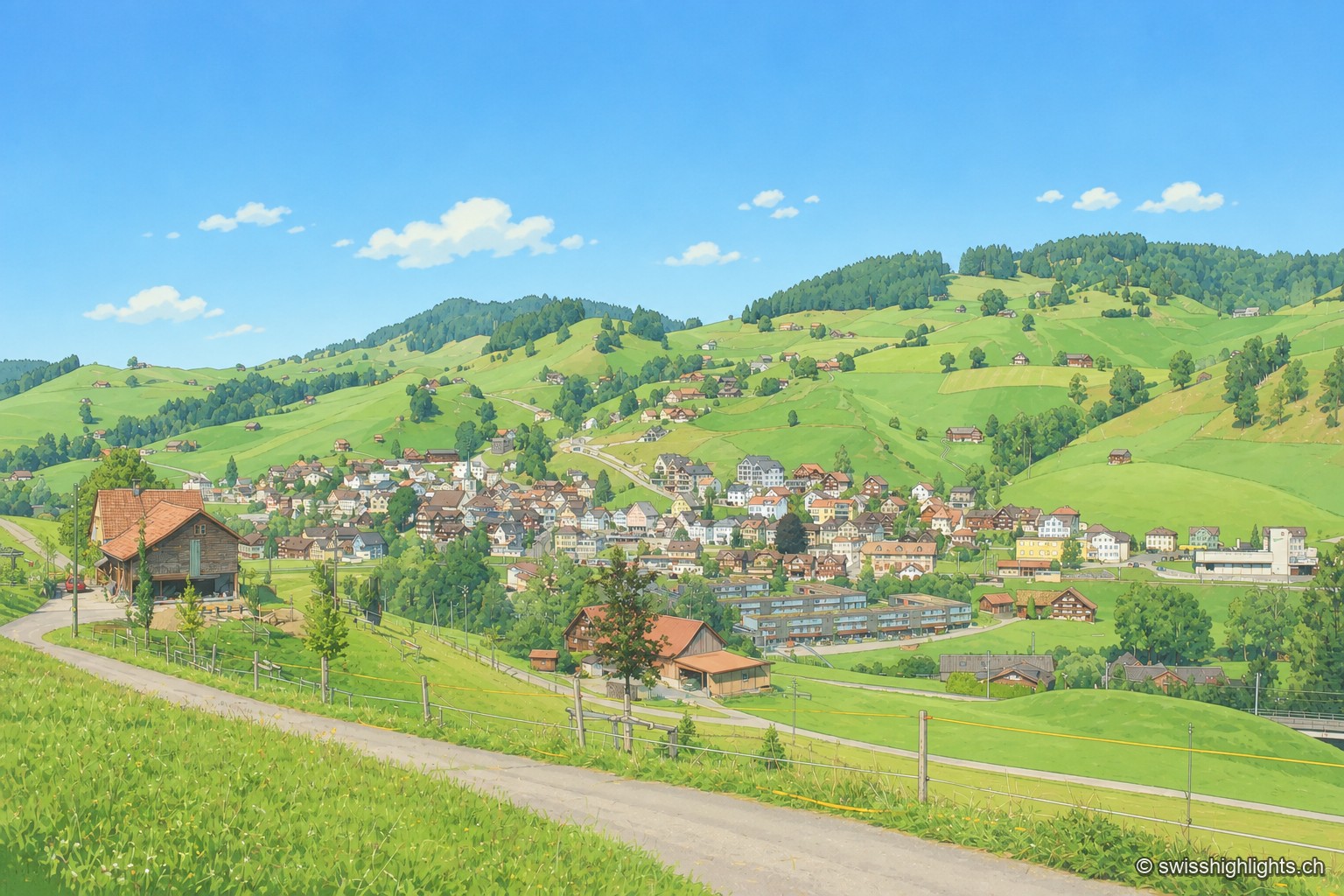
The village of Urnäsch occupies a rolling stretch of green meadows, with an Appenzell farmhouse with a broad red roof in the foreground and wooded hills on the horizon.

Appenzell village · Ausserrhoden

Urnäsch

First recorded in 831, Urnäsch became an autonomous parish in 1417, then, after the 1597 cantonal split, the first of the six Rhoden of Appenzell Ausserrhoden. Weaving, then embroidery, supported generations here.
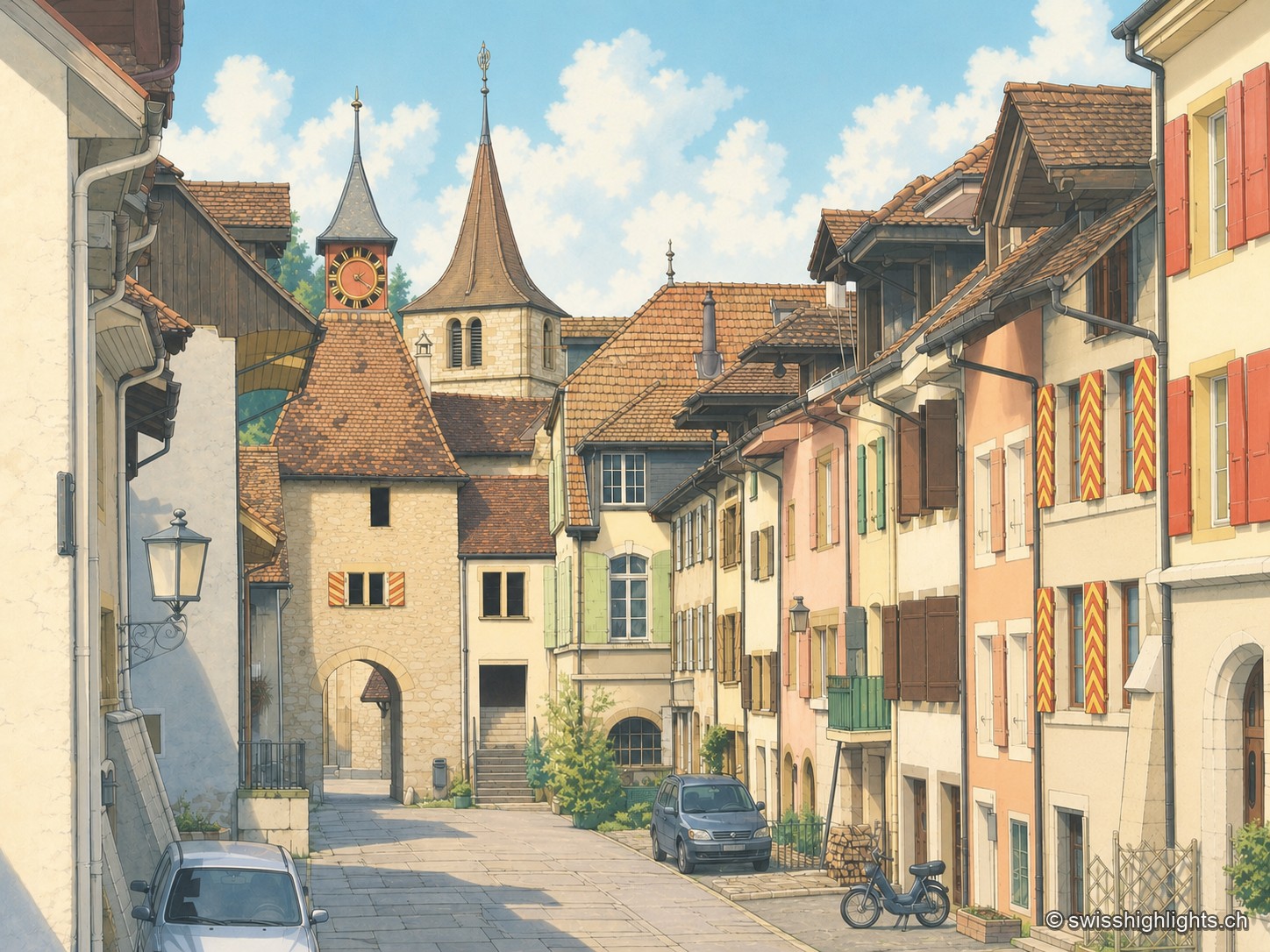
A street in the old town of Valangin, lined with cream, white and beige facades with red shutters; at the far end stand the pointed-roofed gate tower bearing a clock and the slender bell tower of the collegiate church, while a car and a cyclist travel along the cobbled roadway.

Village · Neuchâtel

Valangin

The castle holds the rock that commands the passage; the bourg was founded below it around 1330, the collegiate church consecrated in 1505. In 1853 the beds described here gave their name to the Valanginian.
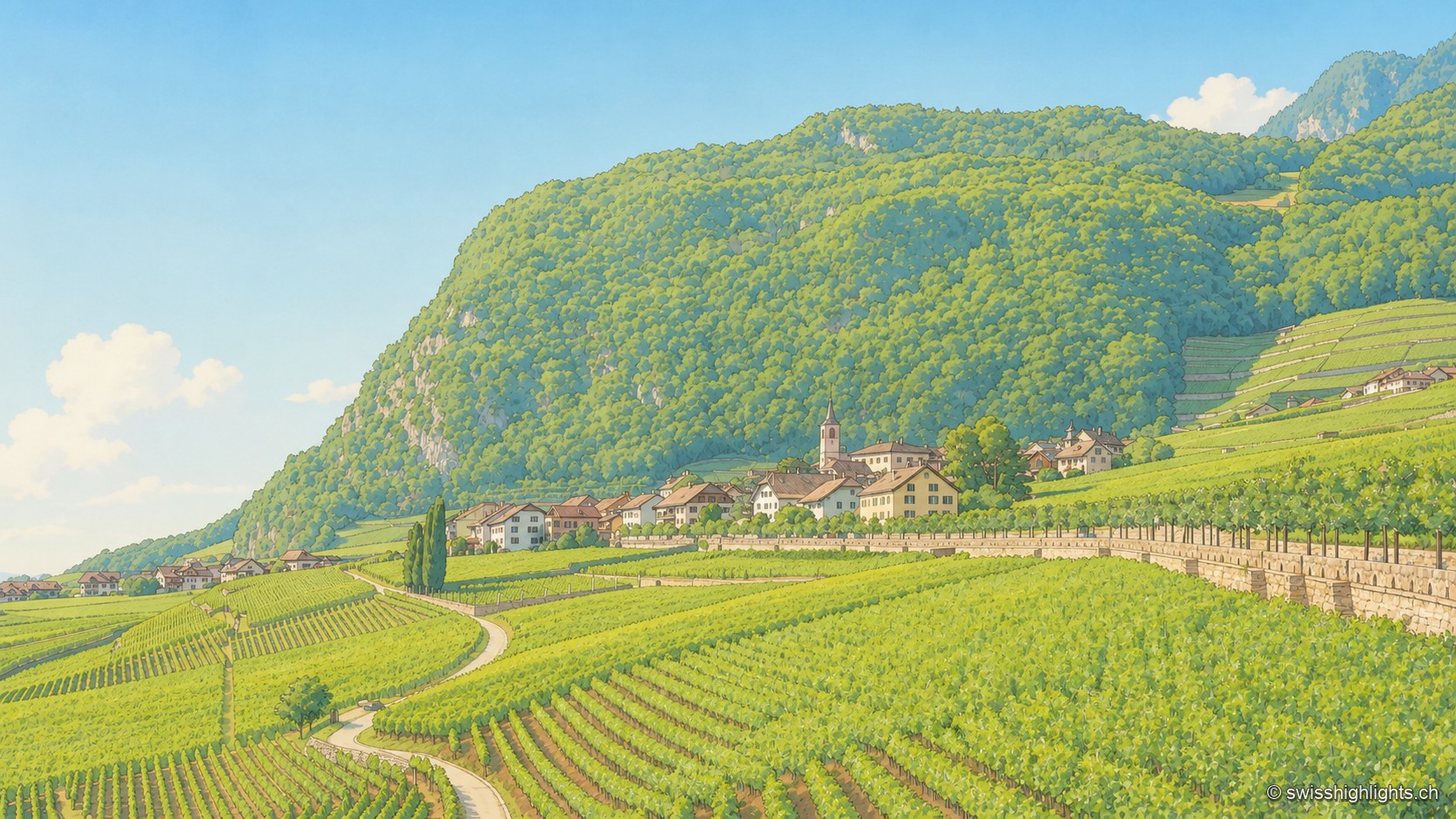
Rows of terraced vines cover the hillside in the foreground, leading to the village of Yvorne nestled at the foot of a rounded, wooded hill, seen from the Ciclet viewpoint under a blue sky with a few clouds.

Wine village · Vaud

Yvorne

A rockslide destroyed the village in 1584; rebuilt further east from 1607, it planted its vines on the rubble. The Truchefardel quarry, active from the 17th century to 1921, supplied the marble for Lausanne's town hall in 1674.
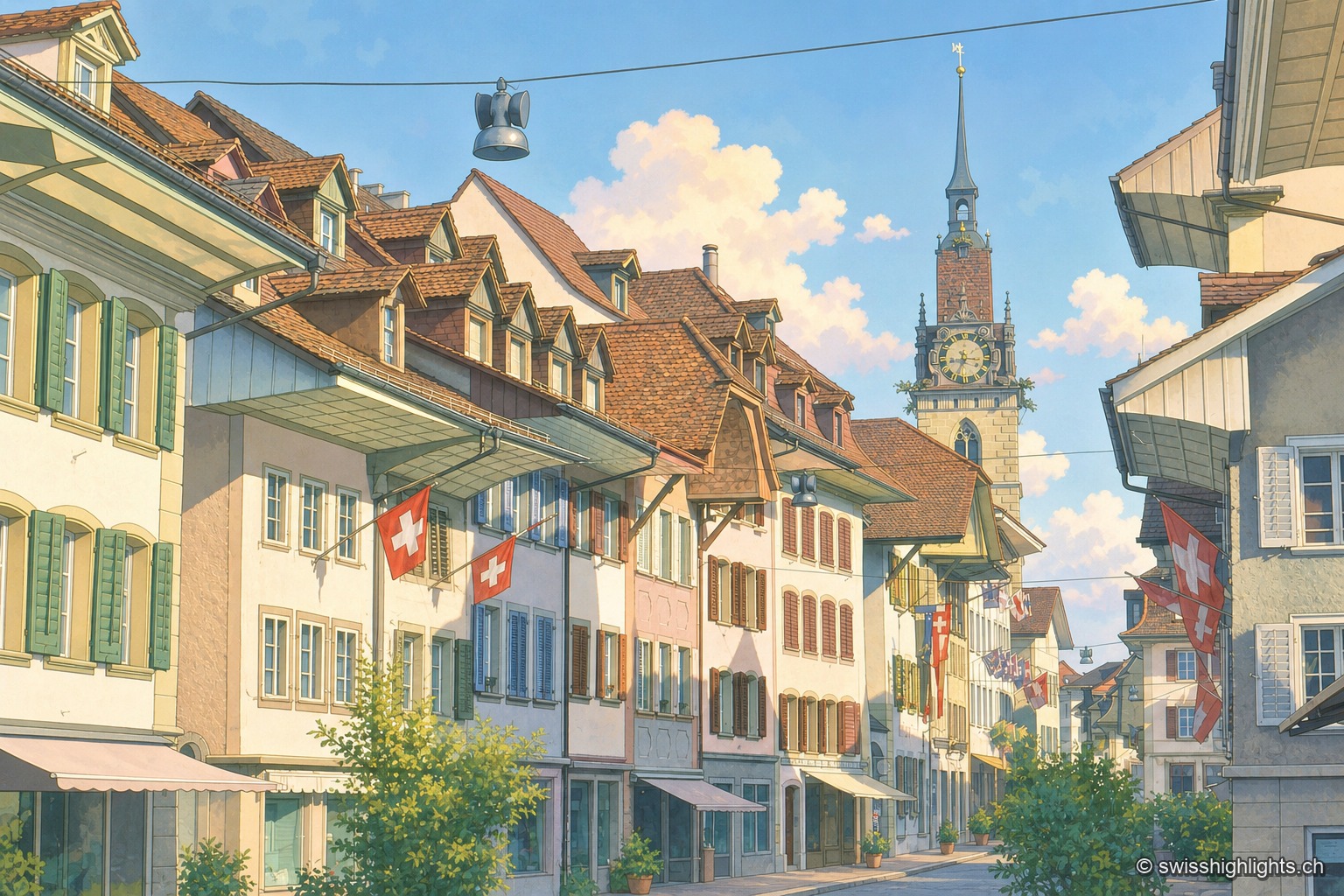
A cobbled street in the old town of Zofingen is lined with colourful gabled facades and shops; Swiss flags hang from the windows, and in the distance stands the clock tower of the church, under a blue sky with white clouds.

Medieval small town · Aargau

Zofingen

Founded by the Froburgs at the end of the twelfth century, the town narrowly missed the great railway junction, which formed at Olten instead. Ten of its monuments are cultural property of national significance.